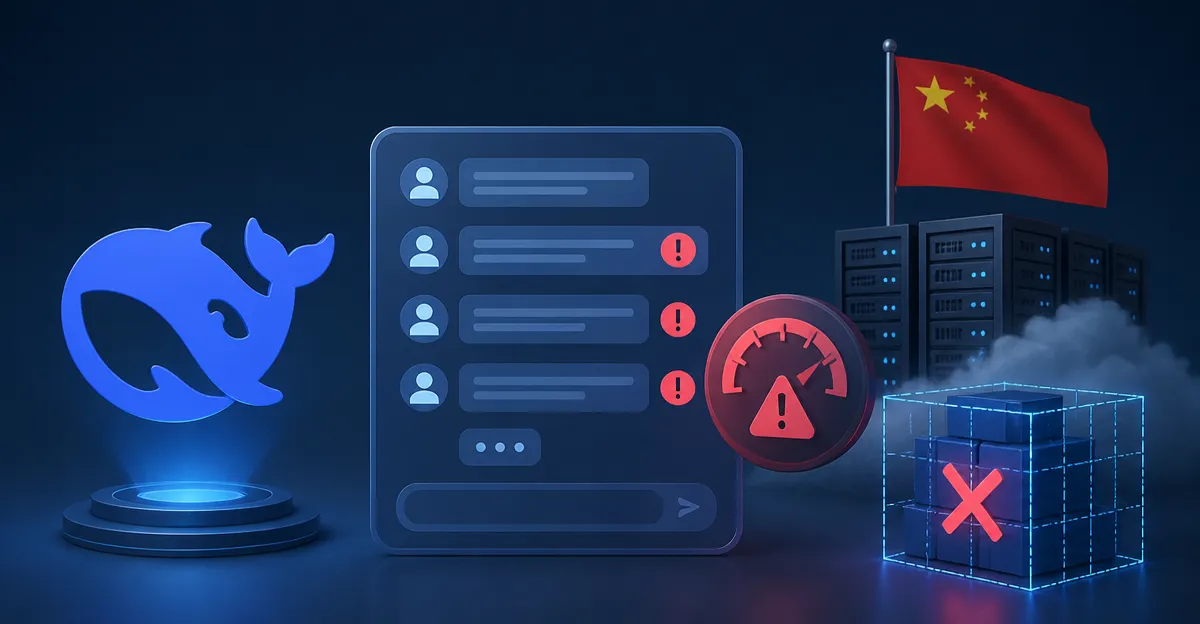
November 16, 2026, (Inside AI) — DeepSeek has quietly imposed new restrictions on its consumer chat service, with users reporting caps on prompt length and the loss of access to long-running conversations. The limits, which surfaced on Sunday, arrive as the company struggles with what it describes as insufficient computing capacity.
Users of the DeepSeek app and website received notices stating that conversations inactive for more than seven days could no longer be resumed. Individual prompts are now capped at roughly 40,000 Chinese characters, and the service displays a usage-limit message once a user hits a daily quota. DeepSeek has not said when the restrictions might be lifted, according to IT Home.
The curbs mark a notable reversal for a company that built its reputation on generous free access to powerful models. DeepSeek's status page has logged eight incidents since October affecting its chat service or its V4 Pro and V4.1 Flash APIs. Those outages and the new limits point to a persistent capacity crunch at the Hangzhou-based firm.
Capacity Crunch Tests DeepSeek's Free-Access Model
The restrictions hit consumer chat hardest. Users who work across multiple sessions may lose the ability to pick up long-running conversations, a feature that has become central to how people use AI assistants for research, coding, and writing projects. The 40,000-character prompt cap also constrains complex inputs, such as lengthy documents or detailed instructions.
Read: Tencent launches Hy4 flash, cutting AI task costs by 95% in internal tests
DeepSeek has not disclosed the exact triggers for the limits or whether they apply uniformly across regions. The company did not respond to a request for comment. Its status page shows a pattern of instability: eight incidents in roughly six weeks, spanning both the consumer chat product and its developer-facing APIs.
The capacity problems come as DeepSeek faces growing demand for its models, which have been praised for strong performance at low cost. The company's V4 series, including the Pro and Flash variants, has attracted developers and enterprises seeking alternatives to pricier offerings from OpenAI and Anthropic. But serving that demand requires substantial compute, and DeepSeek appears to be running short.
Industry analysts note that free or low-cost AI services often face a trade-off between accessibility and reliability. As user numbers grow, providers must either invest in more infrastructure or introduce limits to manage load. DeepSeek's move mirrors similar steps taken by other AI companies during peak demand periods, though those firms typically announce limits in advance.
The lack of a timeline for lifting the restrictions leaves users in limbo. For now, those relying on DeepSeek for long-form work may need to adjust their workflows or seek alternatives. The company's ability to resolve the capacity issues will be closely watched, as it competes in an increasingly crowded market.
DeepSeek's status page currently lists no active incidents, but the recent history of outages suggests the situation remains fluid. The company has not indicated whether the limits are temporary or part of a longer-term strategy to balance supply and demand.
Read: Jensen Huang's Exit Exposes $105 Billion Nvidia Guarantee Risk
For a company that rose to prominence by offering powerful AI at no cost, the new restrictions represent a significant test. How DeepSeek navigates this capacity challenge could shape its reputation and its competitive position in the global AI landscape.

Shamil has a low tolerance for AI that only works in controlled demos. He covers agentic systems and generative AI with the skepticism of someone who has seen too many “revolutionary” tools quietly disappear six months after launch.