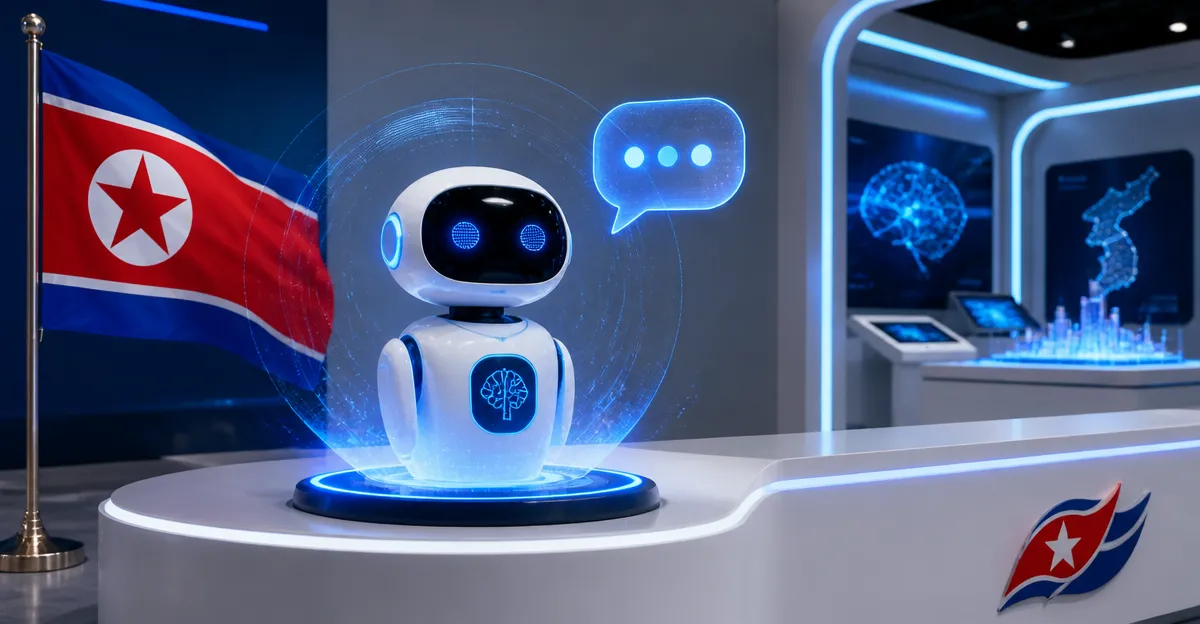
November 19, 2026, (Inside AI) — North Korea has showcased an artificial intelligence chatbot at a technology exhibition in Pyongyang, according to an analysis by 38 North, a think tank that monitors the country. The finding, based on footage broadcast on North Korean state television, suggests the isolated nation is making a public push into consumer AI despite severe international sanctions and limited access to advanced computing hardware.
The chatbot was displayed at an IT exhibition, though the exact date and location of the event were not disclosed. 38 North, which is affiliated with the Stimson Center, published its analysis after reviewing the broadcast. The think tank said the chatbot appeared to be a simple conversational agent, likely trained on a limited dataset. It is unclear whether the system uses a large language model or a more basic rule-based approach.
North Korea's AI ambitions have been building for years. The country has previously shown off voice recognition and machine translation tools, but a chatbot represents a more interactive application. The display comes as Pyongyang seeks to project technological self-reliance, even as its population faces chronic shortages of electricity and internet access. The state television footage, which 38 North analyzed, showed a user typing questions into a computer and receiving responses in Korean.
The development raises questions about how North Korea obtained the necessary hardware and expertise. Sanctions restrict the import of advanced semiconductors, and the country's internet is largely isolated from the global web. According to sources, the chatbot may run on locally developed software and domestically produced hardware, though Inside AI could not independently verify this claim. The exhibition itself was likely a showcase for domestic audiences, intended to demonstrate progress in science and technology.
Read: AI Chatbots May Narrow Human Knowledge, Study Finds
38 North's analysis did not provide technical details about the chatbot's capabilities, such as the size of its training data or the complexity of its responses. The think tank noted that the footage showed a basic interface and that the chatbot's answers were short and formulaic. This suggests the system may be a narrow AI application rather than a general-purpose model like those developed by leading global firms.
North Korea's AI efforts are part of a broader push to modernize its economy and military. The country has established AI research institutes and incorporated AI into propaganda. However, the practical impact of these efforts is limited by the country's infrastructure. Electricity shortages and a lack of widespread internet access constrain the deployment of AI tools. The chatbot on display may serve more as a symbol of technological prowess than a widely used product.
The international community has expressed concern about North Korea's technological advancements, particularly in areas with military applications. AI could be used for surveillance, censorship, or autonomous systems. The chatbot itself is unlikely to pose a direct threat, but it signals a growing capability that could have dual-use implications. 38 North's analysis did not address these concerns directly, focusing instead on the technical aspects of the exhibition.
North Korea's state media has previously highlighted AI achievements, including facial recognition and medical diagnosis systems. The chatbot is the latest in a series of announcements aimed at portraying the country as a modern, tech-savvy nation. Such displays are often timed to coincide with political events or anniversaries. The IT exhibition may have been part of celebrations for a national holiday or a scientific conference.
Experts on North Korea's technology sector say the country has a small but growing community of AI researchers, many trained abroad before returning home. These researchers have published papers in international journals, though their work is often constrained by limited access to data and computing resources. The chatbot could be a product of this community, built with locally available tools and tailored to the Korean language.
The exhibition also featured other IT products, according to the state broadcast, including educational software and mobile applications. The chatbot was one of several displays aimed at showing progress in software development. North Korea has a domestic intranet called Kwangmyong, which connects universities and government institutions but is not linked to the global internet. The chatbot may run on this network, limiting its reach to a select group of users.
38 North's analysis is based on a single broadcast and does not include independent testing of the chatbot. The think tank cautioned that the footage could be staged or edited to exaggerate capabilities. North Korean state media has a history of presenting idealized versions of reality. Without direct access, it is difficult to assess the true state of the country's AI development.
Read: Harvard Economist Jason Furman: AI Race Has No Finish Line, U.S. and China Face Shared Risks
For now, the chatbot remains a curiosity, a glimpse into how one of the world's most closed societies is engaging with a transformative technology. It underscores the global spread of AI, even to countries with limited resources. As AI tools become more accessible, more nations may attempt to build their own versions, raising questions about proliferation and control.

Sofia spent years studying how machines parse human language before pivoting to cover the systems now rewriting it. She reads technical papers the way others read news and looking for what the numbers are actually saying beneath the headlines.