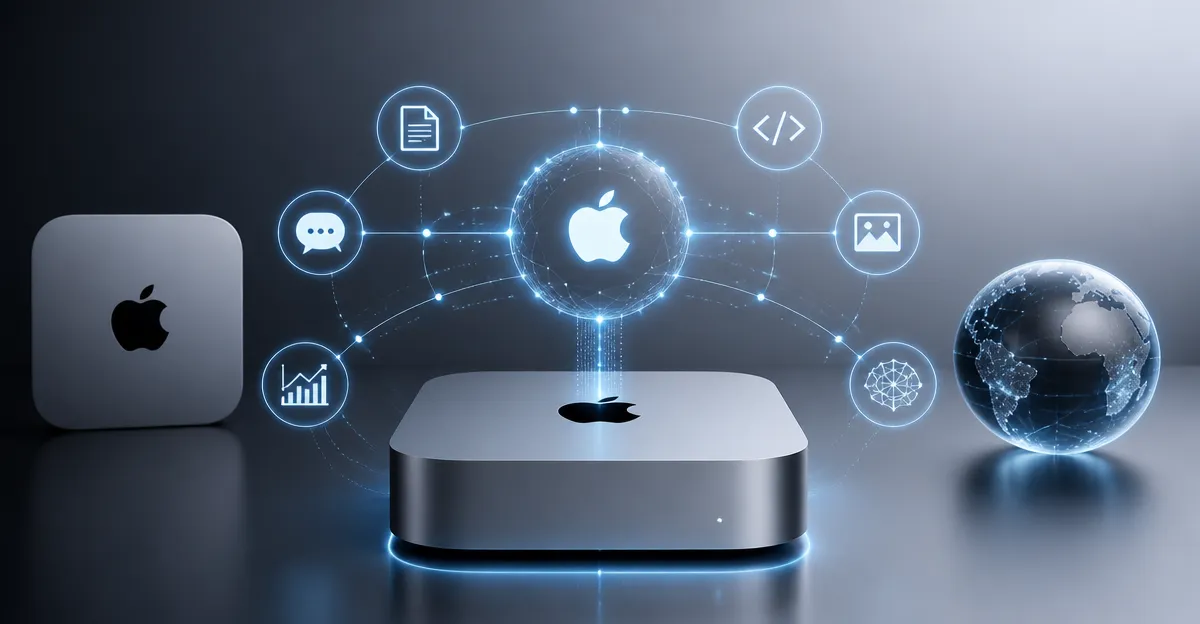
November 23, 2026, (Inside AI) — Apple's new Mac Mini M6, starting at Rs 99,900, is being positioned as an always-on hub for AI agents and scheduled tasks. The device, powered by Apple's M6 silicon, features a 12-core CPU with 2 super cores, 4 performance cores, and 6 efficiency cores, along with a 12-core GPU and 16GB of unified memory. It includes two front USB-C ports with USB 3 support, three rear Thunderbolt 4 (USB-C) ports with USB 4 (up to 40 Gbps), and a 3.5mm headphone jack. The Mac Mini M6 is designed to run continuously with low power consumption, making it suitable for persistent AI workloads.
The significance lies in the shift toward distributed AI workflows. As professionals increasingly rely on multiple AI agents for tasks like scheduling, data sorting, and local model inference, a dedicated always-on machine becomes essential. The Mac Mini M6 fills this niche by offering desktop-class performance in a compact form factor, enabling users to offload AI tasks from laptops that may sleep or shut down. This could redefine home office setups, especially for those experimenting with local AI models and automation.
A Week-Ahead Note, Minus The Laptop
One user's experience illustrates the potential. After setting up the Mac Mini as a mirror of a MacBook Pro using Apple's intuitive setup process (requiring only an Apple ID password), scheduled tasks were migrated to the Mini. A Sunday routine that prepares a week-ahead summary with meeting reminders and pending tasks now runs uninterrupted. Previously, this task often failed when the MacBook Pro was not switched on during weekends. The user noted that after a movie outing, the note was ready for review without touching the laptop.
The Mac Mini also enabled local AI experiments. Running Msty with Gemma 4 E2B locally, the user airdropped over 5,000 photos from an iPhone and asked the model to sort them by date and remove duplicates and screenshots. The model initially could not access HEIC images, so the user employed Claude to convert files to JPEG or PNG, which took over 30 minutes. The model then sorted folders into video and images by date. In another test, the user uploaded over 500 images to Msty, and the model described the batch contents in seconds, from product photos to cityscapes and conference images. It suggested folder names but could not physically move files due to setup constraints.
Read: Self-Hosted LLM Costs
These experiments highlight the Mini's capability for local AI inference, but also reveal limitations. The 256GB base storage may be insufficient for large media libraries, and users may need to opt for more storage or external drives. The M6's 12-core GPU and 16GB unified memory handle most personal AI runs, but long-form video editing or heavier tasks may require a Mac Studio. For more power, an M5 Pro version of the Mini is available.
The Mac Mini M6's always-on nature addresses a key pain point: laptops sleep, but AI agents need persistence. This mirrors the broader trend of edge AI, where processing moves closer to data sources. Apple's focus on efficiency cores allows the Mini to run continuously without high energy costs, making it a viable hub for home automation and AI orchestration.
However, the device's reliance on Apple's ecosystem may limit interoperability. Setting up as a mirror requires an Apple ID and leverages Apple's continuity features, which may not appeal to cross-platform users. Additionally, local AI models like Gemma 4 E2B require technical know-how to configure and troubleshoot, as seen with the HEIC conversion workaround.
The Mac Mini M6 also faces competition from other mini PCs and single-board computers that offer similar always-on capabilities at lower costs. But Apple's integrated hardware-software stack and silicon efficiency give it an edge in performance-per-watt and ease of use for Apple-centric households.
For families, the Mini could serve dual purposes: a study tool for students and an AI experimentation platform for parents. The user in this account plans to purchase a Mini with 512GB storage and pair it with an affordable large display, balancing cost and utility.
Read: KV Cache-Aware Routing
As AI agents become more prevalent, the demand for always-on compute hubs will grow. The Mac Mini M6, with its balance of power, efficiency, and price, positions Apple to capture this emerging market. But success will depend on how well users can integrate it into diverse workflows and whether Apple addresses storage and interoperability concerns in future iterations.

If a research paper dropped this week, Mahesh has already read it. He covers AI tools and vibe coding for builders who need to know what is worth their time and what is not.