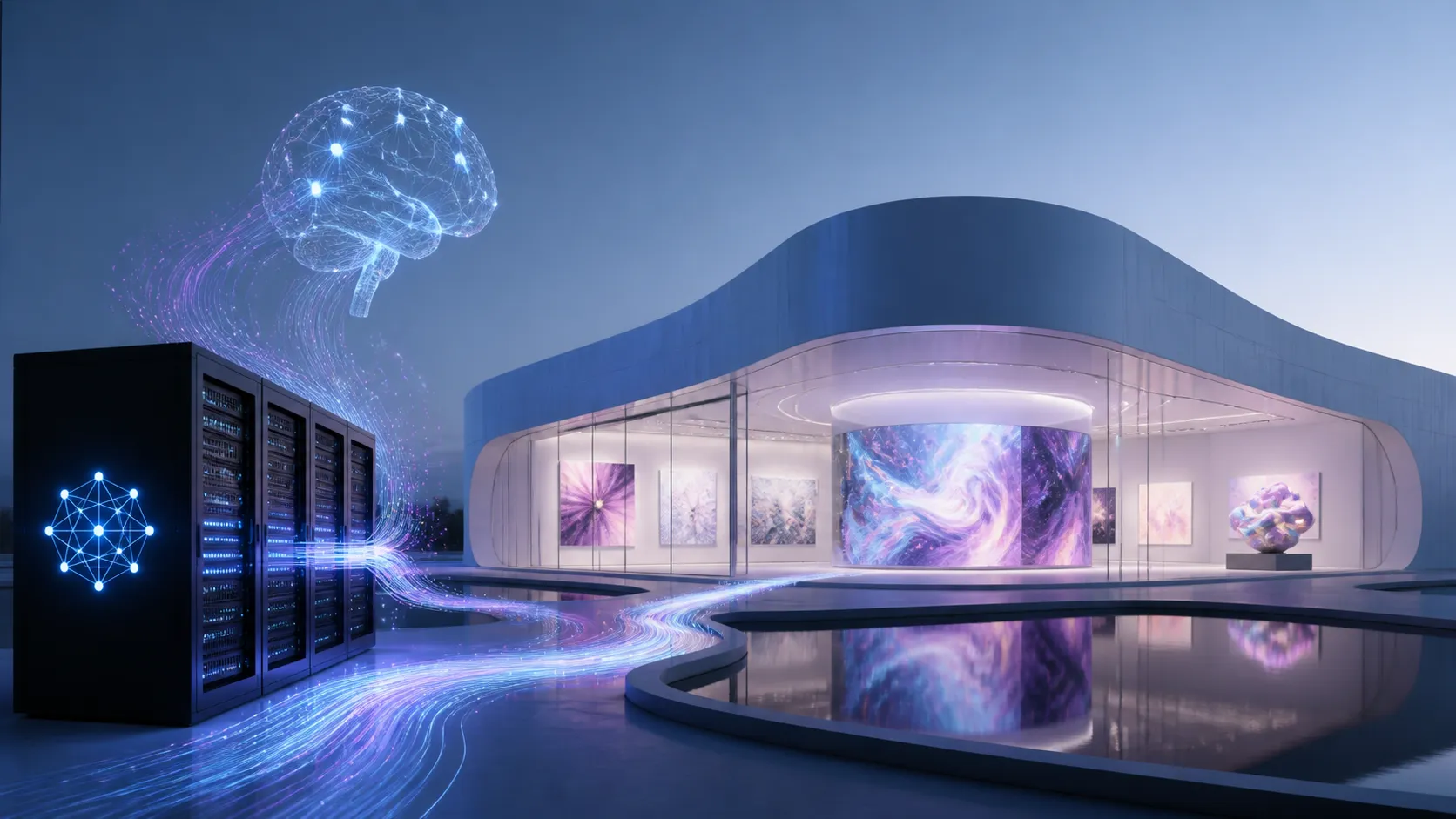
June 18, 2026, (Inside AI) — The world’s first AI arts museum, Dataland, opens its doors with a debut exhibition called “Machine Dreams: Rainforest,” powered by a custom foundational AI known as the Large Nature Model. The museum leverages Google Cloud infrastructure to render 1.2 billion pixels of hyper-generative reality, creating an interactive environment where art responds to visitors in real time.
The Engine Behind the Living Canvas
Dataland’s core is the Large Nature Model, trained on a vast dataset of environmental data. This model drives a multi-sensory experience that blends generative soundscapes, real-time emotion sensing, and algorithmic scent augmentation. Google Cloud’s Compute Engine and the Gemini Enterprise Agent Platform coordinate complex AI models—including GANs, diffusion models, and Gemini—to animate the gallery walls dynamically.
Infrastructure Meets Sustainability
Google Cloud’s computing backbone runs on 87% carbon-free renewable energy, aligning with Dataland’s eco-conscious mission. This infrastructure handles everything from ticketing pipelines to pixel-shifting displays, ensuring smooth, sustainable operations. The museum claims this approach reduces latency and energy waste compared to traditional art installations.
When Art Talks Back
Unlike static exhibits, Dataland’s galleries engage in an active dialogue with visitors. Sensors capture emotional cues, feeding them into AI systems that alter visuals, sounds, and scents in real time. This paradigm shift challenges the passive observer model, turning the museum into a co-creative space.
Read: Bayreuth’s AI-Generated Ring Cycle Staging Called a Mindless Mess
Why a Rainforest? The Data Behind the Dream
The Large Nature Model was trained on terabytes of ecological data—from rainforest acoustics to climate patterns—to generate an immersive, ever-changing ecosystem. Dataland’s founders argue that AI can deepen our connection to nature by making its complexity tangible, though critics question whether synthetic nature dilutes authentic environmental experiences.
Competing Visions of AI Art
Dataland’s launch comes amid a surge in AI-generated art, but its focus on real-time, multi-sensory interaction sets it apart. Projects like Refik Anadol’s data sculptures have used similar tech, yet Dataland’s scale and sensory breadth are unprecedented. Some artists worry that corporate cloud partnerships could homogenize creative expression, while others see it as a necessary evolution.
Unanswered Questions in the Gallery
Dataland has not disclosed the full training data sources for the Large Nature Model, raising transparency concerns. The museum’s reliance on proprietary Google Cloud tools also sparks debate about vendor lock-in and long-term accessibility. Additionally, the emotional sensing technology—while impressive—lacks independent validation of its accuracy and privacy safeguards.
From Server Racks to Scent Trails
Behind the scenes, Google Cloud’s infrastructure orchestrates a complex ballet of AI workloads. The Gemini Enterprise Agent Platform manages model coordination, while Compute Engine provides the scalable horsepower. Dataland’s team fine-tuned diffusion models to generate high-resolution visuals without perceptible lag, a technical feat that required custom optimizations.
Read: AI Zombie Video on Singapore’s National Day Sparks Debate on Filmmaking’s Future
A Glimpse of the Museum’s Future
Dataland plans to expand its model to other ecosystems and incorporate more sensory dimensions, such as haptic feedback. The museum also aims to open-source parts of its framework to foster community-driven AI art. As AI museums proliferate, Dataland’s blend of technology and sustainability may set a template—or a cautionary tale—for the future of cultural institutions.