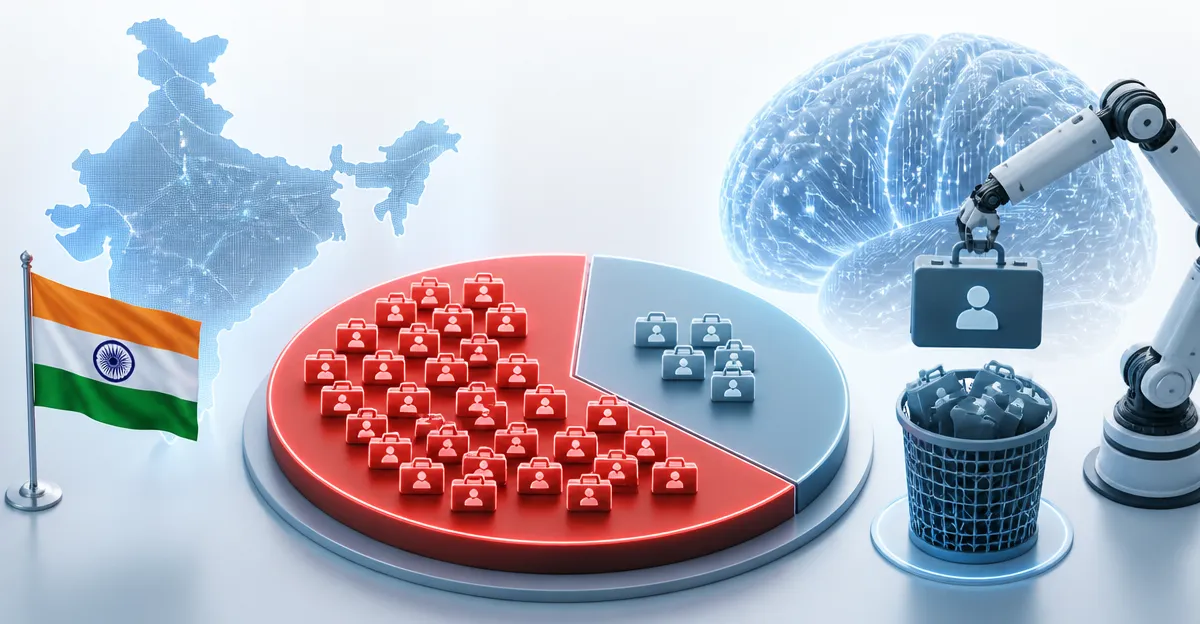
August 8, 2026, (Inside AI) — A striking 66% of India’s artificial intelligence and machine learning professionals expect layoffs or significant team cuts within the next three to six months, according to a July 2026 survey by anonymous professional network Blind. The data, drawn from 1,552 India-based professionals, positions AI/ML workers as the second-most anxious group, trailing only sales and marketing at 68%.
The findings upend the narrative that AI expertise guarantees job security. As companies pour billions into automation, the very engineers building these systems now fear they are disposable. The survey reveals a counterintuitive reality: AI’s disruptive force is ricocheting back onto its creators.
Product and design teams are also on edge, with 65% anticipating cuts. In stark contrast, only 24% of engineers said layoffs were ‘very likely,’ and just 58% fell into the ‘at-risk’ category. Data and analytics professionals were the most confident, with only 51% expecting reductions and 40% deeming layoffs unlikely.
Rick Chen, Blind’s head of public relations, noted the paradox. “AI professionals are building the tools that are automating tasks across industries, yet they feel as vulnerable as those in roles AI is expected to replace,” Rick Chen, Head of Public Relations, Blind.
Company-Level Chasms in Confidence
Anxiety varies dramatically by employer. At Salesforce, 81% of respondents foresee layoffs, followed by Oracle at 80%, Uber at 77%, and PayPal at 75%. Enterprise software and payments firms showed the highest perceived risk. In contrast, Indian SaaS companies appear insulated: only 9% of Zoho employees expect cuts, and Freshworks recorded a 44% at-risk sentiment.
The divergence suggests that global tech giants may be aggressively restructuring AI teams as they shift from research to deployment, while Indian firms maintain steadier headcounts.
Silent Signals, Not Layoff Memos
Employees are reading between the lines. Among those who expect cuts, 27% cited hiring freezes as the top warning sign, 24% flagged budget or headcount reductions, and project cancellations and performance improvement plans were also key indicators. Only 9% pointed to official layoff announcements as the primary driver of concern.
This reliance on indirect signals reflects a broader shift in how workers gauge organizational health. The survey underscores that in AI, where project lifecycles are short and tooling evolves rapidly, job security is measured not by corporate statements but by hiring velocity and resource allocation.
While the survey captures sentiment, not actual layoff data, it aligns with a cooling in India’s once-frenzied AI hiring market. As companies prioritize profitability over moonshots, even the architects of AI are bracing for impact.