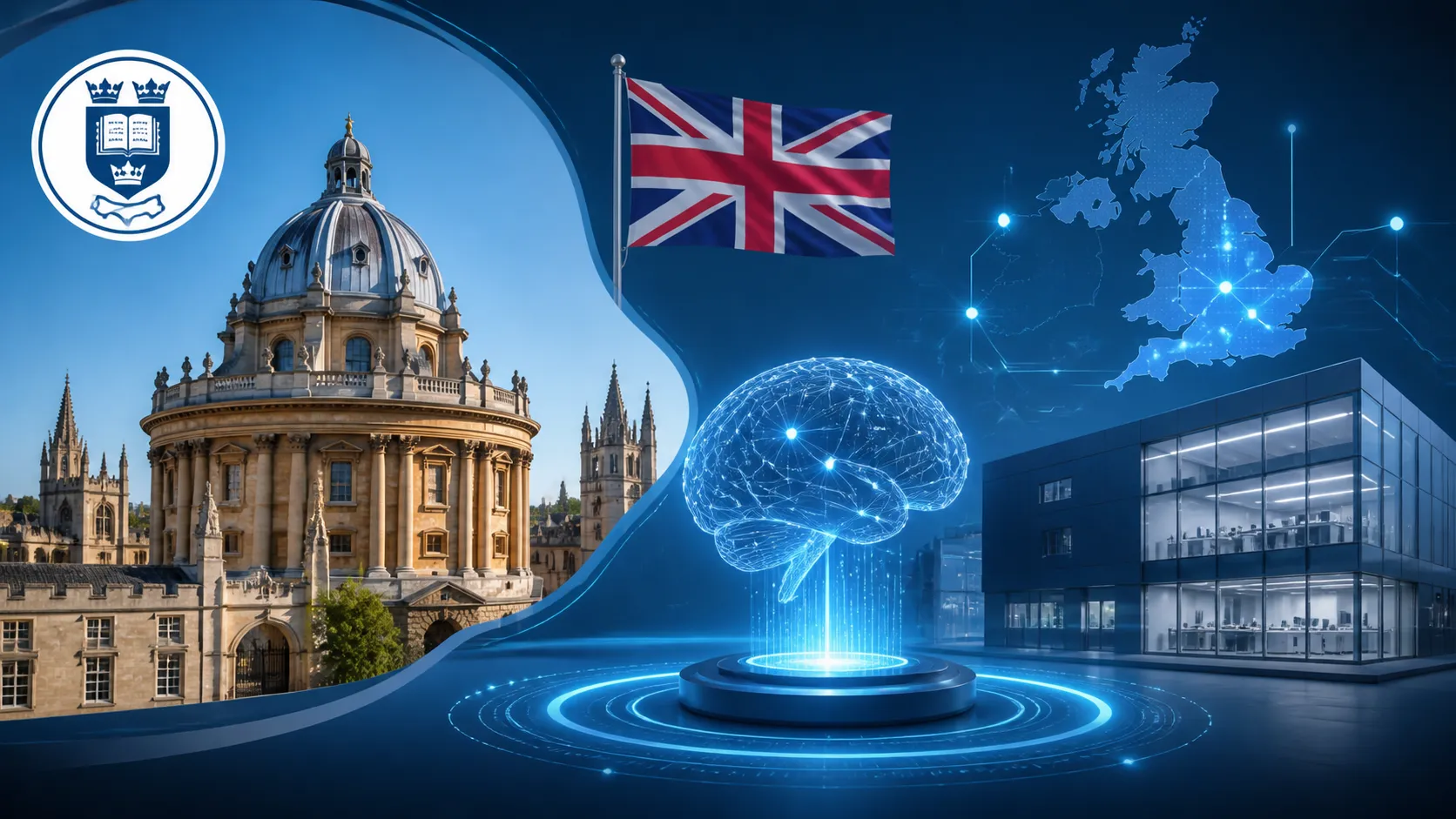
June 24, 2026, (Inside AI) — The University of Oxford will host a new government-backed UK AI Research Lab, uniting researchers from three top universities to develop open, human-centred AI systems. Named the British Open-ended Learning and Discovery Lab (BOLD), it moves away from scaling up neural networks and datasets. Instead, it pursues resource-efficient AI that functions safely in real-world settings.
Associate Professor Jakob Foerster at Oxford’s Department of Engineering Science leads the lab. BOLD aims to translate research into tools for workplaces, infrastructure, and public services. This supports wider AI adoption across the UK economy.
The lab targets socially vital applications. These span education, transport, healthcare, and scientific discovery. It challenges the dominant AI paradigm of larger models and data. BOLD will design scalable technologies that learn continuously and adapt with minimal resources.
Oxford’s selection highlights its interdisciplinary AI strengths. These cover fundamental machine learning, AI safety, ethics, and robotics. As host, Oxford integrates academia, industry, and the UK AI ecosystem. Researchers from Oxford, UCL, and Imperial College London collaborate with technology partners.
Read: AI Adoption in UK Reaches Tipping Point, Google Cloud Exec Says
BOLD also transforms research operations. Academic leads at the three universities merge their individual labs into one focused entity. This unified structure maximizes impact and avoids duplication.
The lab leverages Oxford’s AI@Oxford initiative. That program coordinates cross-university AI research, engagement, and collaboration. It connects multidisciplinary expertise and fosters external partnerships.
Professor Antoine Cully of Imperial College London said:
‘BOLD is an extraordinary opportunity to bring together the best research talent across the UK, deliver impact at real scale, and strengthen the UK’s position at the forefront of global AI research. I’m proud that Imperial is part of that journey.’
Funding details remain undisclosed. The lab’s open-ended learning approach contrasts with industry trends. It prioritizes systems that learn from limited data and adapt to new tasks without retraining. This could reduce computational costs and environmental impact.
BOLD builds on the UK’s strategic AI investments. It aligns with national goals for safe, ethical AI deployment. The lab’s human-centred focus addresses public concerns about opaque algorithms. By embedding safety and ethics from the start, it aims to set global standards.
Read: UK Government Scales AI Planning Tools with Google Cloud at Summit
The collaboration spans London and Oxford, creating a golden triangle of AI research. It draws on each institution’s specialties: Oxford’s safety and ethics, UCL’s foundational AI, and Imperial’s robotics and engineering. Industry partners will provide real-world testbeds.
BOLD’s open-ended learning mimics human curiosity. Systems explore environments, set their own goals, and learn without explicit instructions. This could unlock AI that assists in scientific discovery, formulates hypotheses, and designs experiments.
The lab’s emphasis on resource efficiency tackles the high energy consumption of large models. Techniques like meta-learning and modular architectures may enable AI that runs on edge devices. This suits applications in remote healthcare or autonomous vehicles.
BOLD’s collaborative model may inspire other national AI initiatives. By pooling academic talent and industry input, it avoids siloed research. The UK government likely views this as a blueprint for future labs.
The lab’s success hinges on translating research into practical tools. Past AI labs have struggled with this gap. BOLD’s integrated structure and focus on real-world testing aim to bridge it.
Oxford’s role as integrator reflects its convening power. The university has deep ties with policymakers and tech firms. This positions BOLD to influence regulation and standards.
As AI advances, BOLD’s alternative path could yield breakthroughs that large-scale models miss. Its human-centred, safe, and efficient approach may define the next era of AI research.