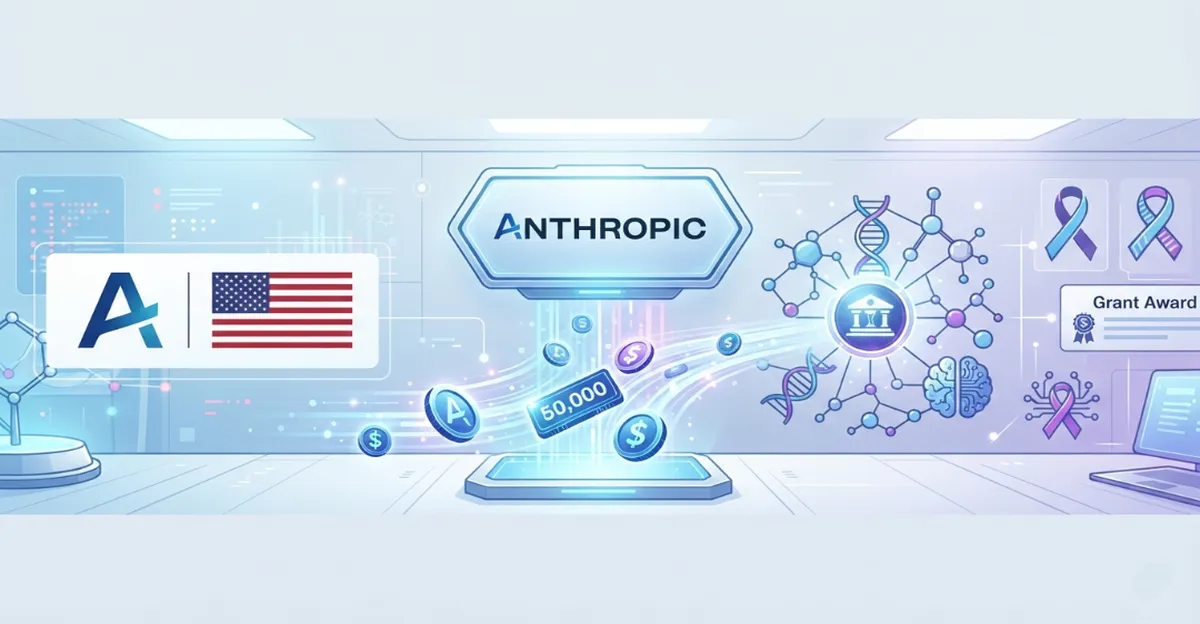
July 21, 2026, (Inside AI) — Anthropic has opened applications for a dedicated grant program under its AI for Science initiative, offering up to $50,000 in Claude API credits to researchers working on rare genetic diseases. The program, announced July 20, 2026, marks the company's first thematic call within its broader scientific research initiative.
The grants target two distinct groups: academic and clinical researchers investigating disease mechanisms, and early-stage biotech companies developing therapies. Applications close August 2, 2026 at 11:59 PM PST. Selected applicants receive six months of Claude usage credits, which can be applied to Claude Opus or other Anthropic models approved for biology research.
Two Tracks, One Goal: Faster Rare Disease Research
The first track focuses on basic science partnerships. Anthropic aims to foster collaboration between clinical researchers, patient organizations, and data scientists to accelerate discovery of disease mechanisms. An early partner is the Monarch Initiative, an international consortium developing standards and resources for rare disease diagnosis.
Monarch's tools include the Mondo Disease Ontology, which reconciles disease definitions across OMIM, Orphanet, ICD, and other sources. Grantees can also access DisMech, a mechanistic disease classification library where Claude analyzes case reports, variant databases, and registry schemas to identify mechanistic similarities between diseases.
The second track targets biotechnologists and early-stage biotech companies. According to Anthropic, moving from a confirmed genetic diagnosis to an available treatment can take one to two years. The program explores how Claude could shorten this timeline by drafting regulatory documents, reviewing safety information, analyzing drug target suitability, and preparing regulatory submissions.
Anthropic says results from academic projects will be shared openly at Monarch Initiative. "We now plan to launch thematic calls for projects within the broader AI for Science program," the company stated in its announcement. "Today, we are sharing a focused call for applications centered specifically on rare genetic diseases."
Why Rare Diseases, And Why Now?
Rare diseases affect an estimated 400 million people worldwide across more than 7,000 conditions. Despite their collective prevalence, each disease affects small populations, creating significant research barriers. Clinicians struggle to build patient registries, identify therapeutic targets, and design clinical trials. The fragmented nature of rare disease research means mechanisms shared across diseases often go undetected.
Anthropic argues AI can address these bottlenecks. AI models can synthesize findings across large literature corpora, extract information from limited datasets, and create shared terminology. The company believes this capability helps researchers better use existing information while more data is generated.
This grant program builds on Anthropic's AI for Science initiative launched last spring. Previous grantees have worked on projects ranging from drug repurposing to quantum simulation. The rare disease call represents a strategic shift toward themed, collaborative cohorts. "Throughout this initiative, we have found that projects are more generative when multiple AI for Science grantees are working on related questions and exchanging tips," Anthropic noted.
Anthropic's approach mirrors broader trends in AI-assisted drug discovery. Other AI companies, including Google DeepMind with AlphaFold and Insilico Medicine, have applied machine learning to protein structure prediction and target identification. However, Anthropic's grant model differs by providing compute credits rather than direct cash funding, effectively lowering the barrier for researchers to access frontier AI capabilities.
Researchers and biotech firms can apply for this grant by filling out this form. Certain projects triggering the company's biological safety systems may qualify for exemptions following review. The application window remains open for less than two weeks, reflecting what Anthropic describes as an urgent need to accelerate rare disease research.