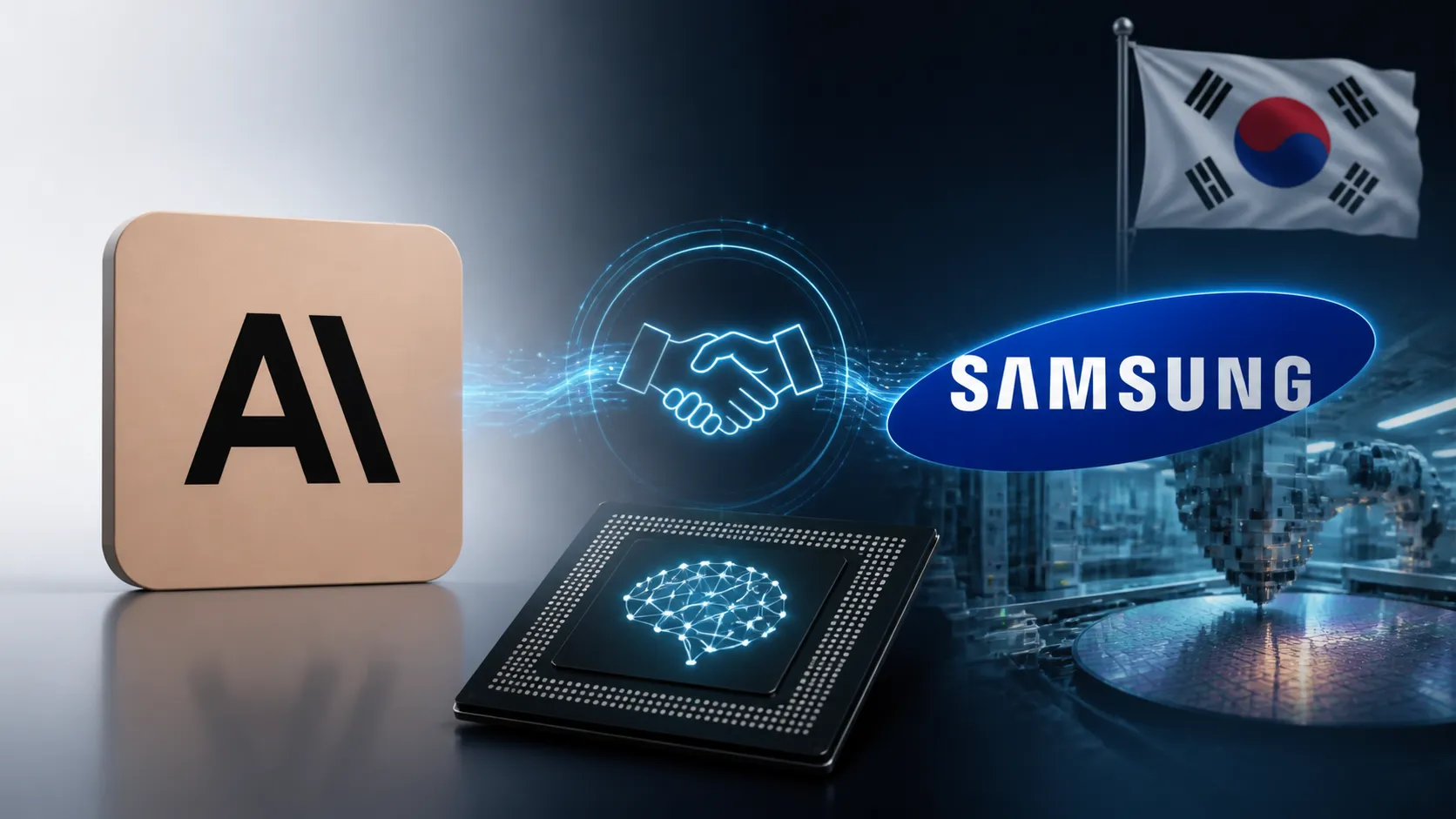
July 4, 2026, (Inside AI) — Anthropic, the company behind the Claude AI assistant, has entered early-stage discussions with Samsung Electronics to manufacture a custom AI chip. The talks, first reported by The Information, signal a potential shift in how the AI lab secures the computing power needed to run its large language models.
Anthropic has relied entirely on chips rented from Amazon Web Services, Google Cloud, and NVIDIA. But as model sizes balloon and inference costs climb, that dependence is becoming a strategic liability. The company is now exploring its own silicon to gain more control over performance and economics.
The discussions are preliminary. Anthropic has not yet defined the chip’s purpose, its performance targets, or how it would integrate into server systems. No design, testing, or manufacturing has commenced. The company is evaluating Samsung’s 2-nanometer process technology and advanced chip-packaging capabilities, which could offer denser transistor counts and improved energy efficiency.
Still, the move is part of a broader industry realignment. NVIDIA commands roughly 74% of the AI chip market, but major US AI firms are racing to diversify. OpenAI recently unveiled its Jalapeño chip built with Broadcom. Google has its Tensor Processing Units, and Amazon has Trainium. For Samsung, landing Anthropic as a foundry client would be a significant win as it challenges market leader TSMC.
Anthropic has been quietly assembling chip expertise. It hired Clive Chan, formerly of OpenAI’s chip team, and in May added Samsung, SK hynix, and Micron as strategic investors in its Series H funding round. These moves suggest a serious, long-term commitment to custom hardware.
Anthropic emphasized that it is not abandoning its current suppliers. In a statement, the company said:
“NVIDIA GPUs, Google TPUs, and AWS Trainium remain central to our compute.”
On the Samsung talks, the company declined to comment further. Samsung also did not respond to requests for comment.
The push for custom AI chips is driven by the staggering costs of training and deploying frontier models. Renting compute from cloud providers can erode margins, especially as AI services scale to millions of users. By designing its own chip, Anthropic could optimize hardware for its specific model architectures, potentially slashing latency and power consumption.
Yet the path from talks to tape-out is fraught with risk. Custom chip development takes years and billions of dollars. Samsung’s advanced nodes are still ramping up, and yield issues have plagued cutting-edge processes. Anthropic would need to build a robust chip design team and navigate complex supply chains—all while maintaining its breakneck pace of model innovation.
Industry analysts note that vertical integration is becoming table stakes for AI leaders. “If you’re spending over a billion dollars a year on compute, even a 20% efficiency gain from custom silicon pays for the R&D quickly,” said Dr. Lin Wei, a semiconductor analyst at TechInsights. “But execution is everything. Many software companies have failed trying to become hardware companies.”
Anthropic’s move also underscores the geopolitical dimension of AI chips. With US export controls tightening on advanced semiconductors, having a diversified manufacturing base—including Samsung’s fabs in South Korea—could offer strategic resilience. Samsung’s advanced packaging, which stacks chips vertically, is particularly attractive for AI workloads that demand high memory bandwidth.
The talks come as Samsung aggressively courts AI chip designers. The company has invested heavily in its foundry business, offering competitive pricing and dedicated AI chip solutions. Winning Anthropic would validate Samsung’s strategy and provide a high-profile reference customer to attract other AI firms.
Anthropic’s custom chip ambitions may also reflect lessons from its competitors. OpenAI’s partnership with Broadcom aims to reduce reliance on NVIDIA, while Google’s TPU program has given it a multi-year head start. By engaging Samsung early, Anthropic could leapfrog some of the integration challenges that have plagued other custom chip projects.
For now, the talks remain exploratory. But the signals are clear: Anthropic is laying the groundwork for a future where it controls its own silicon destiny. Whether that future materializes depends on how quickly the company can turn early interest into a working chip—and whether Samsung can deliver on its advanced manufacturing promises.