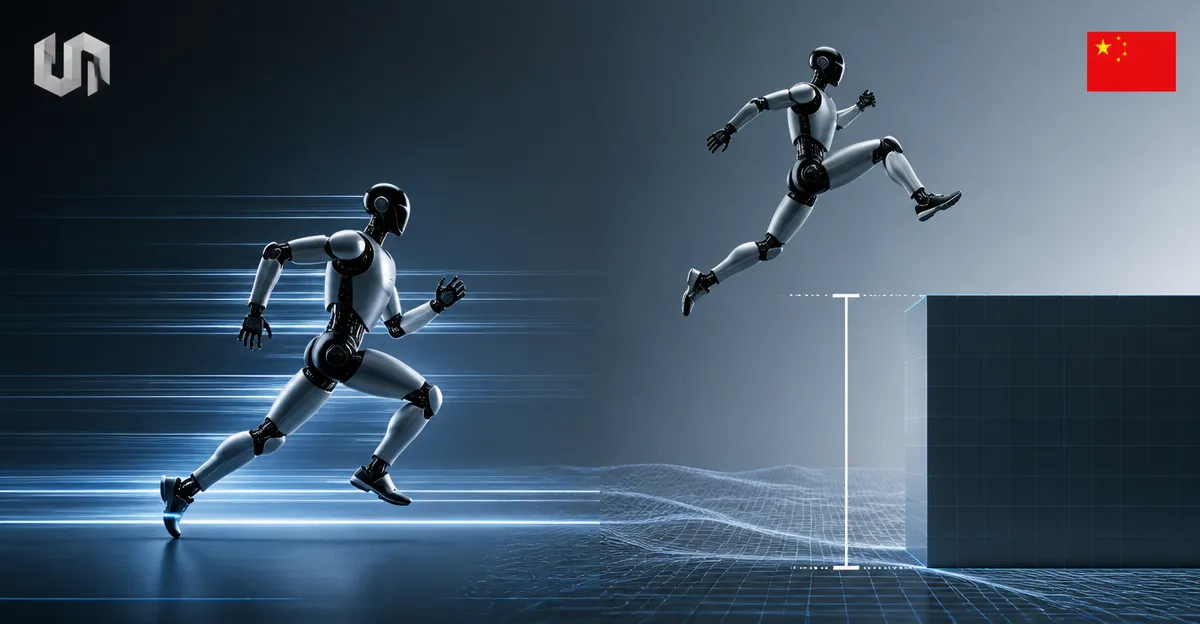
August 18, 2026, (Inside AI) — Unitree claims its new humanoid robot, named Superman, can jump 2 meters from a standing position and sprint at 12.66 meters per second. That speed would outpace every human on record, including Usain Bolt, whose peak velocity reached 12.42 meters per second during his 100-meter world record run in 2009.
The announcement, reported by Chinese tech outlet IT Home, positions Unitree at the extreme edge of legged robotics. No payload, surface condition, or repeatability data accompanied the claim. No independent verification exists. No production timeline was offered.
Unitree has a track record of aggressive performance marketing. Its H1 humanoid, launched in 2023, was billed as the first to run at 3.3 meters per second without a tether. The G1 model, priced at $16,000, targeted mass adoption. The new Superman figures, if accurate, represent a 3.8x speed increase over the H1 in roughly three years.
Why a 2-meter jump rewrites the rules of dynamic stability
A standing vertical leap of 2 meters would exceed the best human performance by nearly 40 centimeters. The current human world record for a standing vertical jump is 1.616 meters, set by Christopher Spell in 2021. For a bipedal robot, that height requires explosive actuator power, precise center-of-mass control, and landing impact absorption far beyond current commercial systems.
Read: Unitree CEO Says Robots Are Nearing a ‘ChatGPT Moment’
Boston Dynamics‘ Atlas, long considered the benchmark for dynamic humanoids, has demonstrated jumps of roughly 1 meter with a running start. Agility Robotics‘ Digit focuses on walking and carrying, not acrobatics. Figure AI and Apptronik prioritize manipulation and workplace tasks. Unitree’s claim, if substantiated, would leapfrog all of them in raw athleticism.
But the absence of test protocol matters. A 2-meter jump on a sprung floor with no payload and a single successful attempt is not the same as repeatable performance on concrete with a 10-kilogram load. Unitree did not disclose whether the robot used a tether, external power, or pre-programmed motion capture.
The gap between demo footage and deployable systems keeps widening
Unitree’s announcement follows a familiar pattern in humanoid robotics: headline-grabbing capability claims without commercial context. Tesla‘s Optimus has shown walking and sorting tasks but remains in development. Xiaomi‘s CyberOne appeared at a launch event in 2022 and then largely disappeared from public view. 1X Technologies and Sanctuary AI emphasize real-world deployment over athletic feats.
Speed and jumping ability do not translate directly to warehouse productivity or elder care. The more relevant metrics are uptime, failure rate, cost per hour of operation, and safety certification. Unitree has not published any of those for Superman.
The company’s G1 humanoid, announced in May 2024, was marketed as a research platform and consumer product. Unitree has sold thousands of its quadruped robots, including the Go2 and B2, to universities and industrial clients. That revenue base funds its humanoid ambitions. But a 12.66 m/s humanoid remains a laboratory artifact until proven otherwise.
Industry observers note that China‘s robotics sector benefits from aggressive government subsidies and a dense supply chain for actuators, batteries, and carbon fiber components. Unitree’s pricing advantage over Western competitors is real. Its performance claims, however, often arrive without third-party validation.
Read: China Humanoid Makers Face Challenge of Putting Robots to Work
The Superman name itself signals intent. Unitree is not positioning this robot as a warehouse worker or factory assistant. It is positioning it as a symbol of what Chinese robotics can achieve. Whether that symbol can survive contact with a loading dock remains an open question.