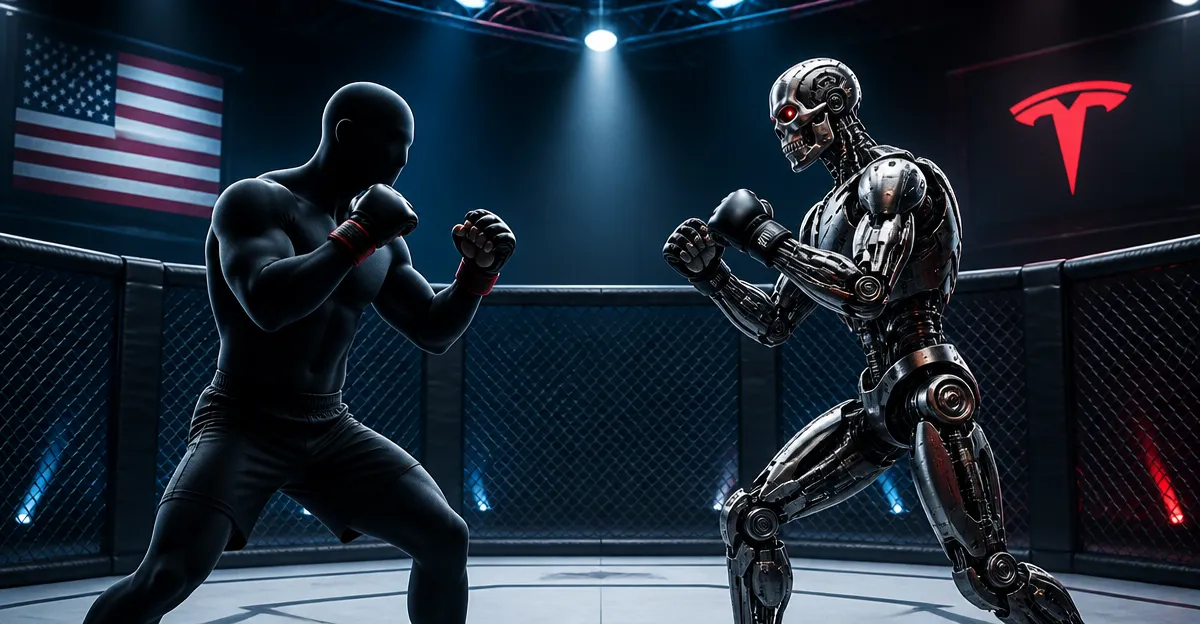
September 22, 2026, (Inside AI) — A humanoid robot traded punches and kicks with an influencer inside a mixed martial arts cage in San Francisco, an event the organizer calls the first human versus humanoid robot fight. The robot, built by US-based Robot Entertainment Kombat (REK), stood six feet tall and was controlled remotely by a human operator during the bout.
The fight, staged by REK, featured content creator Frankie LaPenna against a machine designed to resemble a futuristic combat robot. Video shows LaPenna landing initial punches before the robot responded with strikes that sent him across the cage. REK later stated on X that LaPenna "kept going and defeated" the robot, while clarifying that a human controlled it remotely.
The event raises immediate questions about what was actually demonstrated. A remote-controlled robot is not an autonomous combatant. It is a puppet with a human brain. The operator sees through cameras and acts through actuators. That distinction matters for anyone evaluating claims about machine fighting capability.
Remote Control Changes The Fight
REK's own clarification undercuts the Terminator branding. The robot did not think, adapt, or decide. A person behind the scenes pulled the strings. This is closer to a large-scale drone or a teleoperated industrial arm than to OpenAI's robotics work or Boston Dynamics' Atlas. Teleoperation has existed for decades in surgery, bomb disposal, and space exploration. Applying it to a cage fight is a spectacle, not a technical leap.
Read: Humanoid Robots Earn Golden Buzzer on America's Got Talent
Still, the physics are real. A six-foot machine with metal limbs can generate force no human fist can match. When it connected, LaPenna flew. That is simple mechanics, not artificial intelligence. The robot's "warm-up" before the bout was likely a scripted sequence or operator practice, not autonomous calibration.
The fight's location in San Francisco places it near the heart of the AI industry, but REK is an entertainment company, not a research lab. Its business model involves staging full-contact fights with human-controlled humanoid robots. That is a niche within sports entertainment, similar to BattleBots or Robot Wars, but with humanoid forms and human opponents.
Social media reaction split between curiosity and skepticism. One user wrote, "I'm curious how an actual fighter would do against this. I feel a pro would do much better." Another added, "Not gonna lie, I would watch every episode of this!" The first comment points to a real limitation. LaPenna is an influencer, not a trained MMA fighter. A professional could likely avoid the robot's telegraphed strikes and target its joints or balance. The second comment shows the entertainment appeal regardless of athletic legitimacy.
REK said it would release more footage. The company has not published technical specifications, operator details, or safety protocols. Inside AI could not independently verify the robot's construction, the operator's identity, or whether the fight followed any regulated combat sports rules. California State Athletic Commission, which oversees MMA in the state, has not commented on whether the event required a license.
The broader question is whether remote-controlled robots belong in combat sports. History suggests a pattern. When UFC 1 launched in 1993, critics called it human cockfighting. It later became a global sport with rules and safety standards. Robot fighting leagues like BattleBots have their own dedicated fanbase. A hybrid could find an audience, but only if it answers basic fairness questions. Should the robot have a weight class? Should operators be disclosed? Can a human safely absorb repeated metal strikes?
For now, the fight is a viral moment, not a milestone in AI. It shows that humanoid hardware can take a punch and deliver one. It does not show that machines can fight on their own. The Terminator comparison is marketing. The real story is a remote-controlled puppet in a cage, and the influencer who agreed to stand in front of it.