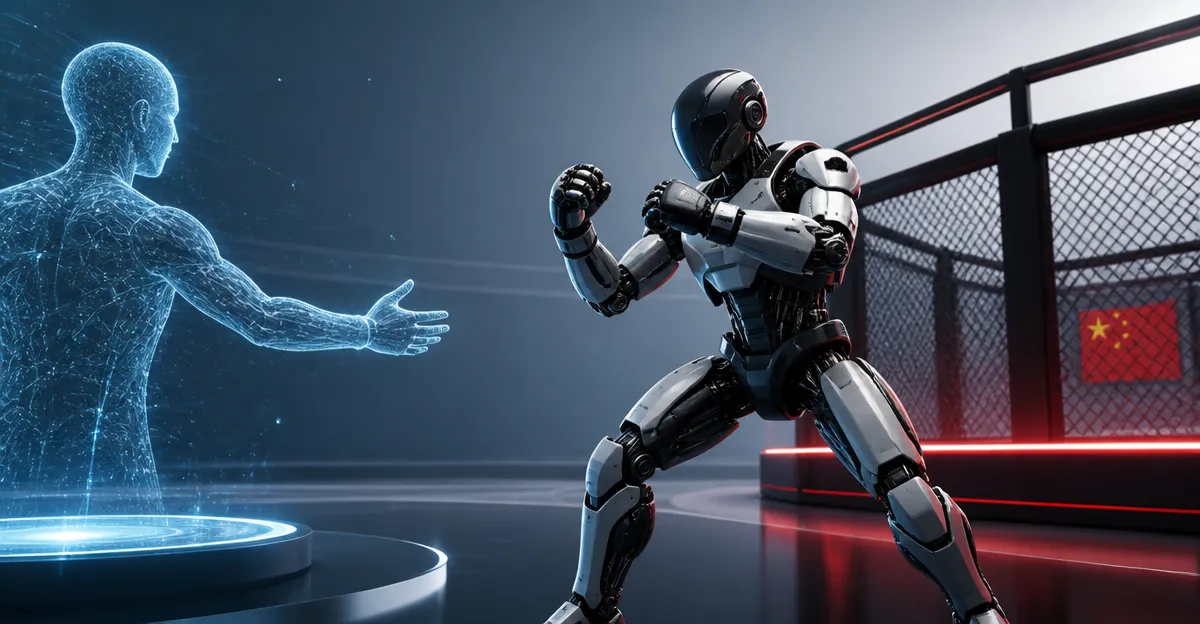
August 31, 2026, (Inside AI) — A Chinese startup is betting that the first embodied AI most people meet will not be in a factory or warehouse, but in a shopping mall arcade. Qianxing Intelligence has launched Iron Armor Battle Arena, a location-based entertainment system that lets players control physical humanoid boxing robots through motion-sensing controllers.
The company has deployed machines in arcades, malls, and theme parks, with overseas customers accounting for nearly half of its client base. Markets include Malaysia, the US, and the UK. A typical match lasts one to two minutes, with both two-player and single-player modes. The replay rate is 40% to 50%, according to company data.
This is not a distant research project. It is a commercial product designed for high-traffic venues. The core technical challenge is latency. Qianxing claims millisecond-level synchronization between player movements and robot actions. That speed determines whether the experience feels like controlling a machine or becoming one.
Industry analysts note that embodied AI has largely focused on industrial use cases such as logistics and manufacturing. Entertainment applications remain rare. Qianxing’s approach inverts the typical go-to-market strategy: instead of proving utility first, it proves engagement.
Read: China’s Humanoid Robot Boom Moves Beyond the Show Floor
The system uses motion-sensing controllers to map punches, dodges, blocks, and combos to the robot in real time. Force feedback and natural responsiveness are critical. The company has also added an AI-powered voice layer for commentary and gameplay prompts. Operators can customize the robot’s voice and personality.
Modular Shells Turn Robots Into Venue IP
The robot’s exterior is modular. Operators can swap shells for branded collaborations or holiday themes. That design shifts the product from a single machine to a platform for venue-specific intellectual property. Theme parks and tourism projects can integrate the robot into their own narratives.
Business model details show two tracks. In China, Qianxing uses revenue-sharing or rental arrangements with arcade chains and malls. Overseas, it sells complete systems outright. Long-term revenue comes from consumables, content updates, and customized IP skins. This layered model mirrors trends in gaming hardware, where software and services drive margins.
Safety and reliability are not afterthoughts. Location-based entertainment robots face different regulatory and maintenance demands than lab prototypes. The company has pursued global safety and quality standards from the outset, a necessity for multi-country deployment.
From Arcade Attraction to Robot League
Qianxing’s roadmap extends beyond single matches. Cross-venue rankings, mech leagues, major IP collaborations, and online-offline competitions could turn Iron Armor Battle Arena into a competitive social platform. The hardware becomes the entry point for a broader ecosystem.
This vision aligns with a broader shift in consumer robotics. Startups like Unitree have demonstrated low-cost humanoid platforms, while entertainment robots such as Sony’s Aibo have shown consumer willingness to engage with physical machines. Qianxing’s differentiator is real-time physical competition.
Critics might argue that entertainment robots are a niche market. But the global location-based entertainment industry is projected to grow steadily, driven by experiential retail and immersive attractions. If Qianxing can maintain low latency and high reliability, it may capture a segment that industrial robotics companies have ignored.
Read: We Asked Show Robotics’ Founder About “Vita”, their Live-Streaming Robot
The company’s philosophy is simple: let people play first. That may be the fastest way to make embodied intelligence feel ordinary. A shopper who scans a QR code and throws a punch through a robot is not thinking about AI architectures. They are experiencing physical agency through a machine.
That moment, repeated across malls worldwide, could normalize embodied AI faster than any whitepaper or keynote. Qianxing Intelligence is not selling a distant future. It is selling a two-minute fight.