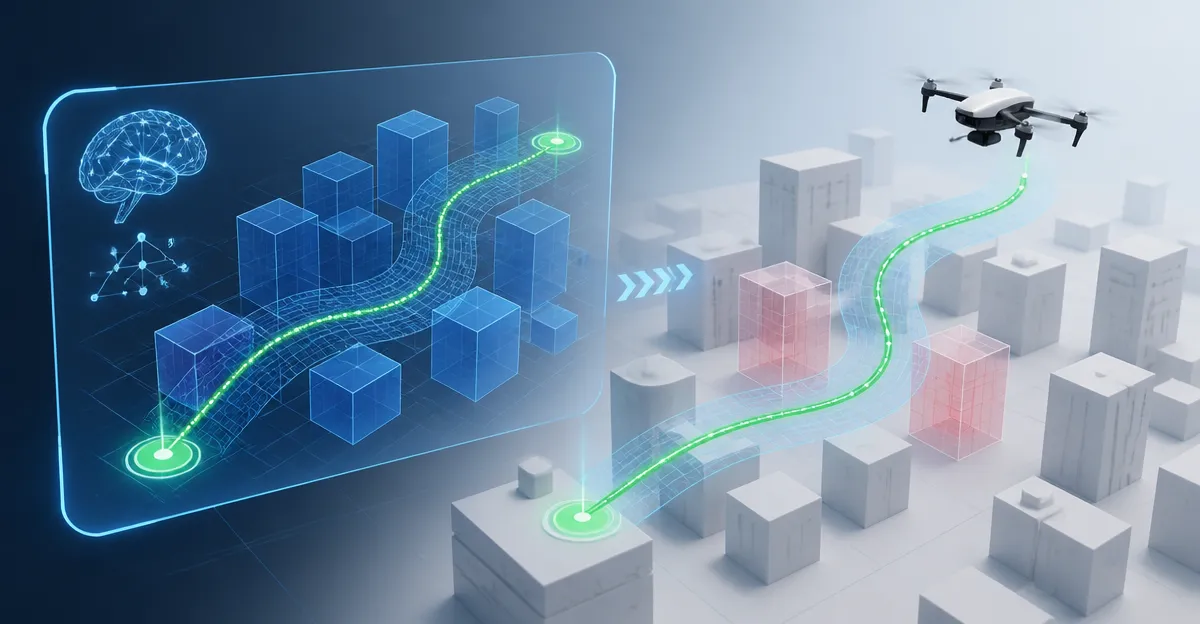
October 7, 2026, (Inside AI) — A team at MIT has developed a new autonomous navigation system that guarantees a drone will avoid collisions in completely unknown environments, even when obstacles are moving unpredictably. The system, called SANDO (Safe AutoNomous trajectory planning for Dynamic unknOwn environments), is the first to provide a mathematical safety guarantee for trajectory planning in dynamic, unmapped spaces. The research, led by Kota Kondo, who recently earned his PhD in aeronautics and astronautics at MIT, appears in the IEEE Transactions on Robotics.
Uncrewed aerial vehicles (UAVs) could one day fly into collapsed buildings, explore hidden mine tunnels, or deliver packages across crowded neighborhoods. But in these cluttered, ever-changing environments, a drone must react to obstacles it has never seen before. Most existing planners either assume a static world or avoid moving obstacles without a formal guarantee of safety. SANDO bridges that gap.
"In the hardest possible environment, where the UAV has no map of the area and there are unknown obstacles moving around, we established a mathematical guarantee of safety. The only thing the planner needs to know is the top speed the obstacles could reach. Given that, you could use it in any environment, without a map, and you know the UAV is not going to crash into anything," says Kota Kondo, lead author of the paper.
The core innovation is a time-sensitive safety corridor. SANDO first builds a series of connected 3D regions that are guaranteed to be free of obstacles. But unlike previous systems, it accounts for how moving obstacles might intrude into that corridor over time. A special module detects and tracks dynamic obstacles, then uses their maximum velocity to compute a sphere that captures all possible future positions within a given timespan. The safety corridor is built around these spheres, ensuring the drone stays clear.
Read: MIT's Paper-Thin Muscle Robot
"In the real world, obstacles are going to move, so the safety corridor you create at one point won't be useful as things move into the corridor. But because we consider this time component, we can now guarantee safety into the future," Kondo explains.
To make the system practical for onboard computers, the researchers used a heat-map based planner to steer the drone away from dense obstacle clusters. Once a safe corridor is established, SANDO optimizes the trajectory within it to find the fastest path. As the drone flies, it continuously updates the corridor and recalculates the trajectory, reacting to sudden changes.
In simulations, SANDO reached goals faster than several state-of-the-art systems while avoiding all collisions. In 12 test flights with a real drone, it avoided all dynamic obstacles using only onboard sensing and computing. The research was funded in part by the Defense Science and Technology Agency of Singapore.
Read: Serve Robotics Partners with Grubhub
The work could have significant implications for search and rescue, where drones must navigate through debris and unpredictable conditions. It also opens the door to combining SANDO with machine learning models that allow users to give instructions in plain language. As autonomous systems move into more complex real-world settings, formal safety guarantees like those offered by SANDO will become increasingly critical.