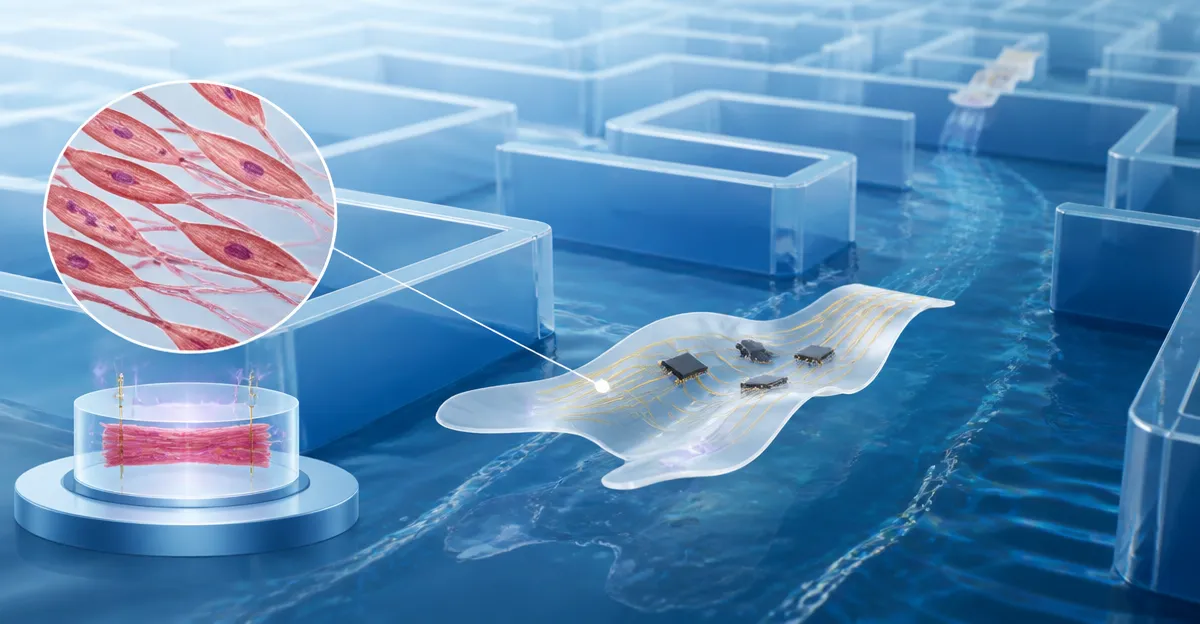
September 29, 2026, (Inside AI) — Engineers at MIT have built a swimming robot just one cell layer thick, powered entirely by living muscle. The device, a gel film the size of a stick of gum, flaps two fins to glide through water when hit by pulses of light. It is the first two-dimensional biohybrid robot that can move on its own, according to a study published today in Advanced Functional Materials.
The robot's skeleton is a half-millimeter-thin sheet of gelatin methacrylate, a common tissue-engineering gel. Each half of the sheet acts as a fin. A single layer of genetically modified muscle cells, thinner than a human hair, covers both fins. The cells twitch when exposed to light. Shine light on one fin, and it flaps with enough force to pull the robot forward. Alternate the light between fins, and the robot turns.
In tests, the bot navigated a simple watery maze. Its top speed was about four body lengths per minute. That is slow compared to Olympic swimmers, who cover up to 65 body lengths per minute. But it matches the leisurely pace of a cow shark.
"It takes a lot of force to move through water versus air," says study author Ritu Raman, associate professor of mechanical engineering at MIT. "The robot's quite strong, given its size."
Read: Spirit AI Predicts Robot Brain Breakthrough by Mid-2027, Homes Eight Years Away
The work builds on a 2025 project from Raman's lab that created an iris-inspired disk of artificial muscle. That disk proved muscle cells could grow in thin, patterned layers and move in multiple directions. But the movements were tiny, only about 100 microns. The new robot amplifies those twitches into useful swimming force by optimizing the gel skeleton.
"People hadn't seen this muscle architecture engineered from scratch before," Raman says. "And the cells were moving in multiple directions. But they only moved about 100 microns. From a robotics perspective, their movements were tiny."
The team tuned three properties of the gel: composition, stiffness, and groove geometry. They stamped grooves into the gel to guide cell alignment. Square-bottomed troughs worked better than curved valleys. Stiffer gels produced more force. And a half-millimeter thickness kept the film light enough that contracting cells did not peel away.
They also switched from fibrin, an ultrasoft gel used in the earlier iris, to GelMA. Fibrin shriveled under muscle forces. GelMA held its shape. After seeding the gel with cells, the researchers "exercised" the muscles with a training routine of flashing lights, strengthening the tissue.
"For engineering any type of tissue, it's known that these are knobs you can tune," Raman says. "And we wanted to optimize all these parameters to support live muscle cells."
The resulting robot has two independent muscles. "You can think of the robot as having two independent muscles," Raman says. "If we shine a light on just one, only that muscle moves. If shining on both, they both flap."
Biohybrid robots have typically relied on bulky 3D chunks of lab-grown skeletal muscle, requiring millions of cells. Raman says thinner designs could be cheaper to build and more efficient. Living tissue is soft, responds to its surroundings, and can heal itself. That makes it suitable for delicate jobs like environmental monitoring in fragile aquatic environments.
Read: China Humanoid Makers Face Challenge of Putting Robots to Work
"We believe that biohybrid robots powered by living muscle could one day perform delicate jobs like exploring environments too fragile or unpredictable for conventional hardware, because living tissue is soft, responsive to its surroundings, and can heal itself," Raman says.
The study's MIT co-authors include first author Maheera Bawa, Arielle Berman, Laura Schwendeman, Ferdows Afghah, and Seanbiron Johnson. The Office of Naval Research supported the work.
The current robot is basic in form. The team's next goal is to optimize the body design for faster swimming. Even at slow speeds, a muscle-powered swimmer could monitor water quality or inspect fragile ecosystems. For now, the bot proves that a single layer of muscle can generate enough force to move through water, a step toward soft, self-healing machines.