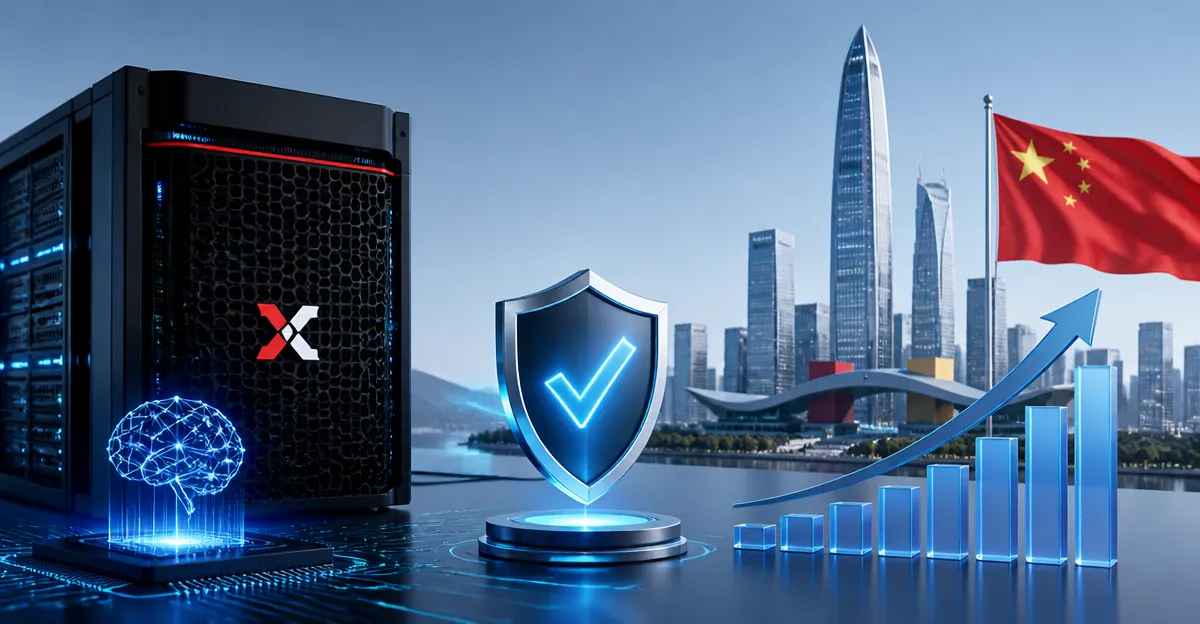
November 13, 2026, (Inside AI) — Chinese AI server manufacturer xFusion Digital Technologies has cleared a critical review by the Shenzhen Stock Exchange for its planned $1.2 billion initial public offering on the ChiNext board, according to a regulatory filing. The approval moves the company closer to a listing that would rank among the largest tech IPOs on the growth board this year and provide a major capital infusion for China's domestic AI infrastructure buildout.
The nod from the exchange's listing committee, disclosed on Friday, means xFusion can proceed to registration with the China Securities Regulatory Commission before setting a timetable for the offering. The company did not specify a date for the float or a final valuation in the filing.
xFusion's move arrives as Chinese AI firms race to secure computing hardware amid tight export controls on advanced chips from the United States. The company, which builds servers optimized for artificial intelligence workloads, has positioned itself as a domestic alternative to international suppliers. Its listing would give it fresh funds to expand production and research, at a time when demand for AI servers in China is surging.
The approval also signals regulatory willingness to support domestic hardware champions. Beijing has encouraged listings on the ChiNext board, which hosts fast-growing technology companies, as part of a broader push to channel capital into strategic sectors. The Shenzhen exchange's review is one of the most rigorous steps in the mainland IPO process, and clearing it typically precedes a public offering by several months.
Details on xFusion's revenue, profitability, and customer base remain limited in the filing excerpt. The company's prospectus, which will be published before the offering, is expected to disclose financials and risk factors. The $1.2 billion target, if achieved, would value xFusion among the larger ChiNext listings in recent years.
US Export Curbs Reshape Server Supply Chains
The listing comes as Washington's restrictions on advanced chip exports to China have forced domestic server makers to redesign products around available components. xFusion and peers have increasingly turned to homegrown processors and alternative supply chains. That shift has created both opportunity and risk for investors. On one hand, government-backed demand for domestic AI infrastructure is strong. On the other, access to cutting-edge GPUs remains constrained, potentially limiting performance for the most demanding AI training tasks.
The timing also coincides with a broader thaw in US-China tech tensions. Recent diplomatic engagements have raised hopes for eased restrictions, though no policy change has been announced. For xFusion, a successful IPO would reduce reliance on private funding and provide a currency for acquisitions or partnerships. The company has not disclosed how it plans to use the proceeds, but industry norms suggest allocation toward R&D and capacity expansion.
Analysts note that the AI server market in China is crowded, with competitors including Inspur and Huawei's server division. xFusion's differentiation may lie in its focus on AI-optimized designs and partnerships with domestic chipmakers. The company's ability to scale will depend on securing stable component supplies and maintaining margins in a price-sensitive market.
Read: SMIC: AI Chip Supply Chain to Stay Tight Through 2027
The Shenzhen Stock Exchange's approval is a vote of confidence in xFusion's disclosure and governance. It also reflects the exchange's appetite for large tech listings that can boost trading volumes. ChiNext has seen a pickup in IPO activity this year as regulators balance market stability with the need to fund innovation.
For global investors, xFusion's offering could offer exposure to China's AI hardware sector, though access may be limited through mainland channels. The listing also underscores the growing self-sufficiency of China's AI supply chain, a trend with implications for global technology trade.
xFusion's IPO will be watched as a bellwether for other Chinese AI hardware firms considering public markets. A strong debut could encourage more listings, while a weak reception might signal caution. The company's next step is registration with the CSRC, after which it can launch a roadshow and price the shares. Market conditions in the coming months will play a key role in determining the final size and valuation.

If a research paper dropped this week, Mahesh has already read it. He covers AI tools and vibe coding for builders who need to know what is worth their time and what is not.