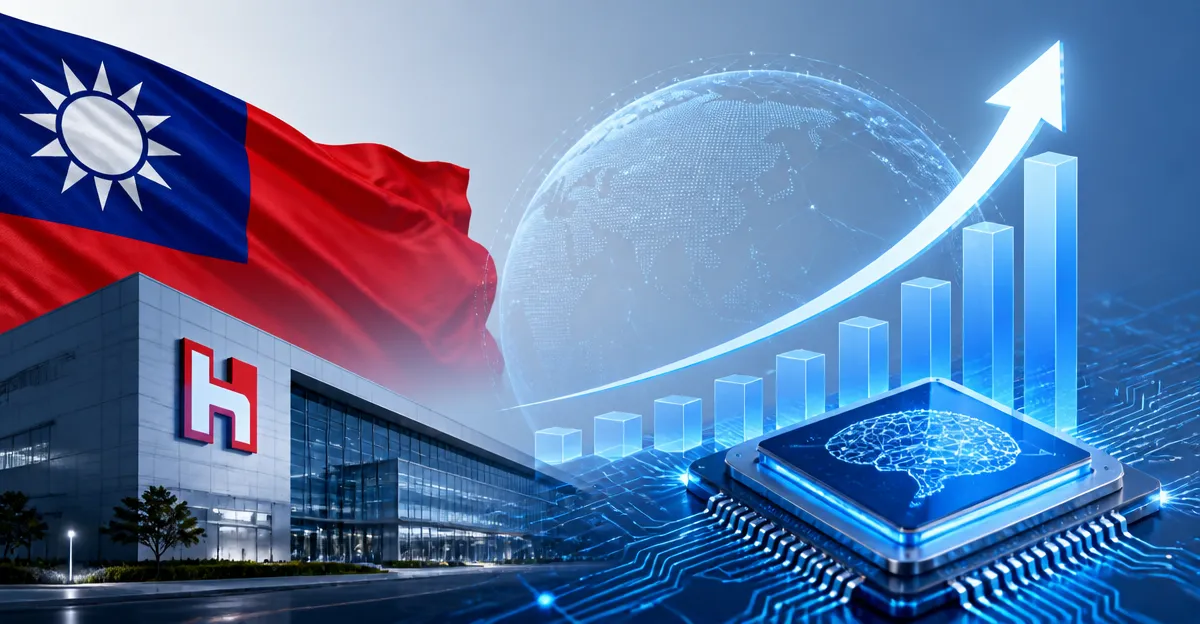
November 12, 2026, (Inside AI) — Foxconn, the world's largest contract manufacturer of AI servers, said on Thursday it expects revenues in 2027 to grow by double-digit percentages year on year, a forecast that rests almost entirely on sustained demand for artificial intelligence computing hardware. The company issued the guidance from Taipei while flagging component shortages, volatile geopolitics, inflation and monetary policy as the biggest uncertainties in the year ahead.
The projection matters beyond Foxconn's own balance sheet. The Taiwanese company assembles AI server racks for the largest cloud providers and chip designers on the planet, which makes its order book a rare forward-looking signal on whether the global AI buildout is still accelerating or beginning to plateau. When Foxconn says it has "strong confidence" in the coming year, it is effectively speaking for the capital expenditure plans of its customers.
"We have strong confidence in 2027," the company said, according to sources familiar with the guidance, adding that double-digit revenue growth is the base case rather than an optimistic outlier.
That confidence carries an unusual dependency. Foxconn does not design the chips or the models that drive demand. It converts orders from firms such as Nvidia and the major hyperscalers into assembled systems, which means its forecast is a derivative of decisions made elsewhere. A single shift in a customer's data center roadmap can move Foxconn's outlook more than any internal efficiency gain.
Component Shortages Loom Over The Forecast
The company's own list of risks is telling. Component shortages sit at the top, and for good reason. AI servers depend on high-bandwidth memory, advanced packaging capacity and power delivery components that remain constrained across the supply chain. Memory makers have spent much of 2026 allocating limited output to AI accelerators, leaving contract manufacturers to compete for the remainder.
Geopolitical volatility ranks alongside it. Foxconn operates sprawling production sites across China, India, Mexico and Vietnam, and its exposure to shifting tariff regimes and export controls is structural rather than incidental. The company has spent years diversifying assembly capacity away from mainland China, but the transition remains incomplete and expensive.
Inflation and monetary policy round out the risk list. Higher interest rates raise the cost of the capital-intensive data center projects that ultimately generate Foxconn's AI server orders. If financing conditions tighten, the double-digit growth target becomes harder to defend.
The forecast also arrives at a moment when the AI hardware trade has grown unusually concentrated. A small number of customers account for a disproportionate share of advanced server demand, and their purchasing decisions are driven by model training schedules that are difficult to predict a full year out. Foxconn's guidance therefore reflects customer commitments already in hand, not a guarantee that new orders will materialize at the same pace.
For the broader industry, the signal is one of continuity rather than breakthrough. Foxconn is not claiming a new market has opened. It is saying the existing one remains large enough to support another year of expansion, even as the company itself acknowledges the conditions that could interrupt it.
Investors and supply chain analysts will watch the company's monthly revenue disclosures for evidence that the 2027 target is holding. Any softening in AI server shipments would surface there before it appears in annual guidance, and would offer the clearest early warning that the buildout is cooling.

If a research paper dropped this week, Mahesh has already read it. He covers AI tools and vibe coding for builders who need to know what is worth their time and what is not.