November 12, 2026, (Inside AI) — Nvidia's board has opened an investigation into whether CEO Jensen Huang was the target of a foreign intelligence operation after he admitted to an extramarital affair with Alice Huang, founder of Singapore-based cloud firm Megaspeed. The board initially expressed confidence in Jensen. That confidence now faces a second disclosure: a reported affair with Nvidia executive Kimberly Powell, who reported directly to him.
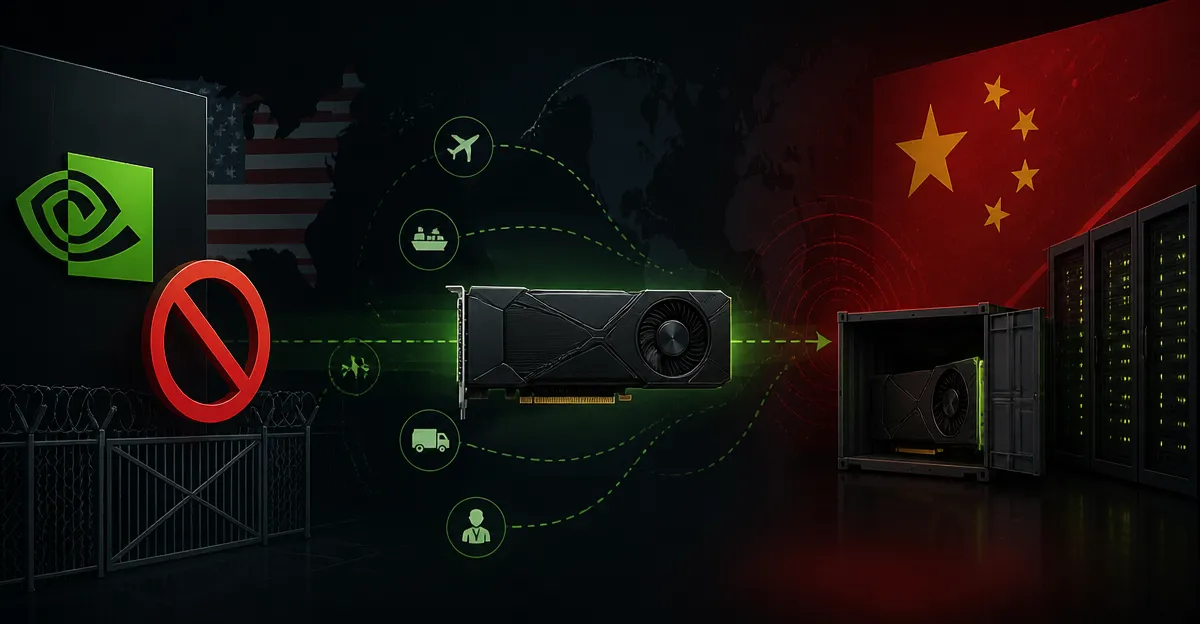
The personal scandal has pulled a harder question into public view. Megaspeed allegedly moved $7.5 billion in Nvidia chips to Chinese buyers, and the company sits at the center of the allegations. The case has renewed scrutiny of how restricted GPUs keep reaching China despite years of US export controls.
Washington's rules rest on a simple premise. Advanced Nvidia processors could let China build military and commercial AI systems that rival American capabilities. The controls govern where chips ship. They do not reliably govern who ultimately uses them. That gap is the story.
Restrictions Tightened, Eased, And Tightened Again
The policy record is uneven. President Trump banned several Chinese firms from US technology during his first term. The Biden administration added broader, tiered restrictions on advanced chips and chipmaking equipment. Trump's second term rescinded the AI Diffusion Rule but added more than 80 companies, mostly Chinese, to the US Entity List in 2025.
Read: Where Is Alice Huang? Nvidia CEO Spy Probe Widens
Earlier this year, the administration eased controls on Nvidia's less powerful H200 chips, taking a 25 percent cut of China sales. The export of Nvidia's Blackwell and Rubin GPUs remains prohibited. Even the eased H200 channel has not worked as intended. Chinese regulators blocked H200 imports to protect domestic chipmakers, and they earlier blocked H20 imports, forcing Nvidia to write off about $4.5 billion.
Demand did not disappear. It moved underground. The enforcement record shows the scale. A Texas bust last year exposed a smuggling network that tried to export at least $160 million worth of H100 and H200 GPUs to China between October 2024 and May 2025. The operation involved phony front companies and a warehouse in New Jersey.
White House adviser Michael Kratsios alleged that Chinese startup Moonshot AI accessed high-end Nvidia chips in Thailand to train its Kimi models. Northwestern Polytechnical University, which has deep ties to the People's Liberation Army, bought at least $7.5 billion worth of H200 chips last month despite sitting on a US blacklist, according to sources.
The Megaspeed allegations fit a pattern rather than an outlier. A 2024 estimate from the Center for a New American Security put potential smuggling volume at more than 12,500 chips entering China each year. That is not enough to train a frontier model. It is enough to equip startups and research labs with modest computing needs.
One underappreciated factor is that the controls target hardware shipments, not remote access. A GPU sitting in a Malaysian or Singaporean data center can serve a Chinese customer over the network without crossing a border. Enforcement agencies must then prove end use, not just end location. That distinction explains why intermediaries in Malaysia, Japan, and Hong Kong keep appearing in seizure records.
The Loopholes Are Structural, Not Incidental
Blacklisted firms have rebuilt themselves through new subsidiaries. Server maker Sugon was blacklisted in 2019. Former executives then set up Nettrix, which sold server racks equipped with Nvidia and Intel chips. Inspur Group, blacklisted in 2023, used six subsidiaries to keep buying US-made chips, according to sources.
Other routes rely on physical movement. Smugglers have dismantled GPUs and shipped them as parts. Some relabeled hardware with the branding of a fictitious company and falsified documents describing chips as adapters or controller modules. The Information reported last year that DeepSeek built its model using thousands of Nvidia chips smuggled in this way.
Human couriers remain in use. A student was paid for each of six chips he carried from Singapore to China in his luggage, according to a 2024 report. Airport authorities raised no suspicion because each chip was roughly the size of a gaming console.
The restrictions have also pushed Chinese firms to innovate. DeepSeek rattled global markets with models it said were trained on lesser-quality chips. Chinese companies stockpiled Nvidia hardware before bans took effect and built software to squeeze more from fewer processors.
Nvidia has not commented publicly on the smuggling allegations tied to Megaspeed. The board's investigation into Jensen Huang's conduct continues. Its findings will determine his future at the company. They will not settle the larger question of whether export controls can hold a line that the market keeps routing around.

If a research paper dropped this week, Mahesh has already read it. He covers AI tools and vibe coding for builders who need to know what is worth their time and what is not.