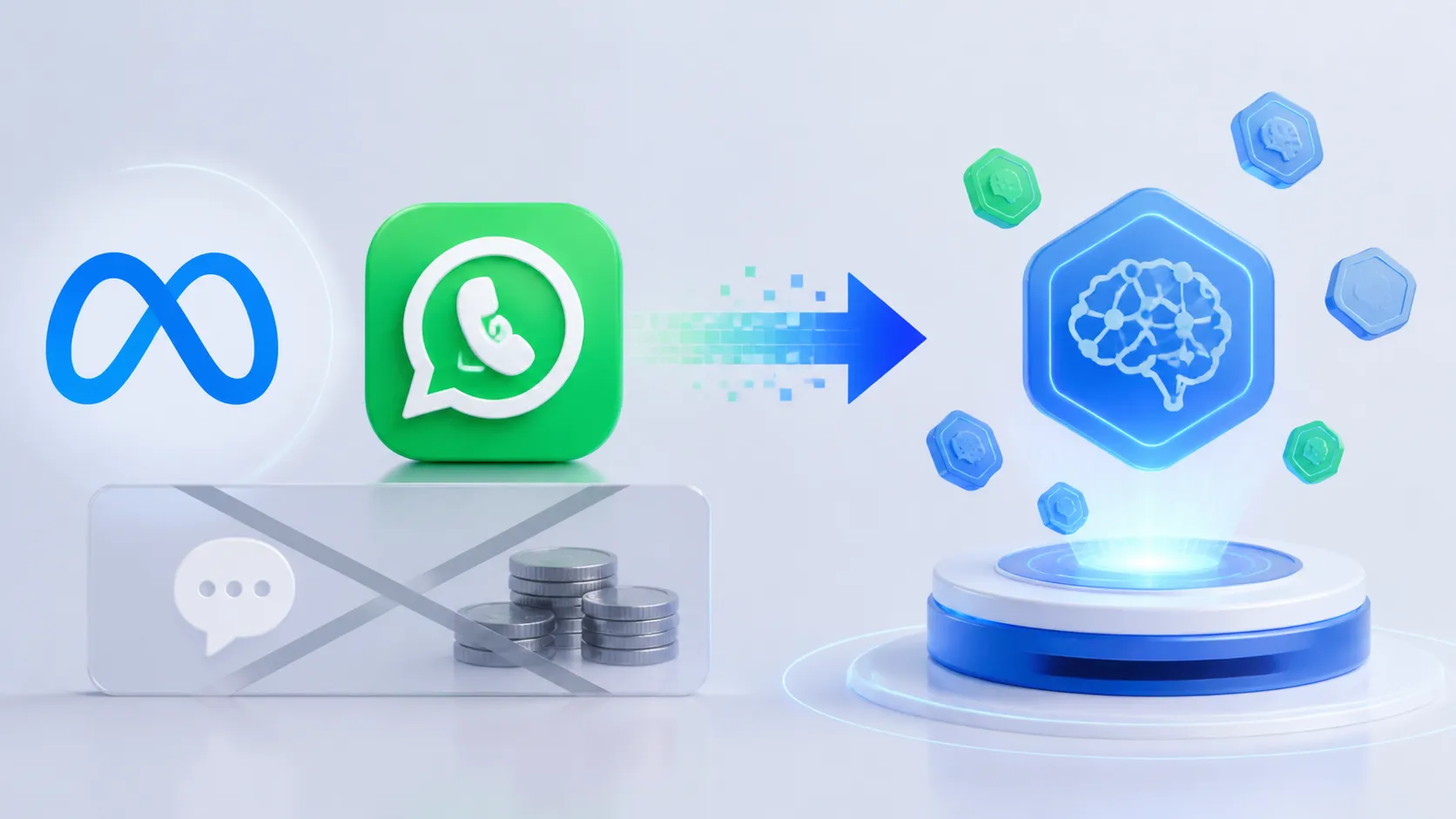
July 4, 2026, (Inside AI) — Meta is overhauling the economic engine of WhatsApp Business, swapping per-message fees for a token-based model tied to AI compute. The change, effective August 1, 2026, means companies using Meta’s business AI agents will no longer pay a flat rate for each message sent. Instead, costs will reflect the data and processing power consumed by artificial intelligence as it handles customer queries.
The move signals a strategic pivot toward monetizing AI’s operational footprint rather than simple message volume. This aligns with broader industry trends where cloud providers and AI platforms increasingly charge based on resource consumption, not just output units.
Under the new system, a simple FAQ response might cost far less than a complex, multi-turn interaction requiring heavy computational lifting. Meta has not yet disclosed the exact per-token rate, but the shift could benefit businesses with high-volume, low-complexity interactions while raising costs for those relying on deep, context-heavy AI conversations.
The Arithmetic of AI Tokens
Tokens are the fundamental units of data that AI models process—words, parts of words, or even characters. Each customer query and AI response consumes a certain number of tokens, and Meta will now charge based on that consumption. This mirrors pricing models used by major AI providers like OpenAI and Anthropic, where API calls are metered by token usage.
Read: Tech Giants Slash AI Spending After Tokenmaxxing Cost Explosion
For WhatsApp Business users, this means cost predictability could become more elusive. A business handling 10,000 simple “store hours” queries might pay less than before, while another fielding 1,000 intricate troubleshooting sessions could see a spike. Meta claims the model better aligns costs with the value delivered, but skeptics see a potential cash grab as AI adoption deepens.
Industry analyst Sarah Kimmel of TechEval Research noted:
“This is Meta monetizing the back-end compute in a way that’s opaque to most businesses. They’re essentially selling AI processing as a utility, but without the metering transparency of a cloud provider.”
Meta has not released detailed documentation on how token counts will be calculated, leaving businesses to guess at their future bills.
Fees Return After a Two-Year Reprieve
In a related move, Meta will reinstate fees on certain categories of business messages starting October 1, 2026. These charges were suspended nearly two years ago, a pandemic-era concession that helped businesses pivot to digital customer service. The reimposition, combined with the token shift, could double the financial impact for some users.
The affected categories likely include marketing and utility messages, which were previously free. Meta’s gradual tightening of the revenue screw suggests a maturing platform strategy: first, hook businesses on free AI-powered messaging, then meter the value once they’re dependent.
Competing platforms like Apple Business Chat and Google’s Business Messages still operate on simpler pricing models, though both are rumored to be exploring AI-based metering. Meta’s move could set a precedent that reshapes the entire business messaging landscape.
Read: Ampersend and Amazon Bedrock AgentCore Payments Enable Pay-Per-Intelligence for AI Agents
For small businesses, the change introduces uncertainty. A bakery using a simple chatbot for order confirmations might see costs drop, but a tech support startup running a sophisticated AI agent could face ballooning expenses. Without clear token calculators, budgeting becomes a gamble.
Meta’s announcement emphasized that the token model applies only to interactions handled by its business AI agents, not to standard human-to-human messages. The company also hinted at future tools to help businesses estimate costs, but no timeline was given.
The shift underscores a fundamental tension: as AI becomes embedded in customer service, the infrastructure costs must be recovered. Whether businesses will embrace the new model or seek alternatives remains an open question.