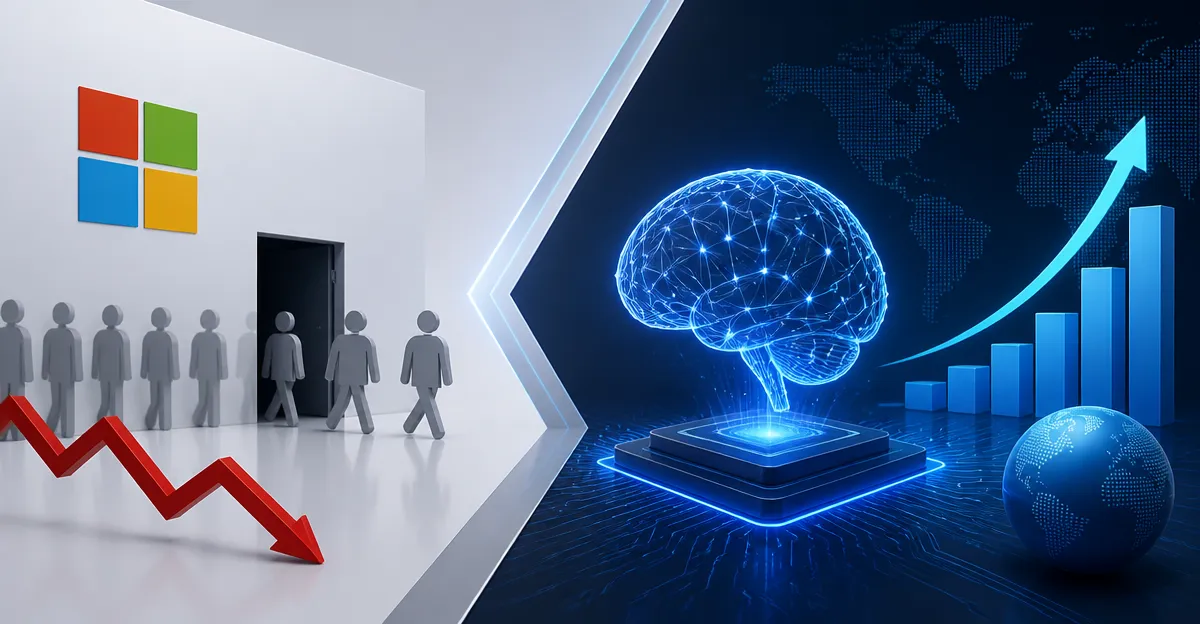
July 7, 2026, (Inside AI) — Microsoft shares fell 1.5 percent in early trading on Monday after the company announced it is laying off 4,800 employees, primarily in sales and customer support roles, as it redirects resources toward artificial intelligence and cloud computing.
The cuts, confirmed in an internal memo from CEO Satya Nadella, represent about 2.5 percent of Microsoft’s global workforce. The move underscores how even tech giants with soaring AI ambitions must shed legacy costs to fund the future.
Nadella framed the decision as a strategic pivot. “We are realigning our talent to high-growth areas like Azure AI and Copilot,” he wrote, according to sources familiar with the matter. The layoffs hit teams across the U.S., Europe, and Asia, with severance packages and outplacement support offered.
Microsoft has poured billions into AI, including a $13 billion partnership with OpenAI and the integration of generative AI across its product suite. Yet the restructuring reveals the painful trade-offs: as AI automates routine tasks, human roles become redundant.
The layoffs come amid a broader industry reckoning. While AI investment surges, companies are trimming non-engineering staff. Google laid off 12,000 workers in 2023, and Amazon cut 18,000. Microsoft itself eliminated 10,000 jobs last year. This new round signals that the AI transition is far from cost-free.
The Productivity Paradox of AI Investment
Microsoft’s move highlights a tension: AI promises efficiency, but implementing it requires massive upfront spending. The company’s capital expenditures hit $50 billion in its last fiscal year, largely for data centers and chips. To offset this, it must streamline operations.
Analysts note that sales and support roles are especially vulnerable. AI chatbots and automated tools can handle inquiries that once required human agents. “This is the classic innovator’s dilemma,” said Dr. Sarah Chen, a labor economist at Stanford. “Companies must cannibalize their own workforce to stay competitive.”
Yet some experts caution that over-reliance on AI could backfire. A recent study by the Brookings Institution found that customer satisfaction drops when AI replaces human interaction in complex scenarios. Microsoft’s challenge is to balance automation with empathy.
Global Ripples and Policy Implications
The layoffs have geopolitical dimensions. In India, where Microsoft has a large presence, the cuts could affect thousands of workers. The Indian government has been courting tech investment, but job losses may strain relations. “We are monitoring the situation closely,” said a spokesperson for India’s IT ministry.
In the U.S., the layoffs reignite debates about AI and labor. The Biden administration’s AI Bill of Rights emphasizes worker protection, but enforcement remains weak. Unions are pushing for retraining programs, but funding is limited.
Microsoft’s stock dip reflects investor unease. While AI hype has boosted tech shares, layoffs can signal deeper structural issues. “The market is asking: Is this a one-time reset or a sign of more pain to come?” said Mark Thompson, an analyst at Wedbush Securities.
Looking ahead, Microsoft plans to hire aggressively in AI research and engineering. But the transition will take years. For now, the human cost of the AI revolution is starkly visible.