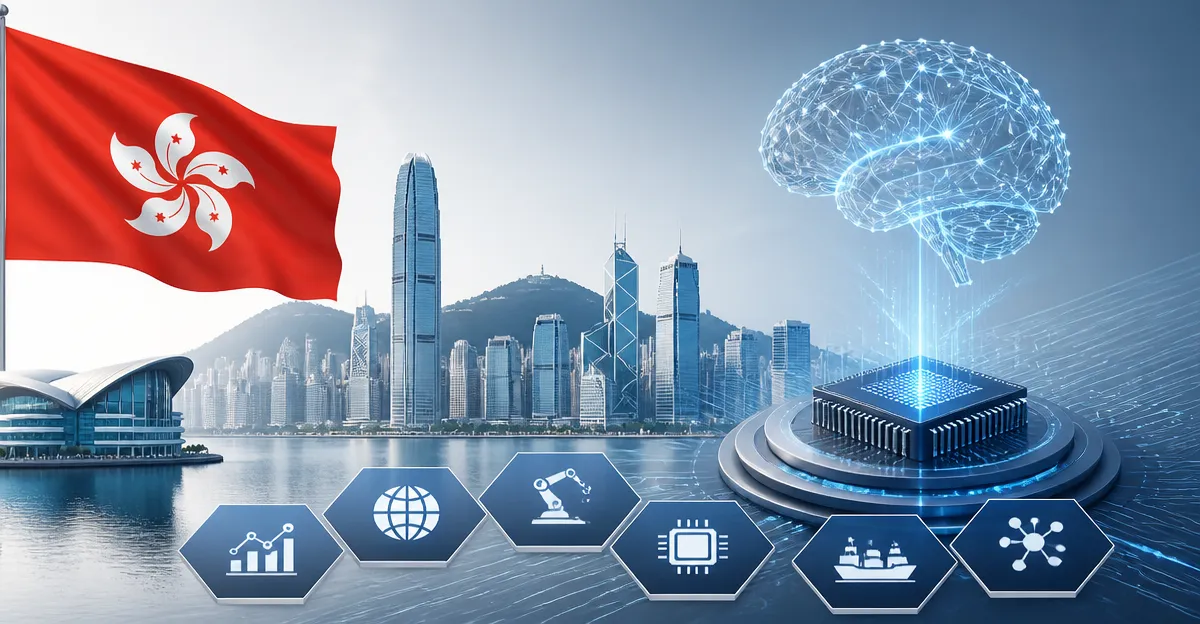
July 7, 2026, (Inside AI) — Hong Kong must craft a focused artificial intelligence strategy that plays to its unique strengths in finance, healthcare, and urban development rather than chasing every frontier technology, industry experts urged at a major conference on Tuesday.
The call came during a panel titled “Intelligence at Scale: Hong Kong’s AI-Powered Future” at the South China Morning Post’s China Conference. Speakers stressed that the city’s first five-year plan should avoid the trap of being too broad, instead doubling down on competitive scenarios where it already excels.
Zhang Xiaoyan, vice-president of the China Centre for Information Industry Development under the Ministry of Industry and Information Technology, delivered a sharp prescription. She noted Hong Kong’s relatively small economy means it cannot cover all frontier technologies.
“Hong Kong, because it’s relatively smaller in terms of economy, so your first five-year plan should not be a very broad one. Just like the mainland, especially in the AI sector, you do not need to cover all the frontier technologies,” Zhang said.
She pinpointed urban development, healthcare, and finance as prime targets, contrasting them with manufacturing, which accounts for just 1% of Hong Kong’s GDP. “You can pick the [strongest or] most competitive scenarios in Hong Kong, such as urban development, healthcare or finance, instead of manufacturing, because manufacturing in Hong Kong accounts for only 1 per cent of your general gross domestic product (GDP). So let us learn from the mainland, but also keep [in line] with Hong Kong’s features and advantages in AI development.”
Zhang also proposed cross-border data transfer pilot programmes to build high-level industry datasets with mainland partners. This aligns with Hong Kong’s role as a launch pad for Chinese enterprises and its unique position under “one country, two systems.”
The discussion surfaces as Hong Kong races to become an international innovation hub. The city has allocated over HK$150 billion in recent years for innovation and technology, but critics argue it lags behind neighbors like Singapore and Shenzhen in AI commercialization.
Playing to Strengths, Not Chasing Hype
Hong Kong’s financial sector, which contributes over 20% of GDP, is a natural AI battleground. The city hosts 160 licensed banks and is a global leader in IPO fundraising. AI applications in fraud detection, algorithmic trading, and regulatory compliance could cement its status.
Healthcare is another pillar. With an aging population and world-class medical research, AI-driven diagnostics and personalized medicine offer high returns. Urban development, including smart city projects like the Northern Metropolis, demands AI for traffic management and energy optimization.
Yet some experts warn against over-reliance on traditional strengths. “The risk is that we become too inward-looking,” said one tech investor who declined to be named. “Hong Kong needs to build AI platforms that serve global markets, not just local niches.”
Data governance remains a hurdle. Cross-border data flows are critical for AI training, but privacy laws and geopolitical tensions complicate transfers. Zhang’s pilot proposal echoes similar sandbox initiatives in Shanghai and Hainan, but Hong Kong’s legal autonomy could provide a testing ground for international standards.
Talent Wars and the Mainland Bridge
Talent acquisition is the linchpin. Hong Kong’s AI workforce is thin compared to Shenzhen’s sprawling tech ecosystem. The city has launched talent schemes like the Top Talent Pass Scheme, but retention is tough amid high living costs and competition from mainland giants.
“We need to attract not just researchers but product managers and entrepreneurs who can translate AI into business value,” said a panel attendee from a local fintech startup. “That means creating a more vibrant startup culture.”
The conference also highlighted Hong Kong’s role as a bridge for mainland AI firms seeking global expansion. With tightening US export controls on chips and technology, Hong Kong’s free flow of capital and information could make it a neutral ground for R&D and IP protection.
But the city must move fast. Neighboring Shenzhen has attracted over 2,000 AI enterprises, and Singapore has rolled out national AI strategies with billions in funding. Hong Kong’s five-year plan, expected later this year, will be a litmus test of its ambition.