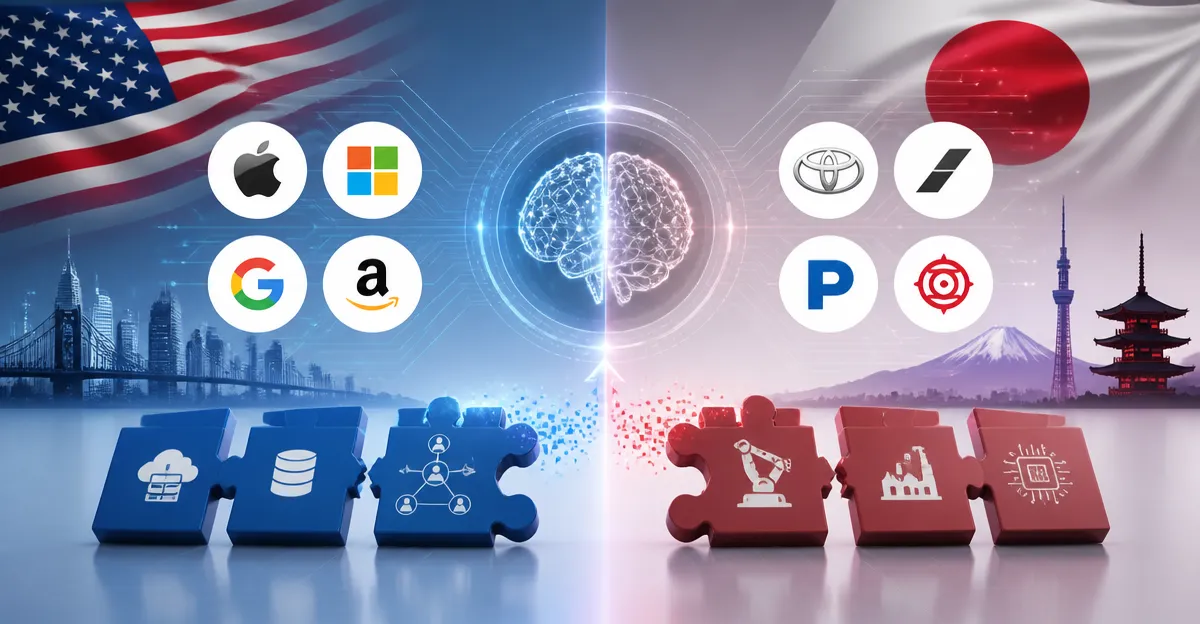
July 13, 2026, (Inside AI) — The United States and Japan are charting starkly different paths in corporate AI adoption, and the divergence offers critical lessons for global business leaders. New data reveals that while U.S. companies lead in deployment breadth, Japanese firms excel in depth and strategic integration.
Recent research from McKinsey found that 88% of U.S. companies use AI in at least one business function. In contrast, a Yano Research Institute study from last spring showed only 26% of Japanese companies reported the same. Private investment figures amplify the gap: the Stanford AI Index 2025 ranked the U.S. first globally in private AI investment in 2024, while Japan placed 14th.
But the numbers mask a more nuanced reality. Experts say Japanese firms, though fewer in number, are embedding AI more deeply into core operations. A 2025 study by the University of Tokyo and Hitachi found that Japanese manufacturers using AI reported a 15% higher efficiency gain than U.S. counterparts, attributed to meticulous process integration and workforce retraining.
“Japan’s strength isn’t in flashy pilots but in disciplined, long-term AI integration,” said Dr. Kenjiro Takada, a researcher at the National Institute of Advanced Industrial Science and Technology (AIST). “We see lower adoption rates because companies wait until they have a clear, measurable ROI plan.”
In the U.S., the rush to adopt has created a different challenge: scaling beyond experimentation. A 2025 MIT Sloan Management Review report noted that 60% of U.S. AI initiatives stall in the pilot phase, often due to data silos and cultural resistance. This suggests that high adoption numbers can be misleading if not paired with effective implementation.
The contrast extends to workforce strategies. Japanese firms prioritize upskilling existing employees, leveraging the country’s tradition of lifetime employment. NTT Data, for example, trained 200,000 staff in AI fundamentals by 2025. In the U.S., companies often rely on external hires and rapid tool deployment, which can lead to friction and underutilization.
“The American model is about speed and optionality, but it often neglects the human infrastructure,” said Sarah Lenz, an AI adoption consultant at Accenture. “Japan’s slower, people-centric approach may yield more sustainable productivity gains.”
Regulatory environments also shape these trajectories. The U.S. has a largely laissez-faire approach, encouraging experimentation but raising concerns about ethics and safety. Japan, meanwhile, has issued clear government guidelines and invested $1.2 billion in AI research centers, fostering a more controlled but trusted ecosystem.
Looking ahead, the two nations could learn from each other. U.S. firms might adopt Japan’s rigorous integration practices, while Japanese companies could embrace more agile experimentation. As AI becomes ubiquitous, the winners may be those who blend American speed with Japanese precision.