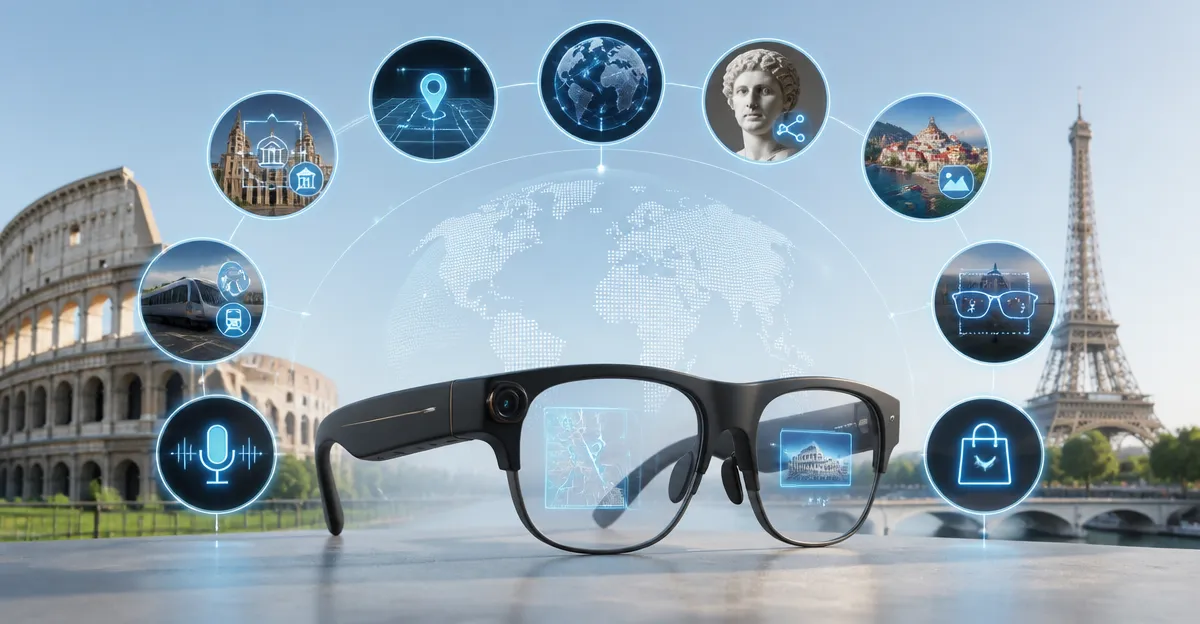
July 14, 2026, (Inside AI) — Meta’s latest AI-powered smart glasses are redefining travel by merging hands-free utility with real-time information, translation, and content capture, directly challenging smartphones as the default sightseeing companion.
The Ray-Ban Meta and Oakley Meta glasses, worn as prescription, transition, or sun lenses, connect via Bluetooth to the Meta AI app, storing media on the paired phone. Battery life often outlasts typical smartphones, ensuring critical moments aren’t missed.
A travel writer who regularly uses the device notes: “I’m a travel writer and always make sure I have Meta glasses with me to record the highlights of my trips, stay in touch with friends and family, and get immersed in a destination.”
At the core is a camera that scans surroundings and delivers spoken facts. A user can say, “Hey Meta, tell me about that landmark,” and receive historical context. For instance, at London’s Tower Bridge, the glasses recite construction dates and architectural style. The interaction continues: follow-up questions about an artist’s fate or a building’s purpose are answered in real time.
Read: Apple Targets June 2027 Launch for AI Glasses to Rival Meta and Google
Hands-free calling and messaging integrate with WhatsApp and Messenger. A double-tap or voice command answers calls, while messages are dictated without touching a phone. This proves useful when carrying luggage or navigating crowded streets.
Navigation links to Google or Apple Maps, offering turn-by-turn audio directions. Unlike staring at a screen, users appear less like tourists and more like locals, a subtle but meaningful shift in travel behavior.
Live translation supports English, Spanish, French, Italian, German, and Portuguese, with more languages promised. By saying “Hey Meta, start live translation,” the glasses listen and translate speech directly into the wearer’s ear. Menus and signs can also be interpreted, reducing reliance on phone screens.
Content creation reaches 3K video and high-definition photos, capturing a first-person perspective rather than a phone’s mediated view. Instant sharing to Facebook and Instagram, including live streaming, keeps social feeds updated from the traveler’s point of view.
Additional features include email recall, open-ear audio from Spotify or Amazon Music, and a memory aid for parking spots or hotel room numbers. A reminder is stored in the Meta AI app upon voice command.
Yet, questions linger. Privacy advocates have long warned about always-on cameras in public spaces. Meta’s previous wearable, the Ray-Ban Stories, faced backlash over recording indicators. The company now includes a capture light, but bystanders remain largely unaware they’re being filmed. In Europe, GDPR compliance adds complexity; in the U.S., no federal law mandates consent for recording in public.
Competing devices like Google’s rumored Project Iris and Apple’s Vision Pro take different paths—bulkier mixed reality versus sleek audio-visual assistance—but Meta’s fashion-first strategy with EssilorLuxottica targets mass adoption. The glasses’ utility for accessibility, such as describing scenes for visually impaired users, remains underdiscussed.
Read: Meta AI Launches Dedicated Mac App
Battery longevity claims lack independent verification. The three-minute video cap limits long-form capture, and translation accuracy in noisy environments hasn’t been rigorously tested. As AI glasses evolve, their impact on travel may hinge less on features and more on social acceptance and regulatory clarity.