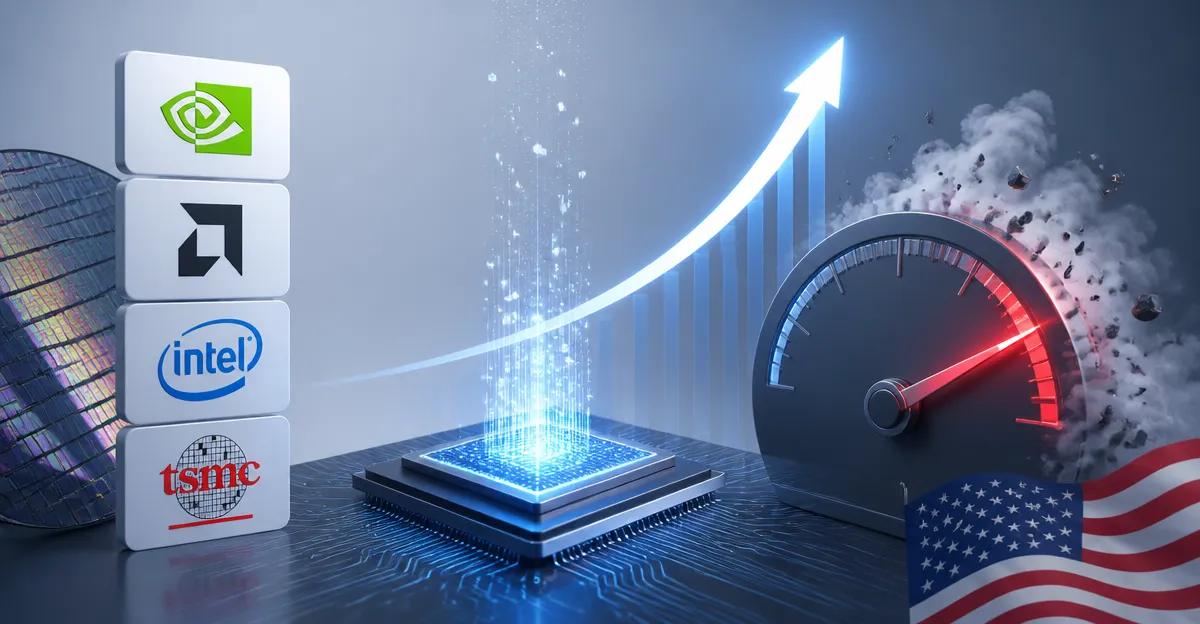
July 14, 2026, (Inside AI) — The artificial intelligence chip sector, which catapulted semiconductor stocks to an 83% surge earlier this year, is now grappling with a reality check. After weeks of volatility, investors are questioning whether the market’s sky-high expectations can be met.
Gina Martin Adams, chief equity strategist at HB Wealth, captured the mood in a recent interview with Reuters. She noted that the sector’s recent wobble reflects a market that sprinted too far ahead of tangible results.
“AI chip expectations are so high they’re impossible to satisfy,” Adams said.
The pullback, while sharp, does not signal an end to the AI demand cycle. Instead, it highlights a classic disconnect between long-term technological shifts and short-term investor impatience. The core drivers—explosive growth in data centers, large language model training, and edge inference—remain intact.
Behind the numbers lies a supply chain straining to keep pace. TSMC, the world’s most advanced chip manufacturer, has repeatedly warned of capacity constraints for its 3-nanometer and upcoming 2-nanometer nodes. These cutting-edge processes are essential for next-generation AI accelerators from Nvidia, AMD, and a growing roster of custom silicon from cloud titans like Google and Amazon.
Nvidia’s H200 and upcoming B100 GPUs are booked months in advance, with lead times stretching beyond 52 weeks for some configurations. This scarcity has fueled a secondary market where chips trade at premiums, but it also introduces fragility. Any hiccup in TSMC’s advanced packaging—specifically CoWoS (Chip on Wafer on Substrate) capacity—can ripple through the entire AI ecosystem.
Wall Street’s recalibration is not happening in a vacuum. In June, Broadcom reported a 12% sequential dip in AI-related networking revenue, triggering a sector-wide sell-off. Yet the same report showed annual AI revenue doubling, underscoring the danger of reading too much into quarterly noise. Analysts at Morgan Stanley recently cautioned that AI infrastructure spending is a multi-year buildout, not a one-time upgrade.
Geopolitical tensions add another layer of complexity. The U.S. government’s tightened export controls on advanced semiconductors to China have forced companies like Nvidia to redesign chips to comply with performance thresholds. These “China-compliant” GPUs, such as the H20, offer reduced performance but are still in high demand, creating a bifurcated market that complicates supply planning.
Meanwhile, the demand side shows no signs of cooling. Meta recently disclosed plans to deploy 350,000 Nvidia H100 equivalents by year-end, while Microsoft and OpenAI are reportedly exploring a $100 billion data center project. Such megaprojects absorb enormous chip volumes, leaving smaller players scrambling for allocations.
Adams’ observation points to a deeper truth: the AI chip market is trapped between exponential demand curves and linear manufacturing expansion. Building a new fab takes three to five years and costs upwards of $20 billion. Until new capacity comes online, the mismatch will persist, and stock valuations will remain volatile.
Investors who lived through the dot-com bubble may see echoes, but the analogy is imperfect. Unlike the late 1990s, today’s AI infrastructure buildout is backed by real revenue and transformative use cases. However, the lesson about inflated expectations remains relevant. As Adams implies, the question is not whether AI will change the world, but whether the market has priced in that change too quickly.
Looking ahead, the sector’s health will hinge on execution. TSMC’s planned 2-nanometer production in 2025, Intel’s ambitious 18A process, and Samsung’s gate-all-around technology all promise to ease bottlenecks. But until those chips are shipping in volume, the gap between hype and reality will test even the most bullish investors.