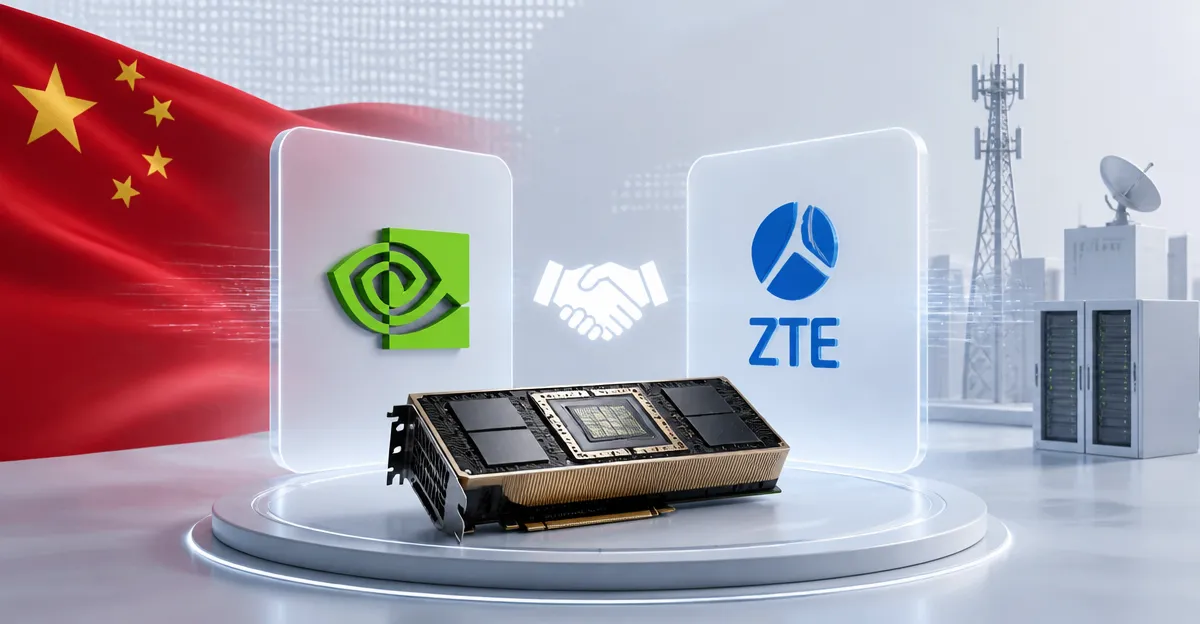
July 14, 2026, (Inside AI) — ZTE Kangxun Telecom, a unit of Chinese telecom giant ZTE Corp, along with server maker Maginfra, have received U.S. approval to purchase Nvidia’s advanced H200 AI chips, according to documents reviewed by Reuters and two sources familiar with the matter. A third firm, Zhuhai Hengqin Yunxiang Zhisheng Network Technology, a subsidiary of cloud computing company Kingsoft, has been cleared to buy comparable AMD chips. These approvals expand the roster of Chinese entities navigating the complex U.S. export licensing regime beyond the major internet platforms and distributors previously reported.
The Nvidia H200, a premier GPU for training and deploying large-scale AI models, sits at the heart of the U.S.-China technology standoff. Washington has progressively tightened controls on advanced chip exports to China since 2022, citing national security risks. Yet the Trump administration has permitted H200 sales, with proponents arguing it reinforces U.S. technological leadership and Nvidia lobbying to maintain access to China’s vast market.
The newly licensed firms join a group of about 10 Chinese companies, including Alibaba, Tencent, ByteDance, and JD.com, that Reuters reported in May had received U.S. clearance. However, at that time, no deliveries had occurred as the deals remained entangled in dual reviews by both Washington and Beijing. Now, some Chinese cloud providers have indicated to partners that they may soon obtain H200 chips, suggesting movement in import reviews by Chinese authorities.
The Licensing Labyrinth: Dual Sovereignty and Strategic Ambiguity
The export control process has become a bureaucratic chess match. The U.S. Bureau of Industry and Security (BIS) oversees licensing, but even with U.S. approval, companies must secure import clearance from China’s Ministry of Commerce. This dual-sovereignty hurdle creates a unique friction point. While the U.S. greenlights sales to boost its own industry, China’s simultaneous push for domestic alternatives like those from Huawei’s Ascend series introduces deliberate uncertainty. Beijing’s calculus may involve slowing imports to nurture indigenous capabilities, a tactic that leaves U.S. chipmakers in limbo.
This dynamic reflects a broader historical pattern. Since the 2018 ZTE ban and the 2020 SMIC entity listing, export controls have evolved from blunt instruments to finely targeted measures. The H200, which began shipping globally in 2024, represents a middle ground—less restricted than the H100’s China-specific variants but still potent enough to advance AI development. The current approvals suggest a transactional approach: allow sales of current-generation chips while blocking cutting-edge designs, a strategy that may delay but not derail China’s AI ambitions.
Market Realities and the Shadow of Substitution
For the licensed firms, the path forward is fraught with commercial and political risk. ZTE, still recovering from its 2018 near-collapse due to U.S. sanctions, is diversifying into AI infrastructure through its Kangxun unit. Maginfra, a lesser-known server maker, and Kingsoft’s subsidiary represent the next tier of Chinese tech firms seeking to build out AI capabilities. Their inclusion signals that U.S. licensing extends beyond hyperscalers to specialized equipment providers, potentially reshaping the competitive landscape.
Yet the window may be narrow. China’s domestic GPU ecosystem, led by Huawei, Biren Technology, and Moore Threads, is maturing rapidly. If import delays persist, these firms could lose first-mover advantages. Meanwhile, Nvidia and AMD face a delicate balancing act—serving shareholders through Chinese revenue while navigating geopolitical headwinds. Neither company responded to requests for comment, nor did the BIS or China’s Ministry of Commerce, underscoring the sensitivity of the topic.
The reported progress in import reviews hints at a possible thaw, but the history of U.S.-China tech policy is littered with false starts. As one source noted, “Some Chinese cloud firms have recently told partners and clients they may soon be able to obtain H200 chips.” This cautious optimism must be weighed against the reality that no deliveries have been confirmed, and the regulatory landscape can shift overnight with a single executive order or ministry directive.
The licensing of these three firms adds a new layer to the narrative of controlled competition. It reveals a pragmatic, if inconsistent, U.S. policy that balances restriction with commercial interests, while China tests the boundaries of self-reliance. For the global AI supply chain, the message is clear: access is conditional, and the rules are written in real time.