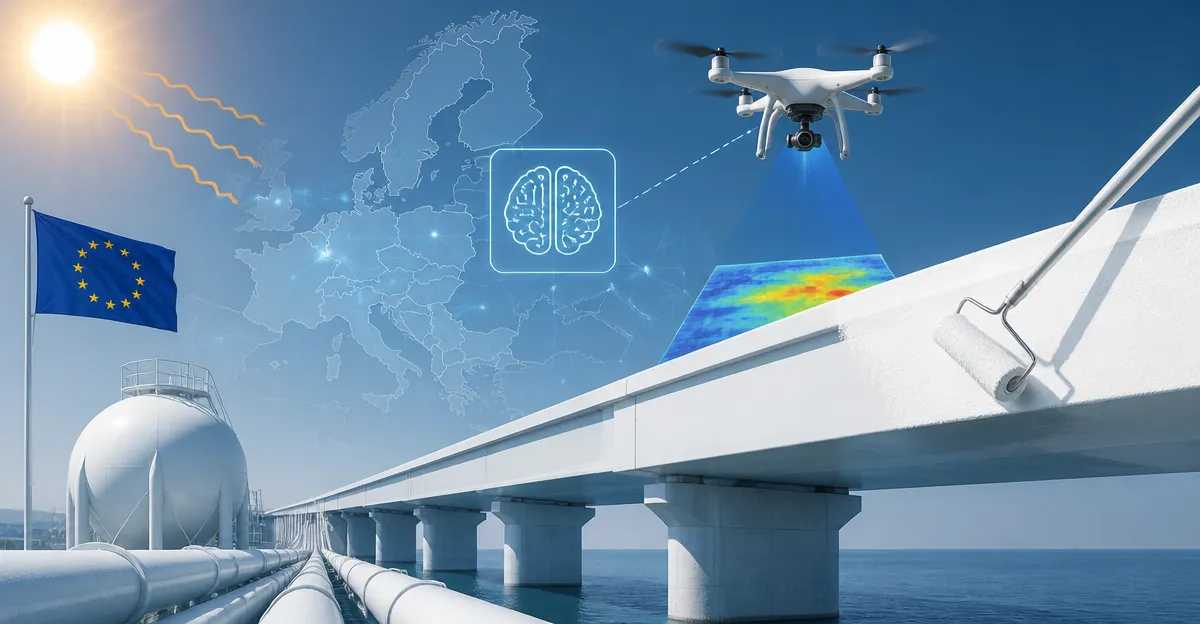
July 15, 2026, (Inside AI) — Europe is deploying drones, AI sensors, and even white paint to shield its aging infrastructure from heatwaves that are buckling railways, melting roads, and straining power grids. The continent, long engineered for moderate climates, is scrambling to adapt as temperatures soar beyond historical norms.
At Oslo airport on Wednesday, workers sprayed 9,000 litres of water onto the tarmac to prevent softening under aircraft weight, with temperatures hitting 30°C—10°C above normal. The fire brigade’s intervention is a stark symbol of how even Nordic nations, accustomed to bitter cold, are now confronting dangerous heat.
“In Norway, the asphalt must withstand both extreme cold and fairly warm temperatures,” said Jørn Arvid Remark, operating engineer at state-owned airport operator Avinor, noting the airport is testing new heat-resistant asphalt.
Across Western Europe, temperatures on Wednesday were 5.5°C above the July 15 average, according to the Reuters Climate Monitor. The heat is not just an inconvenience—it is an economic threat. A 2025 report by leading central banks estimated extreme weather could slash euro zone GDP by up to 4.7% by 2030.
Read: AI Will Boost Fossil Fuel Production More Than Green Energy, Study Finds
“Our infrastructure is in no way prepared for the extreme weather events that we’re going to see,” said Chris Dodwell, co-head of sustainability at Impax Asset Management. He emphasized that heatwaves, once rare, are now regular events.
Rails Buckle, But Storms Wreak Havoc
Europe’s railways are on the front line. An EU report in April found that over 70% of rail managers face growing disruption from extreme weather. Between 2015 and 2024, weather-related interruptions cost the equivalent of one to three years of railway service across the region.
Heat expands tracks and causes points, signals, and power systems to fail. But the real danger often follows the heatwave. “The most critical issue for rail networks is not the heat itself, but the thunderstorms, strong winds and landslides that often follow heatwaves,” said Oliviero Baccelli, a professor at Milan’s Bocconi University. “Italy has already experienced significant disruptions to its railway network, particularly on Alpine routes, as a result of climate-related events.”
Northern countries like Britain face unique challenges because their rail infrastructure was designed for a narrower temperature range. John Lawrence, chair of the IET Railway Technical Network, said many components are “in essence frozen in time.” He noted operators are exploring more stable sleeper designs and technologies like AI and drones to “speed up the amount of track that can be inspected and monitored.”
Britain’s Network Rail has pledged £2.6 billion ($3.5 billion) between 2024 and 2029 to weatherproof its network. But not all fixes are costly. Stockholm’s transport authority spent about 100,000 Swedish crowns ($10,300) painting metro track sections white in May and June to reflect heat and reduce buckling risk.
Read: US Builds Twice as Much Gas-Fired Capacity as China in AI Boom
Learning from the Desert, Redesigning for the Future
Martin Wilson, engineering director at French rail equipment manufacturer Alstom, believes Europe can learn from systems like the Riyadh Metro and Dubai tram, designed for temperatures above 50°C. “Today’s heatwaves are often more intense, more frequent and longer-lasting,” he said. “Rising temperatures are increasingly challenging rail systems across Europe.”
Roads face similar pressures. Northern European highways were built for freeze-thaw cycles, while southern countries like Spain use asphalt blends for prolonged heat. Finding a balance is harder as winters stay cold and summers get hotter. “They may have to adjust their approach,” said José Pablo Sáez Villar of the Spanish Civil Engineers Association, referring to planners in northern Europe.
Paris transport operator RATP has created a heatwave contingency unit and will finalize a climate adaptation plan by year-end. In Norway, warmer, wetter weather is reshaping design standards. “Roads are going to be made more robust,” said Grethe Vikane, head of social development and climate at the Norwegian Public Roads Administration. “So they can withstand both the challenges already being experienced and the consequences of expected climate change.”
As Europe bakes, the race to retrofit its infrastructure with a mix of high-tech and low-tech solutions is only beginning. The continent’s ability to keep trains running, planes landing, and traffic moving will depend on how quickly it can adapt to a climate it was never built for.