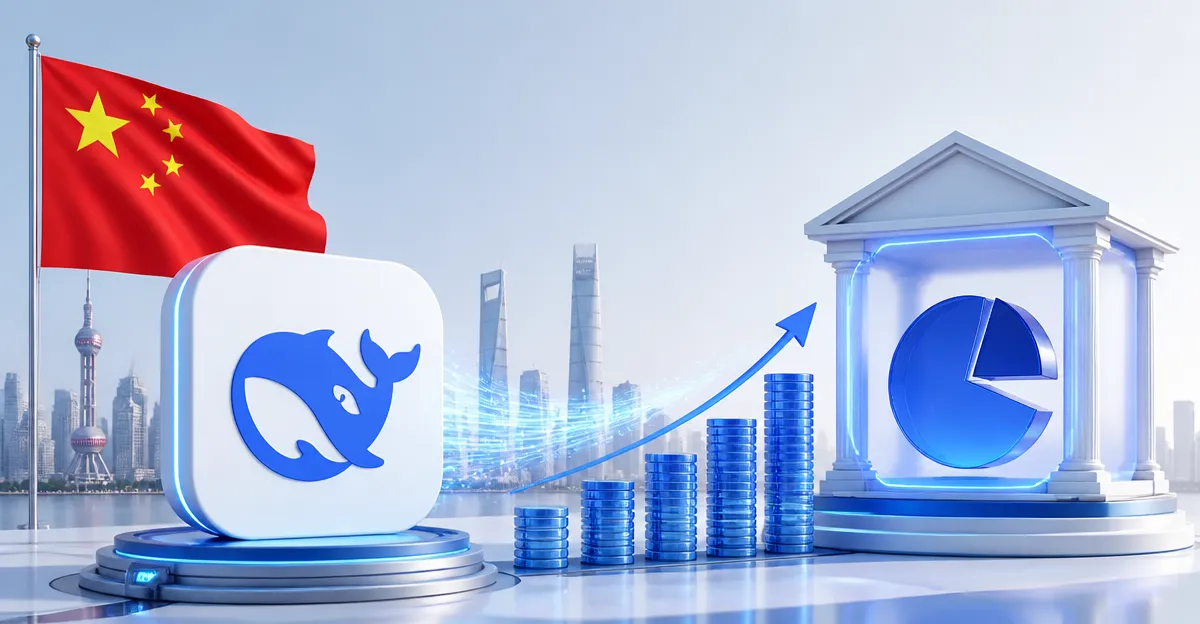
July 15, 2026, (Inside AI) — Chinese AI startup DeepSeek is launching a fresh fundraising round targeting a valuation of approximately 500 billion yuan ($74 billion), two sources told Reuters. The move comes ahead of a potential mainland initial public offering on Shanghai’s STAR Market.
The Hangzhou-based company, which stunned global markets in 2025 with low-cost AI models rivaling U.S. systems, is seeking up to 50 billion yuan in the new round, a third person said. This follows a $7.4 billion raise in June at a post-money valuation of about 450 billion yuan.
The rapid succession of fundraisings highlights fierce investor demand but also the escalating costs of AI leadership. DeepSeek now faces steep bills for computing power, data centers, and engineering talent, forcing a strategic pivot after years of self-funding by founder Liang Wenfeng through his hedge fund High-Flyer.
The company has started early deliberations on an IPO on Shanghai’s Nasdaq-style STAR Market, five sources said. An internal target aims to complete the filing this year, one source noted. All sources spoke anonymously as the plans are private and subject to change.
DeepSeek did not respond to a request for comment. Bloomberg first reported the IPO preparations on Tuesday, while the Financial Times said the firm was weighing a fundraising at a valuation of at least 480 billion yuan.
The Price of Ambition: From Bootstrapping to Big Capital
DeepSeek’s cost-efficient models once rattled Silicon Valley, but the financial reality of AI development has caught up. After its June fundraising, the company announced plans to double staff across departments, including data centers and AI agents—systems that perform tasks with minimal prompting.
Some initiatives demand massive capital. Reuters reported this month that DeepSeek is developing its own AI inference chip and has discreetly ramped up hiring of chip-design engineers. Such hardware ambitions mark a significant escalation from its software roots.
“DeepSeek had long stood out in China’s AI sector for rejecting outside funding,”
sources previously told Reuters. Founder Liang Wenfeng had largely bankrolled the company using his quantitative hedge fund High-Flyer before its recent external financing.
But staying at the frontier now requires deep pockets. DeepSeek faces stiff domestic competition from tech giants ByteDance and Alibaba, as well as well-funded startups like Z.ai, Moonshot, and MiniMax.
In the June round, Liang personally committed 20 billion yuan. Tencent Holdings and battery giant CATL invested 10 billion yuan and 5 billion yuan respectively, becoming the largest external shareholders. Other backers include China’s national AI fund, NetEase, JD.com, IDG Capital, Loyal Valley Capital, Monolith Management, and Shixiang Capital.
The state-backed fund’s participation underscores DeepSeek’s strategic role in Beijing’s push for domestic AI champions and reduced reliance on foreign technology. Yet the rush to public markets raises questions about sustainability. Some analysts warn that Chinese AI valuations may be inflated by nationalistic fervor rather than revenue fundamentals.
IPO on the STAR Market: A Test of Maturity
A listing on the STAR Market would subject DeepSeek to stricter disclosure and governance standards. While the board has nurtured tech giants, it has also seen volatility and regulatory tightening. For DeepSeek, the move signals a transition from research lab to commercial powerhouse.
The company’s trajectory mirrors a broader shift in China’s AI landscape, where state guidance and private capital are converging to build national champions. But the path is fraught: export controls on advanced chips, talent wars, and global skepticism about Chinese AI could complicate its ambitions.
As DeepSeek races toward an IPO, its ability to balance innovation with fiscal discipline will be closely watched. The fresh capital may fuel its next leap, but the real test lies in delivering on the hype that has made it a household name in tech circles worldwide.