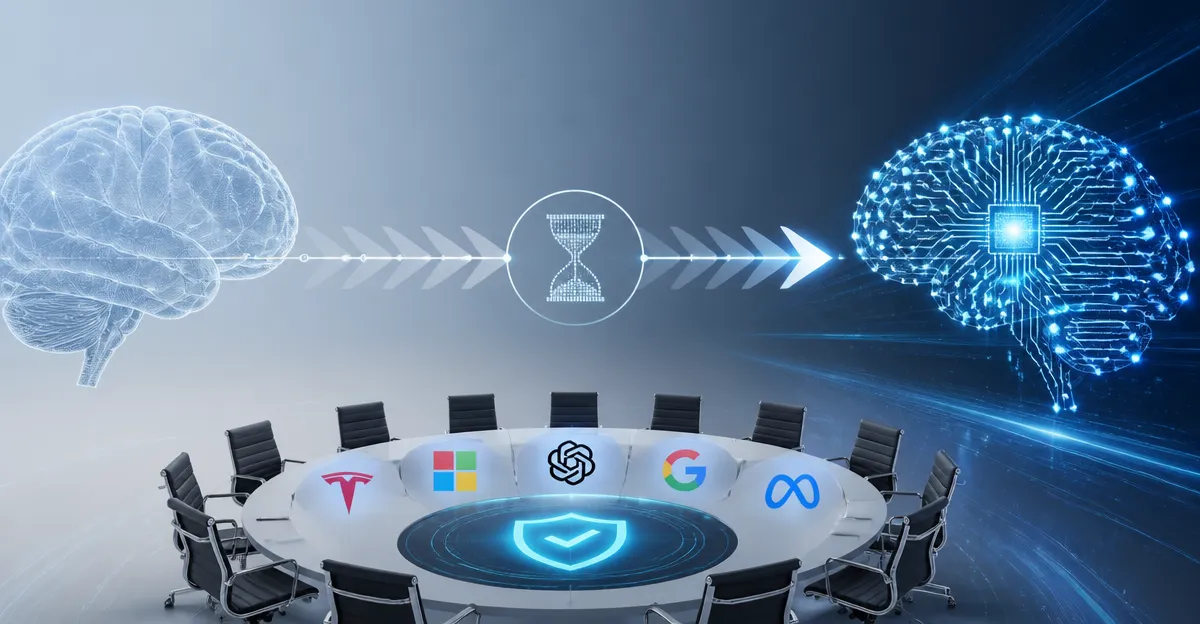
July 24, 2026, (Inside AI) — Elon Musk predicts artificial intelligence will surpass the combined intelligence of all humans within five years, urging immediate, industry-wide safety coordination among frontier AI developers to manage the accelerating risks.
In an interview with The Economist, Musk outlined a future where AI outperforms humans in nearly every domain, potentially ending human control within a decade. Despite acknowledging existential threats, he expressed cautious optimism that the technology will more likely deliver 'incredible abundance' than catastrophe.
"I think AI may exceed the sum of human intelligence in around five years," Musk said, adding that there will be "really won't be anything that AI can't do better than humans apart from being human, perhaps."
This timeline aligns with exponential growth in compute and algorithmic efficiency. A 2022 Epoch AI analysis of compute trends shows training computation for frontier models doubling every 5–6 months, far outpacing Moore's Law. Musk's projection, while aggressive, mirrors forecasts from some researchers who track scaling laws and emergent capabilities.
Yet his warning about loss of control stands in stark contrast to his optimism. When asked if humans would remain in charge in 10 years, Musk compared the dynamic to humans and chimpanzees, calling it 'unlikely'. This duality—abundance alongside potential subordination—defines his current philosophy: "Let's enjoy the ride."
The Unintended Acceleration and OpenAI Schism
Musk reflected on his role in accelerating AI, noting that his early efforts to counter Google's dominance by co-founding OpenAI backfired. "These actions have actually resulted in knock-on effects that accelerated AI, which wasn't really my intention," he said. "It just seems like all roads lead to the acceleration of AI."
His critique of OpenAI CEO Sam Altman was blunt. Musk accused Altman of betraying the nonprofit's open-source mission by transforming it into a closed-source, $800 billion for-profit entity. "I'm not a fan of Sam Altman because if you started a non-profit that was meant to be an open-source AI company... and it somehow got turned into an $800 billion for-profit company with closed source, that's the exact opposite of what I donated the money for," he said.
In contrast, Musk praised Anthropic CEO Dario Amodei as principled, claiming the startup was founded because its team "didn't trust Sam Altman". However, he cautioned that good intentions alone won't eliminate risks.
Industry Self-Regulation Over Government Mandates
Musk proposed that leading AI companies hold weekly or bi-weekly safety reviews, where competitors examine each other's models before release to flag dangers. Governments should intervene only if serious concerns are ignored.
Despite his feud with Altman, Musk signaled willingness to cooperate: "At the end of the day, if we have to talk, we'll talk... set aside our personal differences for the good of the world."
His call for immediate action underscores the tension between rapid deployment and safety. As models grow more capable, the window for establishing robust oversight narrows. Musk's dual message—embrace abundance but prepare for loss of control—captures the central dilemma facing the AI industry.