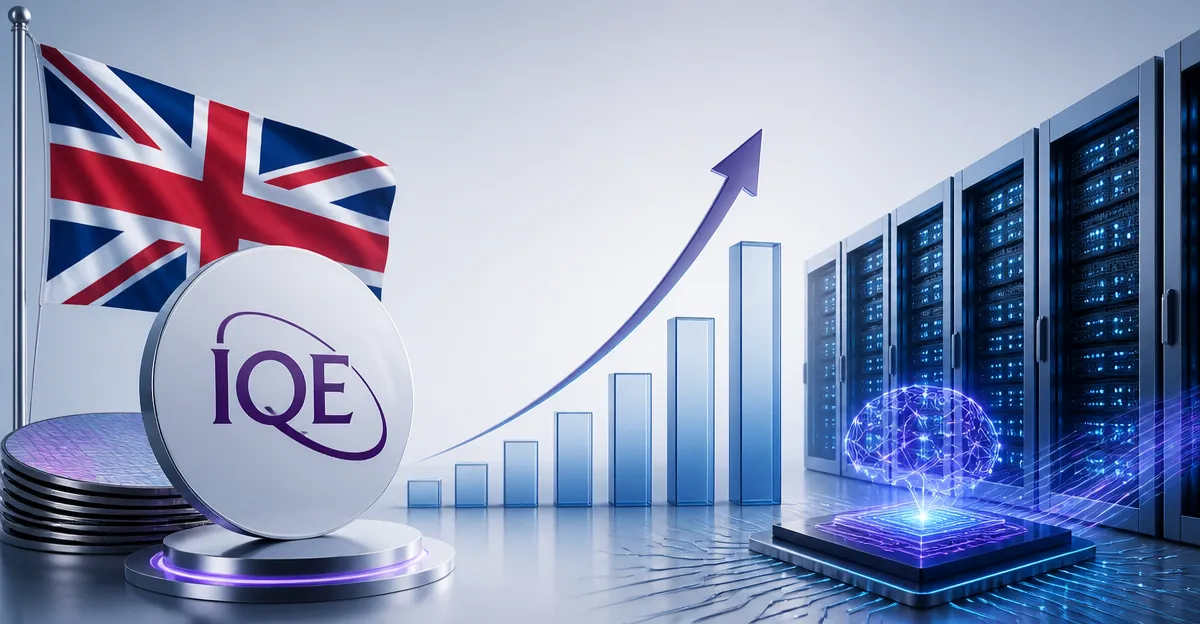
September 7, 2026, (Inside AI) — British chip components maker IQE Plc swung to a half-year core profit of £6 million ($8.11 million), reversing a loss of £0.4 million from the same period last year. The Wales-based company credited surging demand from AI infrastructure, data centres, and defence customers.
The turnaround marks a sharp reversal for IQE, which had been squeezed by a slowdown in the electronics market and disruption linked to U.S. tariffs. Now, the company is riding a wave of AI-driven investment in data centre construction, where its advanced semiconductor wafers are critical components.
IQE said first-half performance exceeded management expectations and that positive momentum has continued into the second half. The company reiterated its full-year forecast, signaling confidence that the AI infrastructure boom will sustain demand for its products.
The results highlight a broader shift in the semiconductor supply chain. While consumer electronics and automotive chip demand has cooled, spending on AI accelerators and networking equipment has surged. IQE, which specializes in compound semiconductor wafers used in photonics and radio frequency applications, sits in a key niche of that market.
Industry analysts note that AI data centres require high-speed optical interconnects and advanced RF components, both of which rely on materials like gallium arsenide and indium phosphide. IQE is one of the few global suppliers of these wafers, giving it pricing power as demand grows.
The company also announced plans to move its listing from London's Alternative Investment Market to the Main Market, targeting completion in the first half of 2027. The upgrade could broaden its investor base and improve liquidity, a move often seen as a sign of corporate maturity.
AI Spending Shifts Semiconductor Fortunes
IQE's rebound mirrors a wider trend in the semiconductor industry. Companies exposed to AI infrastructure have outperformed those tied to smartphones, PCs, and industrial electronics. Chipmakers like TSMC and Broadcom have reported strong AI-related revenue, while legacy analog and microcontroller suppliers have struggled.
The U.S. tariff disruptions that hurt IQE earlier were linked to trade tensions affecting global supply chains. But the company's pivot toward AI and defence customers has offset those headwinds. Defence spending, particularly in Europe, has also risen sharply, adding another demand driver for specialized semiconductor components.
IQE's adjusted core profit figure excludes certain one-time items, giving a clearer picture of operational performance. The £6 million profit is modest in absolute terms, but the swing from loss to profit underscores how quickly the AI cycle can reshape a small-cap supplier's fortunes.
Some analysts caution that AI infrastructure spending could face a correction if hyperscaler capital expenditure slows. However, IQE's reiterated forecast suggests its order book remains solid through year-end.
Main Market Move Signals Ambition
The planned move to the Main Market is a strategic step for IQE. Companies on the Alternative Investment Market often face lower valuations and less institutional coverage. A Main Market listing could attract more long-term investors and reduce share price volatility.
The timing of the move, targeted for the first half of 2027, aligns with expectations that AI infrastructure demand will continue growing. IQE's management appears to be positioning the company for a larger capital base to fund capacity expansion.
For now, the company's focus remains on executing its current growth plan. With AI data centre construction accelerating globally, IQE's specialized wafers are likely to remain in high demand. The half-year profit is a clear signal that the company has turned a corner after a challenging period.