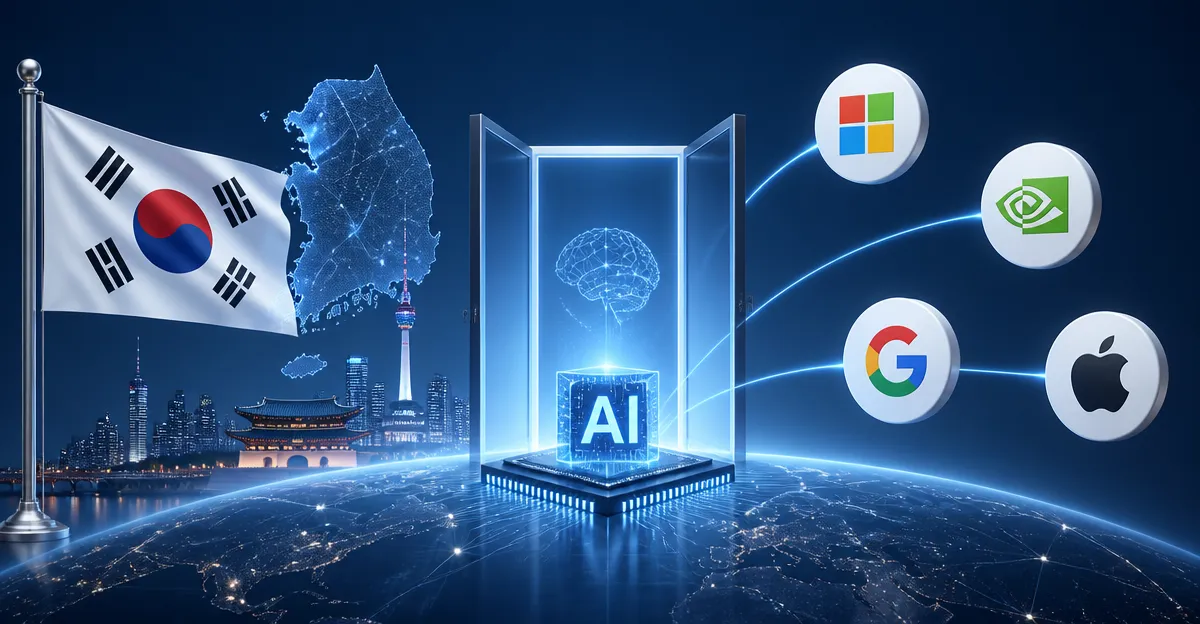
July 25, 2026, (Inside AI) — South Korean President Lee Jae Myung convened a high-stakes AI summit in San Francisco on Friday, gathering CEOs from Nvidia, OpenAI, Anthropic, and Broadcom alongside South Korean conglomerate leaders. The meeting aimed to cement South Korea's role as a global AI supply chain hub and deepen technological cooperation with the United States.
The summit drew approximately 150 executives, investors, and researchers. Lee delivered a keynote unveiling the "San Francisco AI Declaration," a framework for joint AI development and supply chain integration. He held separate bilateral talks with Jensen Huang, Sam Altman, Dario Amodei, and Hock Tan before the main event.
"I'd like to present a vision for the future of AI and propose global cooperation to make it happen," Lee said.
"South Korea will make the leap as a key nation in the global AI supply chain."
The declaration signals Seoul's intent to leverage its semiconductor dominance and manufacturing prowess to attract foreign investment and co-development deals. South Korean officials framed the summit as a direct response to intensifying global competition for AI infrastructure, where nations like Japan and Singapore have also courted hyperscalers with subsidies and streamlined regulations.
Nvidia and SK Group's $500 Billion AI Infrastructure Pact
On the summit's sidelines, Nvidia and SK Group announced a massive joint initiative exceeding $500 billion, focusing on AI data centers and next-generation memory. SK Telecom will construct a 2-gigawatt data center powered by Nvidia's upcoming Vera Rubin chips and SK Hynix HBM4 high-bandwidth memory, targeting a 2027 launch.
The deal underscores Nvidia's deepening reliance on SK Hynix for advanced memory, a critical bottleneck in AI training. HBM4, expected to offer 1.5 TB/s bandwidth per stack, could significantly reduce latency for trillion-parameter models. This partnership mirrors Nvidia's strategy to lock in supply chains early, as seen in its prior agreements with TSMC for advanced packaging.
However, the scale of the investment raises questions about power availability and regulatory hurdles. South Korea's grid, already strained by chip fabrication plants, may require substantial upgrades to support multi-gigawatt data centers. The government has not yet detailed energy infrastructure plans, a gap that could delay timelines.
Samsung and Hyundai Join Forces with Global AI Leaders
South Korean industry heavyweights Samsung Electronics Executive Chairman Jay Y. Lee, SK Group Chairman Chey Tae-won, Hyundai Motor Group Executive Chair Euisun Chung, and Naver founder Lee Hae-jin also attended, signaling broad corporate alignment. Samsung's presence is notable given its rivalry with SK Hynix in the memory market, yet both firms appear to be cooperating on national AI goals.
Hyundai's participation hints at AI integration in autonomous vehicles and robotics, areas where it has invested through acquisitions like Boston Dynamics. Naver, operator of South Korea's dominant search engine, could leverage OpenAI or Anthropic models to enhance its AI offerings, competing with Google's Gemini in the Korean language market.
Despite the fanfare, the summit lacked concrete commitments from U.S. firms beyond the Nvidia-SK deal. OpenAI and Anthropic have not announced new Korean data centers or partnerships, a silence that may reflect the high cost of compliance with South Korea's data localization laws. The country's Personal Information Protection Act imposes strict cross-border data transfer restrictions, potentially complicating cloud-based AI services.
President Lee's push comes as South Korea faces a demographic crunch and slowing productivity growth, making AI a national economic priority. The government has allocated $7 billion for AI R&D through 2030, but critics argue that bureaucratic red tape and a rigid labor market hinder startup innovation. The summit's success will ultimately depend on follow-through, not photo ops.