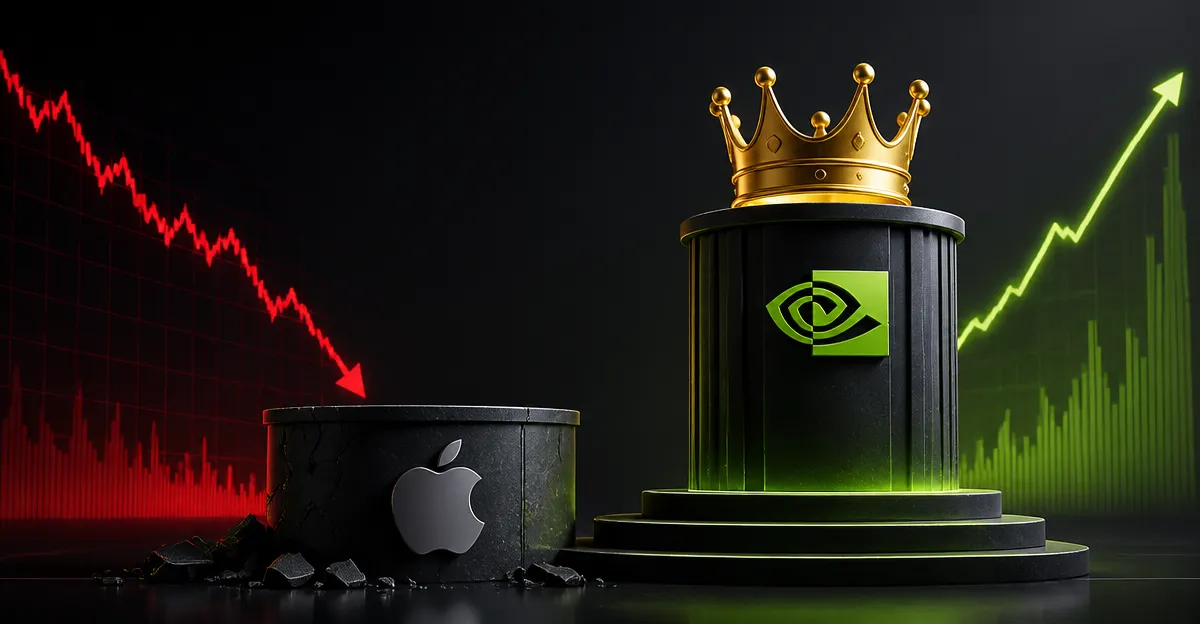
August 1, 2026, (Inside AI) — Apple shares plunged nearly 10 percent on Friday, erasing almost $500 billion in market value after the company issued a disappointing forecast. The decline, the worst single-day drop since March 2020, hands the title of the world’s most valuable company back to Nvidia, just days after Apple reclaimed it.
The selloff was triggered by a revenue growth forecast of 9 to 11 percent for the current quarter, falling short of Wall Street’s roughly 12 percent estimate. The shortfall stems from a severe shortage of key components as the AI-driven data center boom strains global supply chains.
On his final earnings call before handing the CEO role to John Ternus in September, Tim Cook called the shortages “very significant” and said the company had limited options. Big tech firms are buying up advanced chip-making capacity and memory chips for AI data centers, driving shortages and price increases that are expected to shrink both the PC and smartphone markets this year.
Apple had partially offset rising memory costs by drawing on stockpiled inventory, but Cook said that buffer is running out, leaving the company unable to meet strong demand for iPhones and Macs due to processor shortages. This supply crunch highlights a structural shift in the semiconductor industry, where AI workloads are consuming an ever-larger share of advanced packaging and high-bandwidth memory (HBM).
Softer growth in the services division also weighed on otherwise strong results for the June quarter. This trend concerned investors because it coincided with strong iPhone sales, which normally boost revenue from App Store purchases and services like Apple Music and Apple TV. The decoupling suggests that Apple’s ecosystem lock-in may be weakening under regulatory pressure and competitive alternatives.
Analysts at Morgan Stanley said Apple’s leverage over its supply chain appeared to be in question, adding that the impact of AI on products and services remained unclear. At least four brokerages cut their price targets, while three raised theirs, moving the median target to $330, according to LSEG data. Shares of Apple had risen 22.7 percent for the year as of Thursday’s close.
Apple’s custom silicon strategy, while advanced, may not insulate it from memory and packaging bottlenecks that are increasingly controlled by a few suppliers like SK Hynix and Samsung.
Cook’s Final Warning as CEO Exposes Apple’s AI Dilemma
Cook’s candid remarks on his last earnings call underscore a painful irony: Apple’s historic strength in supply chain management is being tested by an AI boom it has yet to fully monetize. While Nvidia’s GPUs are the picks and shovels of the AI gold rush, Apple’s AI features remain largely on-device and incremental. The company’s Apple Intelligence suite, launched in 2025, has not driven a significant upgrade cycle, and the Vision Pro’s mixed reality bet has yet to scale.
Investors are now questioning whether Apple can sustain premium pricing if component costs continue to rise. The average selling price of iPhones has increased 18 percent over the past three years, but further hikes could dampen demand in an already saturated market. Meanwhile, Nvidia’s data center revenue is projected to exceed $150 billion this fiscal year, dwarfing Apple’s services segment.
The leadership transition to Ternus, a hardware engineering veteran, may signal a renewed focus on operational efficiency. However, without a breakthrough AI product or a relaxation of trade restrictions affecting chip access, Apple’s valuation premium could erode further. As the AI infrastructure buildout accelerates, the company that once defined mobile computing finds itself scrambling for the basic building blocks of its own devices.