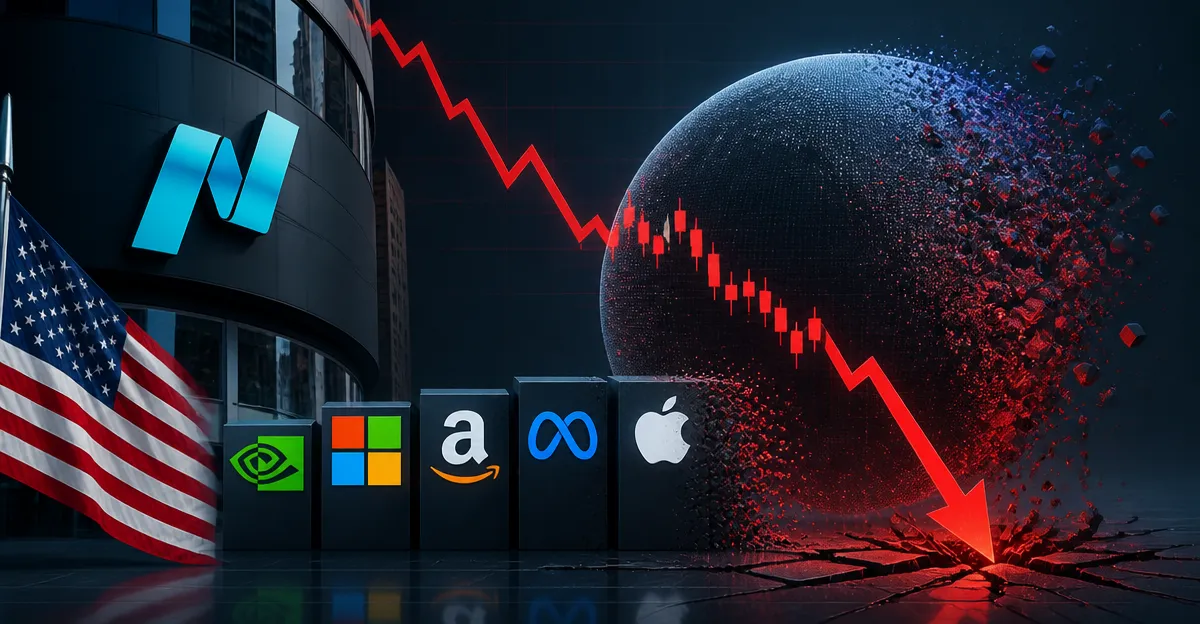
October 30, 2026, (Inside AI) — The Nasdaq 100 is on course to shed more than $2 trillion in market value this month, a decline slightly larger than the entire valuation of SpaceX. The index has dropped 5.8% in October as third-quarter earnings from the largest technology companies intensified scrutiny of whether massive artificial intelligence investments can produce returns fast enough to justify them.
The selloff marks a shift in how investors are treating the AI trade. For three years, revenue growth across the Magnificent Seven appeared to validate nearly any level of spending. That patience is now colliding with rising borrowing costs and capital expenditure forecasts that keep climbing.
Alphabet's Record Slide Signals New Anxiety
Alphabet posted its largest single-day percentage decline on record on Thursday, after weak search advertising results and a sharp acceleration in cash burn. The company raised its spending forecasts alongside Meta Platforms and Amazon.com, which are racing to expand AI infrastructure.
Meta's plan for a record $97.5 billion fund raise sharpened concerns about shareholder dilution. It also raised a broader question: whether other large technology companies will increasingly turn to capital markets to finance AI buildouts.
Read: Big Tech Returns Smallest Share of Cash to Shareholders in 15 Years as AI Spending Surges
Microsoft and SpaceX broke from the gloom with results that showed AI spending beginning to pay off. Microsoft is reportedly planning to raise about $25 billion through its first US investment-grade bond sale in more than nine years. Meta, Amazon and Alphabet have issued hundreds of billions of dollars in bonds over the past four years, a reliance on debt that now worries investors.
The concern has spread beyond equities into credit markets. Investors are beginning to price in the possibility that rising financing costs, combined with slower returns on AI spending, could squeeze companies once viewed as insulated from macroeconomic pressure.
"It may be that we've overestimated how strong the growth might be, but they're not going negative in aggregate," John Bilton, global head of strategic research at Multi-Asset Solutions, said. "We have an insatiable and growing demand for data."
The debt picture deserves particular attention because it changes the character of the AI race. When hyperscalers funded expansion from operating cash flow, a slow payoff was a patience problem. When they fund it with bonds, a slow payoff becomes a refinancing problem, and credit investors price that risk faster than equity holders do. The spread widening in AI-linked debt is the metric to watch, not the index drawdown.
Capital Spending Forecasts Keep Climbing
Morgan Stanley forecasts that capital spending on AI infrastructure overall will surpass a trillion dollars next year. J.P. Morgan expects global AI capex to reach $5.5 trillion by 2030, with $900 billion spent in 2026 alone.
The bank also noted that this year's AI capex by Amazon, Alphabet, Meta, Oracle and Microsoft would likely equal their cumulative spend since the November 2022 launch of ChatGPT. That comparison captures the scale of the acceleration in under four years.
Read: AI Spending Fears Trigger Global Stock Selloff, Bond Rally
Revenue has remained strong across the Magnificent Seven since ChatGPT's launch. Amazon Web Services continued to accelerate. Meta offered better-than-expected revenue growth and an upbeat outlook. Microsoft forecast strong cloud growth in its latest report.
Big Tech has historically spent heavily on infrastructure to build cloud computing, online advertising and e-commerce businesses. The AI boom has pushed capital expenditure to levels without precedent in the sector.
Apple is set to report next week, and AI bellwether Nvidia is due in mid-November. Both results will test whether the October selloff reflects a lasting repricing of AI economics or a temporary reset after an extended run.