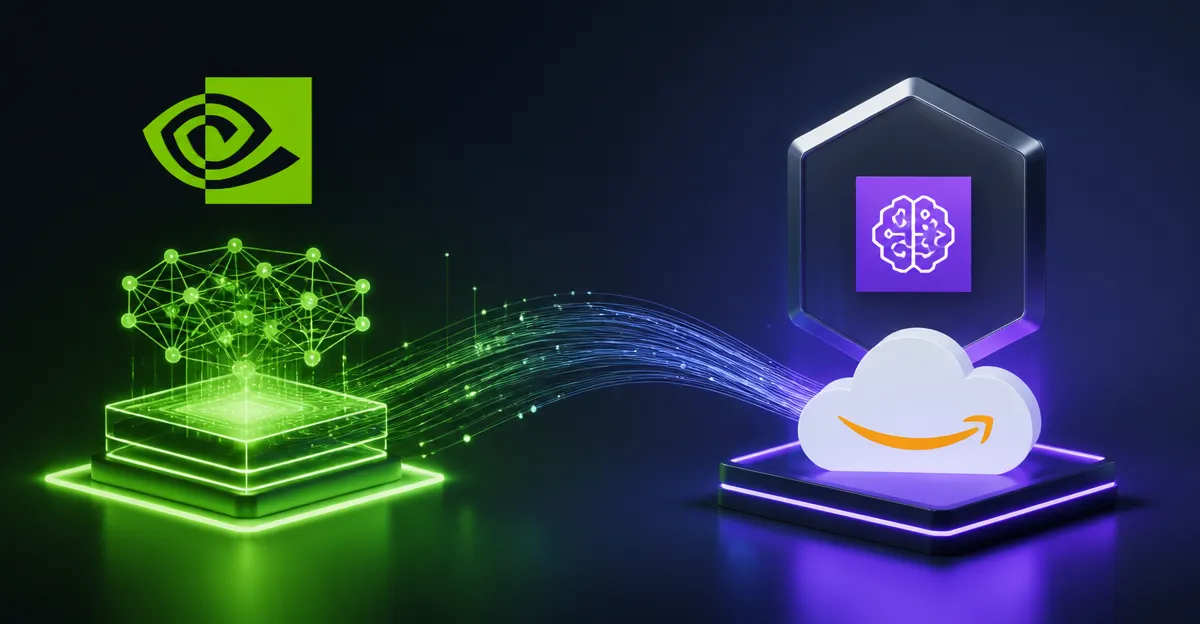
August 11, 2026, (Inside AI) — NVIDIA’s Nemotron 3.5 Lightning is now available on Amazon SageMaker JumpStart, granting AWS customers streamlined access to what the company calls the fastest open model in its class for persistent agent workloads.
The model targets high-throughput enterprise automation, including personal assistants, financial document processing, cybersecurity triage, and telecom operations. Its hybrid Mixture-of-Experts (MoE) architecture packs 30 billion total parameters but activates only 3 billion per forward pass, delivering up to 4x throughput at roughly 410 tokens per second and 30% faster task completion than comparable models.
This launch underscores a growing industry push to shrink agent latency without sacrificing capability. By integrating directly with popular agent harnesses and supporting up to 1 million tokens of context via DFlash speculative decoding, Nemotron 3.5 Lightning aims to close the gap between research benchmarks and real-world deployment speed.
Distilled from Nemotron 3 Ultra, the model is fully open-trained on open datasets. Enterprises can post-train it for proprietary tools, workflows, and policies, then deploy with complete ownership across edge, on-premises, or cloud infrastructure. That licensing flexibility contrasts with some competitors that impose usage restrictions even on open-weight releases.
Read: OpenAI GPT-5.4 and NVIDIA Nemotron 3 Super 120B Now in AWS GovCloud
MoE Efficiency Meets Persistent Agent Demands
Persistent agents, systems that maintain context and state over long-running tasks, require both low latency and high throughput. Nemotron 3.5 Lightning’s sparse activation pattern means only a fraction of parameters fire for any token, slashing compute costs while preserving quality on reasoning-heavy chains. Early adopters in cybersecurity triage, for example, can parse massive log streams and correlate threats without the lag that plagues dense models of similar scale.
Yet the MoE design introduces complexity. Routing decisions between experts must be finely tuned to avoid token-dropping or load imbalance, challenges that Google’s Switch Transformer and Mistral’s Mixtral have also grappled with. NVIDIA claims DFlash speculative decoding mitigates tail latency by predicting future tokens in parallel, but independent benchmarks on agentic tasks like SWE-bench or WebArena remain scarce at launch.
Deployment Simplicity vs. Vendor Lock-in Risks
SageMaker JumpStart allows customers to deploy Nemotron 3.5 Lightning in a few clicks via the SageMaker console or Python SDK. This one-click experience lowers the barrier for teams lacking deep MLOps expertise, but it also tethers the model to AWS’s ecosystem. While the open license permits migration, the operational convenience of JumpStart’s managed endpoints and monitoring could create soft lock-in, a pattern seen with Azure’s OpenAI Service and Google Cloud’s Vertex AI.
For enterprises already invested in AWS, the integration is seamless. For others, the model’s availability on NVIDIA NIM and direct downloadable weights provides an escape hatch. This dual distribution strategy mirrors Meta’s approach with Llama, which is simultaneously offered through cloud marketplaces and self-hosted options.
Customers can find the model in the SageMaker JumpStart model catalog. For deployment details, see the Amazon SageMaker JumpStart documentation.
Read: AWS Debuts Mistral’s Ministral-3-14B-Instruct for Multimodal Agentic AI in SageMaker
The move intensifies competition in the small-but-mighty model segment. Microsoft’s Phi-4, Anthropic’s Claude Haiku, and Google’s Gemma 3 all vie for enterprise agent workloads, each trading off parameter count, context window, and licensing. Nemotron 3.5 Lightning’s 1M-token context and 410 tokens-per-second throughput set a high bar, but real-world agent reliability will ultimately determine adoption.