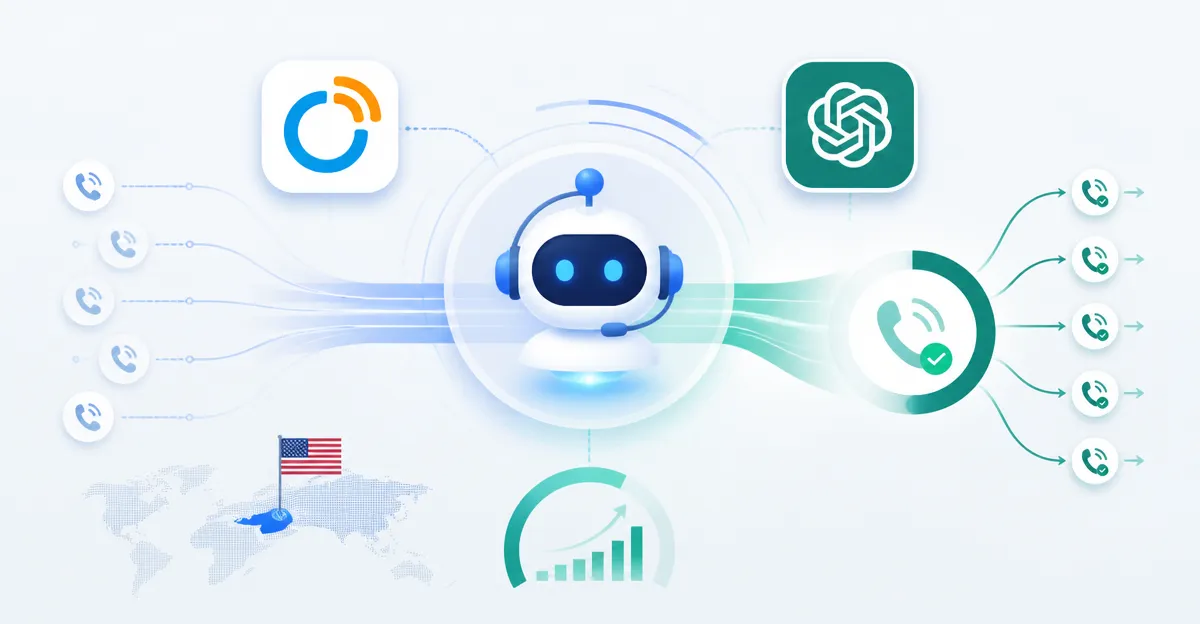
September 23, 2026, (Inside AI) — Ringg, a voice and chat agent platform, announced that its AI agents now resolve up to 65% of routine customer inquiries without human intervention. The company handles more than 7 million connected calls each month, with an average customer satisfaction score of 4.8. By migrating real-time workloads from GPT-4.1 to GPT-5.6 Luna, Ringg cut model costs by roughly 90%, according to an official spokesperson.
The development signals a shift in enterprise customer service, where AI agents are moving from simple chatbots to autonomous systems that complete complex tasks. Ringg's platform spans voice, chat, WhatsApp, and the web, integrating with CRMs, ticketing systems, payment gateways, and scheduling tools. This approach addresses a longstanding pain point: fragmented systems that force human agents to juggle multiple interfaces.
Ringg's orchestration layer executes actions across these systems, escalating to a human only when necessary. The platform uses a knowledge system that combines structured filtering with semantic retrieval across datasets, PDFs, CSVs, and business documents. For longer conversations, the system creates a structured summary at approximately 80,000 tokens, preserving key information without resending entire histories. This technical design allows agents to maintain context and complete multi-step workflows.
The company evaluated OpenAI models against alternatives like Gemini 2.5 Flash across conversational quality, latency, instruction following, tool calling, multilingual performance, reliability, and cost. Ringg found that OpenAI delivered the strongest overall balance for production workloads. In one test, GPT-5.6 Terra outperformed Gemini 2.5 Flash for post-call analysis, achieving up to 97% accuracy on common regional languages. Ringg subsequently moved summaries and sentiment classification to Terra.
"Migrating suitable real-time workloads from GPT-4.1 to GPT-5.6 reduced model costs by approximately 90% while delivering the required quality and latency," said a Ringg spokesperson. The company routes tasks to specific OpenAI models: GPT-4.1 handles most real-time voice and chat traffic, GPT-5.6 Luna is used when its performance or price-performance profile fits, GPT-5.6 Terra manages post-call analysis, and GPT-5.6 Sol supports evaluation and prompt improvement.
Ringg's evaluation platform tests models using historical conversations and simulated customer flows before deployment. Models that pass offline testing are introduced to a small share of production traffic before broader rollout. In production, Ringg's router monitors latency and endpoint health across regions, shifting traffic when an endpoint becomes unavailable or crosses a latency threshold. Specialized nodes, alerts, and versioned deployments help isolate problems.
Customer results highlight the impact. Policybazaar, one of India's largest online insurance platforms, uses Ringg to connect more than 57,000 customer requests, with 67% of calls handled without human intervention. Policybazaar's average response time fell from 8-12 minutes to under 60 seconds, an improvement of approximately 88%. At Practo, a global healthcare platform, Ringg's agents achieved an 85% first-call resolution rate and response times below three seconds. Operating costs declined by 70% compared with its previous human-led workflow, and Ringg now completes more than 1,000 appointment bookings each day. Groww, an online investment platform, resolves 72% of inbound queries related to IPOs, futures, and options through self-service, with an average handling time of two minutes.
Ringg is also developing browser agents using OpenAI's computer-use capabilities for platform onboarding, Know Your Customer (KYC) processes, IT troubleshooting, on-call incident support, and claims processing. A context layer is in development to preserve information across channels, allowing customers to start a request over voice, continue on WhatsApp, and finish in a browser without repeating details.
These advancements come amid growing competition in the AI agent space. Startups like Sierra and Decagon offer similar solutions, while established players like Salesforce and Microsoft integrate AI agents into their CRM platforms. Ringg's focus on high-volume, multilingual markets like India gives it a distinct edge. However, challenges remain: ensuring reliability across diverse networks, managing data privacy, and scaling human oversight for complex cases.
Read: Enterprise AI Agents Fail Without Employee Trust, Wharton Blueprint Finds
"For Ringg, the next generation of customer operations will be measured by completed business outcomes and automation depth, rather than call volume or headcount," the spokesperson added. As AI agents become more capable, the pressure on traditional customer service metrics will intensify, forcing companies to rethink how they measure success.