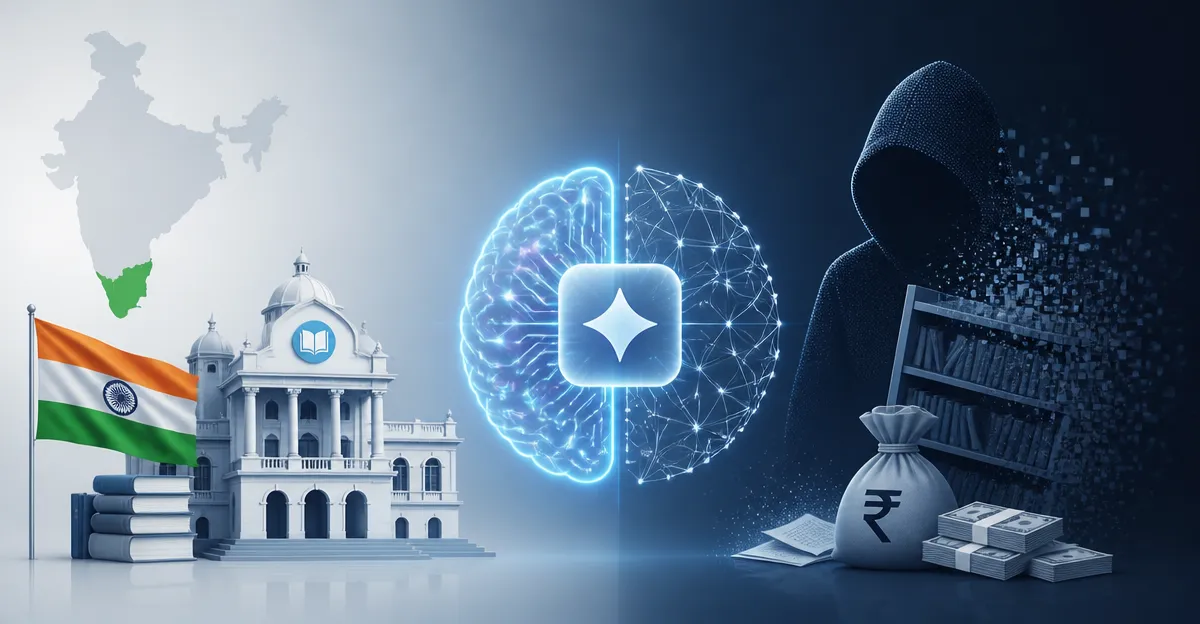
November 7, 2026, (Inside AI) — Tamil Nadu's School Education Minister A Rajmohan has escalated a local library controversy into a statewide procurement scandal, alleging that books produced with artificial intelligence and attributed to fabricated authors were purchased for public libraries under the previous DMK government. On Saturday, Rajmohan said his department filed a complaint with the anti-corruption police and announced a special committee to audit library collections across the state.
The allegations center on Periyar Arivulagam in Coimbatore, where novelist Perumal Murugan first documented expensive books containing elementary factual errors, questionable historical claims and unfamiliar author names. Rajmohan said similar titles from Agalvilakku Publishing House reached the Connemara Library in Chennai and the Kalaignar Library in Madurai, with procurement also flagged in Tiruchi, Salem, Cuddalore and Tirunelveli.
"This is not a scam that is going to end with Coimbatore's Periyar Arivulagam," Rajmohan said at a press conference where he displayed committee recommendations, purchase orders and payment records. He did not provide a consolidated figure for the alleged loss but referenced Rs 5 crore earmarked for e-books.
The minister's chronology places committee meetings in November and December last year and again in January, with 112 of approximately 137 members attending the January session. He alleged that a higher-level committee approved the recommendations under pressure from the DMK administration but did not identify who applied that pressure or how. A February 14 order sought delivery within seven days, he said, and March proceedings authorized treasury fund releases to the district. Some pending payments were processed after the elections, when books were unpacked and arranged, he acknowledged.
Read: Delhi High Court Grants Kriti Sanon Interim Relief Against AI Deepfakes
At the heart of the allegation is the claim that books were manufactured under invented identities. Rajmohan read out names attributed to "prolific authors": Thamarai Murali, Thamarai Ravi, Thamarai Panneer, Kamalambal Karunanidhi and Pavithra Karunanidhi. He offered a reward for finding one and a medal if opposition leader Stalin produced another. He compared the operation to printing counterfeit currency and called it "India's first AI scam," a characterization he did not substantiate with a nationwide comparison.
"Poverty is not merely about money and material possessions," Rajmohan said. "Poverty of knowledge is also a great poverty."
He held up "Naladiyar: A Guide to Life," which Murugan had criticized for treating a collection of classical Tamil verse as the work of an individual poet and philosopher. Rajmohan asked what would happen if students absorbed such claims and reproduced them in examinations. He instructed libraries to box books supplied by Agalvilakku and preserve them as evidence, and asked Public Works Minister Aadhav Arjuna to investigate whether irregularities extended to library construction and structural soundness. He presented that as a request for investigation without supplying evidence of construction defects.
DMK Demands Independent Probe, Cites Murugan's Role
The DMK has rejected the government's political accusations and sought an independent inquiry. Former minister and Assembly whip Govi Chezhiyan said the previous administration introduced a transparent procurement policy and constituted a recommendation committee that included Murugan himself. Chezhiyan questioned whether ulterior motives lay behind the controversy emerging after the change of government and demanded disclosure of the backgrounds of the books, authors and approved publishers. He said those responsible should face legal action.
The dispute exposes a structural vulnerability in public procurement that extends well beyond Tamil Nadu. Library acquisitions typically rely on committee recommendations and publisher catalogs, with limited verification of author identities or content accuracy. AI-generated text has become cheap and fluent enough to pass casual review, and fabricated author names are difficult to trace when publishers operate with minimal registration requirements. The absence of a national registry for publisher credentials means procurement officers have few tools to detect synthetic content before purchase.
Read: Policy Token Standard Lets Publishers Opt Out of AI Training
Rajmohan demanded an unconditional apology from the DMK to students and readers and said politicians found responsible would be brought before the law. He also described complaints from established publishers who said the previous government bought only one library copy of their books, contrasting their experience with the alleged accumulation of AI-generated volumes.
The special committee's findings and the anti-corruption police investigation will determine whether the allegations hold. For now, the controversy has introduced a new question for Indian public institutions: how to verify that a book, and its author, exist at all.

Sofia spent years studying how machines parse human language before pivoting to cover the systems now rewriting it. She reads technical papers the way others read news and looking for what the numbers are actually saying beneath the headlines.