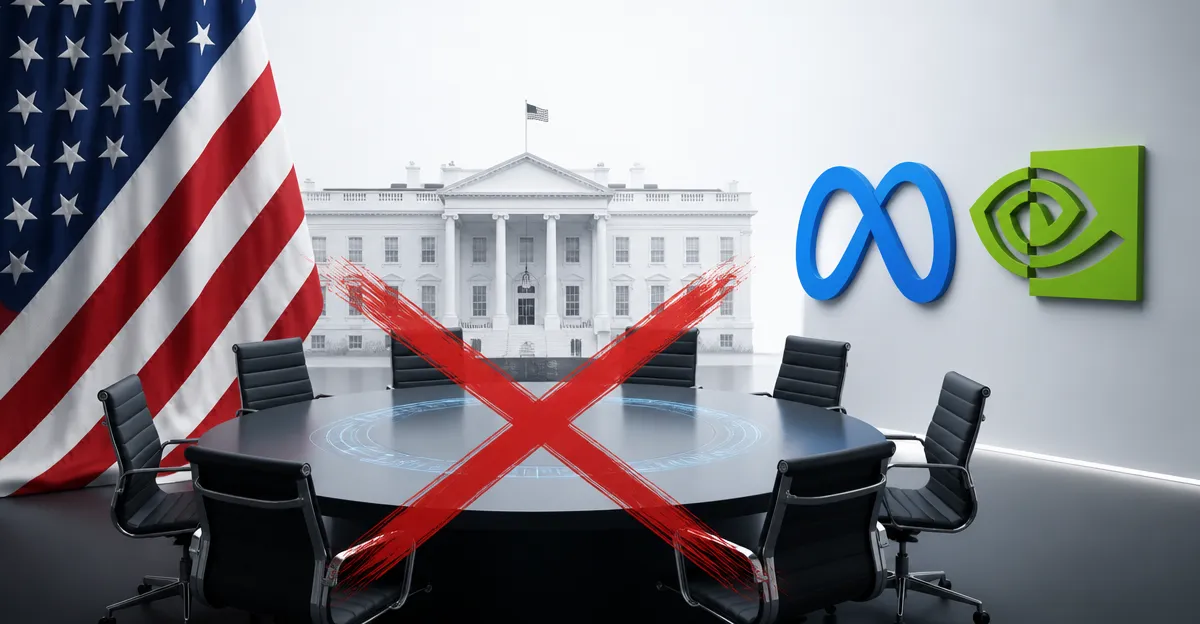
November 6, 2026, (Inside AI) — The White House postponed a Friday meeting of the President's Council of Advisers on Science and Technology, a panel that includes Nvidia CEO Jensen Huang, Meta CEO Mark Zuckerberg, AMD CEO Lisa Su, and Andreessen Horowitz co-founder Marc Andreessen. An Energy Department spokesperson confirmed the postponement. The White House did not respond to a request for comment on the reason.
The delay lands at a volatile moment for the technology sector. Technology shares sold off sharply on Thursday, driven by two overlapping fears: that a new Congress will slow AI development through legislation, and that the enormous capital spending on AI infrastructure will not produce adequate returns. The selloff has intensified scrutiny of the sector from both Silicon Valley executives and Washington policymakers.
The President's Council of Advisers on Science and Technology is an outside panel that advises the White House on science and technology policy. Its membership gives it unusual weight. Huang leads the dominant supplier of AI chips. Zuckerberg runs a company spending tens of billions on AI data centers. Su heads Nvidia's closest competitor in AI accelerators. Andreessen is one of the most influential venture investors in the sector.
That composition means the panel sits at the intersection of the two anxieties now driving markets. The same executives whose companies are under pressure to justify AI spending are also the people the White House consults on AI policy. A postponed meeting does not resolve that tension. It only delays the conversation.
Why the Delay Matters Beyond the Calendar
The postponement comes as investors question whether the AI buildout can generate returns fast enough to justify its cost. Data center spending by the largest technology companies has climbed into the hundreds of billions of dollars. Nvidia's market value has made it one of the most valuable companies in the world, and its chips are the foundation of most large-scale AI training. Any signal that Washington might slow the sector's expansion has immediate market consequences.
The political backdrop adds to the uncertainty. A new Congress has raised the prospect of legislation that could affect AI development, from export controls to safety rules. The panel's advice would normally help shape the administration's response. Postponing the meeting leaves that channel idle at a moment when the industry wants clarity.
Neither the White House nor the companies represented on the panel have publicly explained the delay. An Energy Department spokesperson confirmed the postponement but did not give a reason. Inside AI could not independently verify the cause.
The episode also highlights a structural feature of the current AI boom. The executives most exposed to market swings are also the ones advising the government on the rules that shape those swings. That overlap is not new in Washington, but the scale of AI capital spending makes it more consequential than in earlier technology cycles.
For now, the practical effect is limited. The panel is advisory, and its meetings do not produce binding policy. But the timing matters. A postponed meeting during a market selloff signals that the administration is not rushing to publicly align itself with the AI industry's priorities.
Investors will watch for a rescheduled date and for any statement from the White House. The companies on the panel have not commented publicly. The next few weeks will show whether the delay was procedural or a sign of a broader recalibration in how the administration handles AI policy.

Sofia spent years studying how machines parse human language before pivoting to cover the systems now rewriting it. She reads technical papers the way others read news and looking for what the numbers are actually saying beneath the headlines.