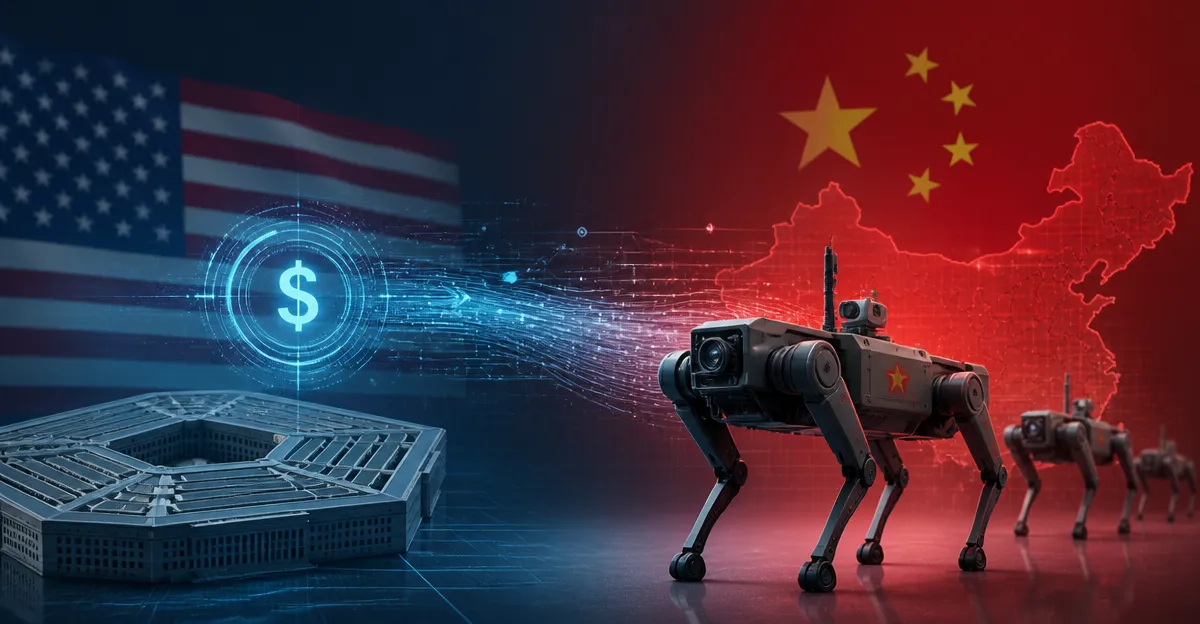
August 18, 2026, (Inside AI) — Unitree Robotics, the Chinese firm now valued near $9 billion, built its dominant Go2 robot dog on designs funded by the U.S. Army Research Laboratory. That is the central finding from a Reuters investigation citing a former defense official and three researchers who worked on the original project.
The $1,600 Go2, launched in 2023, helped Unitree sell over 18,000 quadrupeds last year. Another Unitree robot has appeared on Chinese state television, armed and moving with People’s Liberation Army troops.
The Army-funded program created what Gavin Kenneally, a former University of Pennsylvania researcher, called “basically, the first Unitree robot that had any kind of scale.”
“basically, the first Unitree robot that had any kind of scale,” Gavin Kenneally, founder, Ghost Robotics
Ben Katz, a former MIT Biomimetic Robotics Lab researcher, said Unitree’s Go series dimensions were “to the millimeter” almost identical to the Mini Cheetah robot he helped develop under military funding.
The technology transfer was legal. Research findings were published openly, a common practice to stimulate progress. But the episode exposes a structural gap: America funds breakthrough research, while China’s state-directed manufacturing turns it into cheap, mass-produced hardware.
How Pentagon Dollars Seeded a Chinese Market Leader
The Army funded the Robotics Collaborative Technology Alliance from 2010 to 2020. The consortium included UPenn, MIT, Boston Dynamics, NASA’s Jet Propulsion Laboratory, and General Dynamics Land Systems.
In 2016, UPenn researchers eliminated heavy central gearboxes and placed motors in robot legs. MIT’s lab built on that work, and in 2019 presented the Mini Cheetah, capable of backflips.
Months earlier, Katz published his MIT master’s thesis detailing Mini Cheetah’s actuators. Within six months, Chinese companies were selling actuator copies on AliExpress.
Unitree founder Wang Xingxing cited MIT’s Cheetah work in his 2016 Shanghai University master’s thesis. He acknowledged the lab’s “pioneering” contributions and referenced Kenneally’s Army-funded paper.
Joao Ramos, a former MIT lab researcher, said Unitree copied the Mini Cheetah’s shape, structure, and design. But he credited the company with doing “proper engineering” to perfect mass production.
“The actual practical implementation, bringing it to real life, that’s all on them,” Joao Ramos, former MIT researcher
Unitree says it “independently developed the motors, reducers, controllers, and even some sensors.” The company did not respond to Reuters requests for comment.
China’s Supply Chain Chokehold Leaves Few Escape Routes
Kenneally commercialized the U.S. breakthroughs through Ghost Robotics, which supplies special forces with ruggedized robots. But production is small and costly. Ghost has shipped about 1,000 Vision 60 robots, priced above $165,000 each.
Unitree’s B series sells for under $100,000 in the U.S. No American company has mass-produced comparable robots, including Tesla’s Optimus, which remains a prototype.
China’s dominance extends beyond assembly. The country refines critical minerals for magnets and hosts dense clusters of motor, gear, and actuator suppliers near Unitree’s Hangzhou base.
Ghost Robotics moved its motor supply from China to South Korea two years ago. But Kenneally said eliminating Chinese magnets and some metal components remains difficult.
“We need to work closely with our allies. There’s absolutely no path forward without them,” Gavin Kenneally, founder, Ghost Robotics
In 2024, South Korea’s LIG Defense & Aerospace acquired a 60% stake in Ghost Robotics for $240 million. The company is exploring production in Taiwan.
U.S. policy has leaned on trade restrictions. In July, the Federal Communications Commission banned imports of future foreign-made humanoid and quadruped robots, including Unitree’s. China threatened retaliation.
Reyk Knuhtsen, a robotics analyst at SemiAnalysis, called the failure to commercialize domestic research a “dropped ball,” citing venture capital’s preference for high-return software startups.
“This is a very big hill for the U.S. to climb,” Reyk Knuhtsen, robotics analyst, SemiAnalysis
Jaret Riddick, a former Army Research Laboratory director who oversaw the project, said it did kick-start the U.S. quadruped industry. But without support for large-scale production, Unitree “just kind of consumed that space.”
The Pentagon added Unitree to a list of Chinese military companies in June, limiting future U.S. military use. Unitree has said its robots are for civilian use and signed a 2022 pledge against weaponizing robots. Yet Chinese state television has shown a modified B1 series robot firing a mounted assault rifle.
In September 2023, the U.S. Army secured a federal waiver to purchase two Unitree Go2s, citing insufficient American alternatives. Reuters could not confirm whether the purchases went ahead.