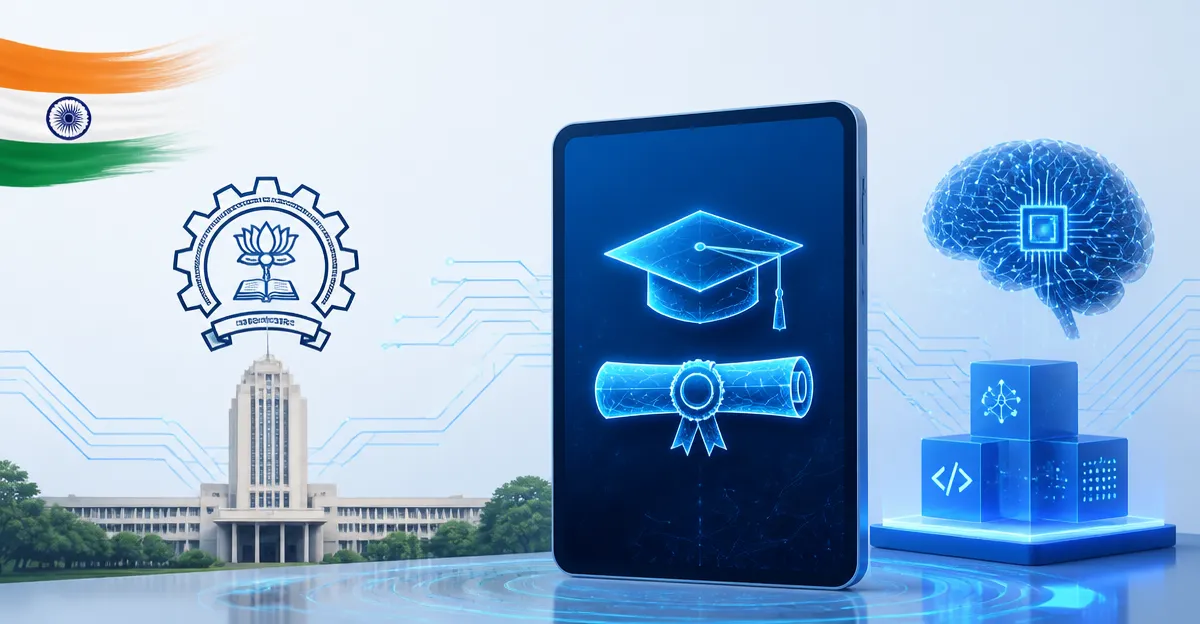
August 18, 2026, (Inside AI) — IIT Bombay has launched an e-Postgraduate Diploma in Computer Science and Artificial Intelligence, targeting working professionals who want deeper technical foundations rather than surface-level tool training.
The program runs through IIT Bombay’s Educational Outreach initiative with Great Learning as the EdTech delivery partner. It blends synchronous and asynchronous online sessions with an in-person campus immersion at the institute.
Eligibility extends beyond fresh graduates. Software developers, engineers, IT professionals, and data scientists with undergraduate CS backgrounds or equivalent work experience can apply.
The curriculum pairs core computer science concepts with current advances in AI and machine learning. IIT Bombay frames this as a deliberate contrast to short-term certificate courses that teach specific tools without underlying theory.
Read: IIT Roorkee Launches No-Code AI Business Applications Certificate Programme
“Understanding Computer Science and Artificial Intelligence at a foundational level will help learners adapt, compete and excel in the increasingly AI-centric world,” Prof Vinay J Ribeiro, faculty coordinator of the IIT Bombay e-PGD (CS & AI) programme and a professor in the Department of Computer Science and Engineering.
The launch lands at a moment when India’s premier engineering schools are aggressively expanding executive education, a market long dominated by the Indian Institutes of Management. Fee-based programs now offer IITs a more sustainable revenue stream than government-subsidized BTech degrees.
First-generation IITs have spent the past four to five years building online and hybrid master’s programs and postgraduate diplomas in emerging technology fields. Nearly all now offer credentials that let working professionals earn an IIT qualification without pausing their careers.
Why foundations matter more than tools
IIT Bombay’s positioning reflects a broader industry correction. As generative AI tools become easier to use, employers increasingly distinguish between practitioners who understand model behavior and those who only operate interfaces.
The program’s emphasis on computer science fundamentals signals that Indian institutions see durable demand for rigorous, theory-backed AI education. It also responds to criticism that many online AI courses overpromise job readiness while underdelivering on mathematical and algorithmic depth.
Great Learning’s involvement mirrors a pattern across Indian higher education. EdTech platforms bring enrollment infrastructure and corporate outreach, while faculty retain control over content and assessment. This division of labor has accelerated since the pandemic normalized online delivery.
The campus immersion component remains a differentiator. Hybrid models that include physical residencies often command higher completion rates and stronger alumni networks than fully remote alternatives.
Read: IIM Calcutta Plans AI-First Online MBA for Working Professionals
Executive education shifts toward engineering schools
The IITs’ move into executive education is not isolated. Demand for upskilling in AI, data science, and cybersecurity has pushed engineering institutes to compete directly with business schools for mid-career learners.
Industry partnerships play a central role. Companies seeking to reskill technical staff increasingly fund enrollment in IIT-branded programs, viewing them as credible alternatives to internal training or foreign university certificates.
Financial logic also drives the expansion. Unlike BTech programs constrained by fee caps and subsidies, executive diplomas operate on market pricing. This gives IITs flexibility to invest in specialized faculty, lab infrastructure, and learning technology.
The program’s long-term impact will depend on placement outcomes and alumni career trajectories. Early signals from similar IIT offerings suggest strong demand, but sustained quality will require continuous curriculum updates aligned with industry shifts.