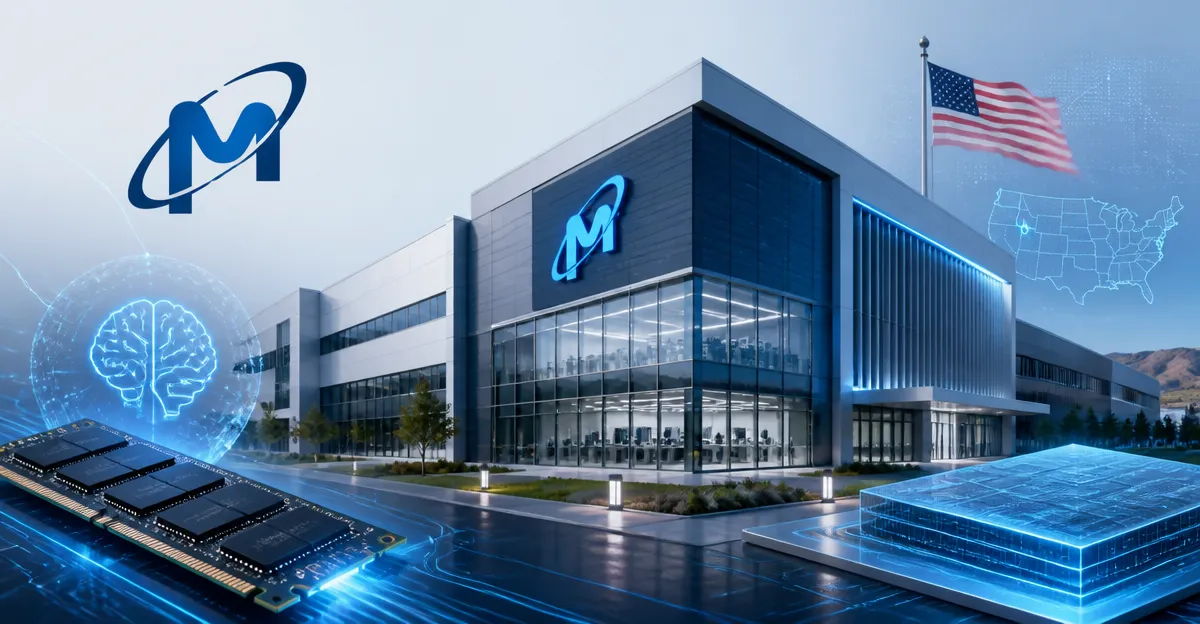
August 20, 2026, (Inside AI) — Micron Technology will invest $10 billion over the next decade in a new research lab in Boise, Idaho, the company said Thursday. The facility will focus on advancing memory technologies, developing compute systems, and supporting future chip manufacturing.
The announcement comes as memory chipmakers ride a wave of demand driven by rapid AI infrastructure expansion. Micron joins rivals Samsung Electronics and SK Hynix in scaling research and development to meet the needs of data-hungry AI models.
The Boise lab will sit at the center of Micron’s long-term strategy. The company has not disclosed specific timelines for hiring or construction milestones, but the decade-long commitment signals a sustained bet on memory innovation.
Micron’s investment lands at a critical moment for the semiconductor industry. AI training and inference workloads require high-bandwidth memory and advanced storage solutions. Memory has become a bottleneck in some AI systems, pushing chipmakers to accelerate development cycles.
The $10 billion figure is notable. It matches the scale of Micron’s previous commitments to U.S. manufacturing, including its New York megafab project announced in 2022. That facility is expected to cost up to $100 billion over 20 years.
Industry analysts see the Boise lab as a direct response to competitive pressure. Samsung and SK Hynix have both expanded their research footprints in the U.S. and South Korea. Micron’s move ensures it keeps pace in the race for next-generation memory.
Why Memory Chips Are Central to AI Growth
AI systems depend on fast access to massive datasets. High-bandwidth memory, or HBM, has become essential for GPUs and accelerators. Micron’s HBM3E products are already used in leading AI platforms.
The new lab will likely explore HBM4, next-generation DRAM, and novel compute-in-memory architectures. These technologies could reduce data movement bottlenecks and improve energy efficiency.
Micron’s research focus extends beyond memory. The company said the lab will also develop compute systems, suggesting a broader push into heterogeneous computing. This could include co-designing memory with processors for AI workloads.
The Boise location is strategic. Micron’s headquarters and existing R&D operations are already there. The new lab will consolidate research efforts and tap into local engineering talent.
Memory demand has surged as cloud providers build AI data centers. Micron reported record revenue in its most recent quarter, driven by data center sales. The company expects AI-related memory demand to grow faster than the overall market.
Competing for the Next Memory Breakthrough
Samsung and SK Hynix have announced their own multi-billion-dollar research initiatives. Samsung is investing in advanced packaging and HBM development. SK Hynix is expanding its Indiana packaging facility for AI memory.
Micron’s $10 billion lab adds another layer to this competition. The company aims to differentiate through U.S.-based innovation and closer collaboration with American AI firms.
The investment also aligns with U.S. government efforts to boost domestic semiconductor research. The CHIPS and Science Act has allocated billions for R&D, though Micron did not say if it would seek federal funding for the Boise lab.
Reporting by Jaspreet Singh in Bengaluru. Editing by Shilpi Majumdar.

If a research paper dropped this week, Mahesh has already read it. He covers AI tools and vibe coding for builders who need to know what is worth their time and what is not.