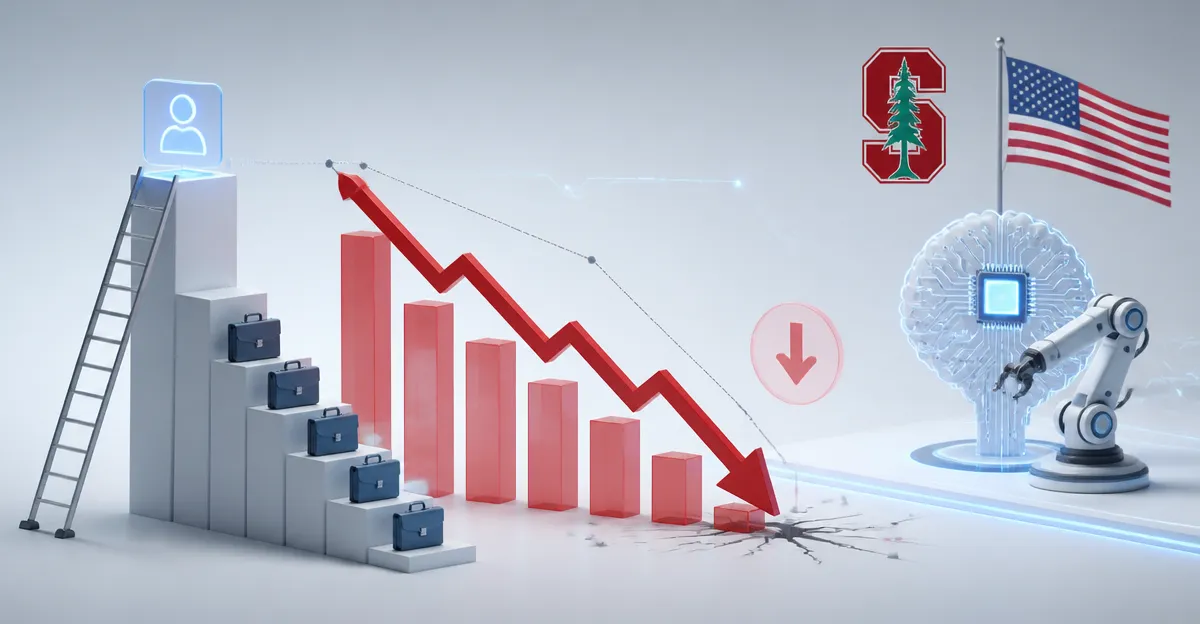
August 25, 2026, (Inside AI) — Entry-level jobs are vanishing fastest in the occupations most exposed to artificial intelligence, according to a new Stanford University study. Employment for workers aged 22 to 25 in the most AI-exposed roles now sits 19 percent below that of peers in less exposed fields. The same gap measured 13 percent last year.
The August 2026 paper, titled ‘Canaries in the Coal Mine? Six Facts about the Recent Employment Effects of Artificial Intelligence’, refines earlier findings with fresh payroll data. It shows the damage is concentrated in hiring, not wages. Young workers are simply not being brought in.
This is not a story about mass unemployment. Overall employment shows little difference between AI-exposed and non-exposed jobs. The disruption is quieter: a closing door for new graduates in specific fields.
Hiring Freeze Hits the Youngest Workers Hardest
The researchers analyzed anonymized, high-frequency payroll data from ADP. They rated each occupation’s AI exposure using labor market impact gauges from previous work, including the Anthropic Economic Index and a Google report on Gemini usage.
After isolating workers aged 22 to 25, the pattern sharpened. Employment in the top 40 percent of AI-impacted jobs fell by about 11 percent. In the 60 percent of jobs with the least AI impact, employment for the same age group grew by 10 percent.
Lead researcher Erik Brynjolfsson described the trend in stark terms.
“The entry-level effects we’re measuring are real, persistent and widening, and I’m more worried than I was about a labor market that keeps its overall employment level while quietly closing the on-ramp for people starting their careers,” Brynjolfsson was quoted as saying by Washington Post.
The study found the divide stems from lower hiring rates for entry-level workers in AI-impacted fields. Wages for those who do get hired remain largely unaffected.
Codified Knowledge Is the Dividing Line
The sectors seeing the sharpest declines share a common trait: heavily codified knowledge. These are jobs that can be taught through education, textbooks, or written procedures. AI systems excel at absorbing and replicating such knowledge.
Jobs involving practice, mentorship, and repeated exposure to real situations are emerging as safer ground. In these roles, AI tools complement the worker rather than replace them. This aligns with Anthropic’s latest Economic Index, which separates tasks into ‘automative’ and ‘augmentative’ categories.
Higher education may offer some protection. The study found that occupations with a higher share of college graduates showed more muted differences between more-exposed and less-exposed roles. In jobs with few college graduates, the least AI-exposed occupations saw growth while the most exposed declined.
The findings add to a growing body of evidence on AI’s uneven labor market impact. A separate report noted that 66 percent of AI workers in India expect layoffs. Meanwhile, a World Bank report suggested countries like India may not see many jobs disappear due to AI.
Brynjolfsson’s warning is specific: the labor market may keep its overall employment level while quietly closing the on-ramp for new workers. That scenario poses a different kind of policy challenge, one focused less on retraining mid-career workers and more on creating entry paths for the next generation.