August 25, 2026, (Inside AI) — OpenAI recently hosted about 40 top mathematicians at its offices to discuss the future of their profession. The meeting was off-the-record, but the mood, according to recent articles by mathematicians, was mostly glum. People fear for their jobs, their careers and the work they love.
Yet the contrary view is more likely, at least in the short term. AI models are nowhere near as capable as experienced academic mathematicians. That is the central argument advanced by security technologist Bruce Schneier and mathematician Kasra Rafi.
This is not to say that AIs are not producing stunning mathematical results at the level of PhD researchers. In mid-May, OpenAI announced that its frontier AI model disproved the unit distance conjecture, a famous 80-year-old problem in discrete geometry. In July, Anthropic published two AI-derived results in academic cryptanalysis. Earlier this month, OpenAI published 10 new mathematical results from its latest AI model. And Anthropic published Claude’s attempt to prove the century-and-a-half-old Riemann hypothesis.
These results are both a vivid demonstration of the amazing capabilities of frontier AI in 2026 and an illustration of their limitations. In general, these AI-powered advances in mathematics fall into one of two categories. Some are counterexamples to mathematical statements that people had been trying to prove. Others are novel applications of known techniques to existing problems that human experts either did not know or did not think of using.
Read: KPMG Retracts Agentic AI Study After GPTZero Finds Fake Citations and Hallucinations
The counterexample to the Jacobian conjecture is the most notable example of the first kind. Once it had been found, checking it was quick and straightforward. The difficult part was finding it among a large number of possibilities. The AI seems to have combined some sort of intuition acquired through machine learning with extensive computational search, in order to find the right example.
An example of the second kind is the unit-distance conjecture. It was motivated by an elegant construction, and most mathematicians expected it to be essentially optimal. So they generally tried to prove rather than disprove it. The counterexample brings in ideas from elsewhere in mathematics: algebraic number theory. If an expert with that background deliberately set out to find a counterexample, they would probably have succeeded. But there was no reason for someone with precisely that expertise to focus on this problem. Because of its scope, AIs do not have those same limitations.
AI’s Limits in Building New Theory
These results are relatively low-hanging fruit for AI. None of them required developing an extensive new theory. This does not make the discoveries trivial, or the AI’s achievements less impressive. Choosing the right direction, and recognizing an unexpected connection between subjects, are themselves forms of creativity. They are the same sorts of capabilities that led to AIs playing the game of Go at the grandmaster level, or doing Nobel-prize level chemistry in the area of protein folding.
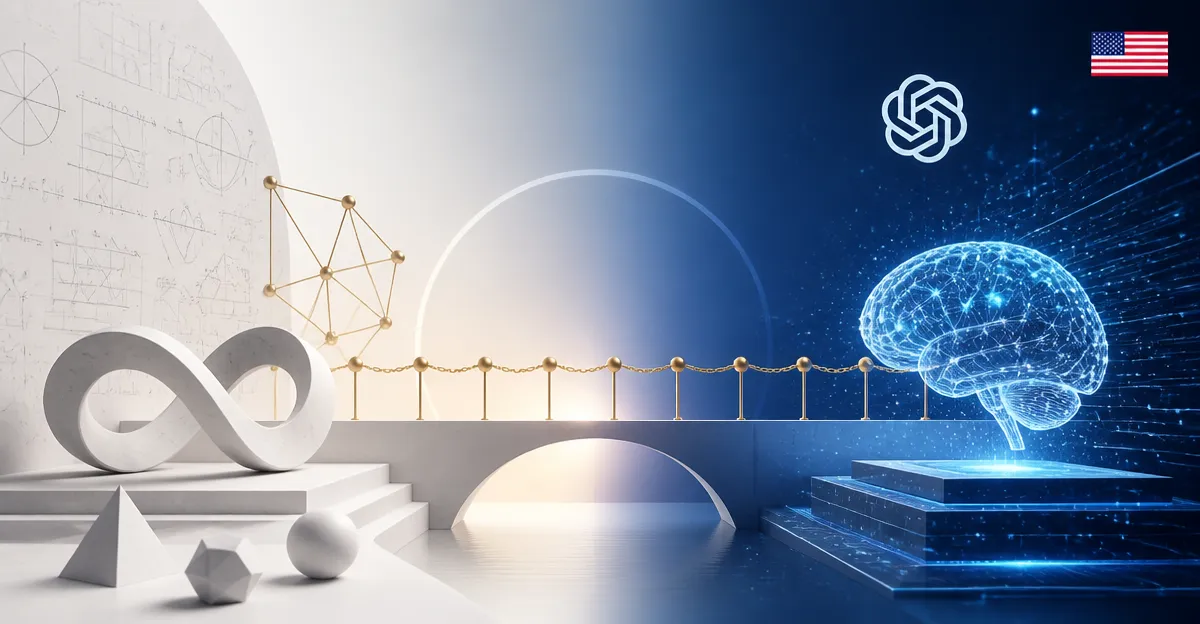
What we have not yet seen is an AI developing a substantial new conceptual framework in order to solve a mathematical problem. Much of mathematics proceeds by identifying the objects that are truly central to a question and then developing a theory that helps us understand them. Current AIs are very strong at searching and recombining existing ideas, but they are weak at building any deep and sustained new theory.
This speaks to a more general limitation of current AI systems. They are creative in the sense that they can recombine existing ideas in novel ways. But they are not creative in others: they have not yet developed conceptually new theories or structures. And while they have larger working memories than humans do, know more about more different things than any particular human does, and can process information faster than humans can, true novelty is still largely beyond their reach.
Read: AI Job Creation vs Destruction: Why 78 Million Net New Roles Mask a Looming Crisis
How Long Will That Last?
Of course, that distinction may not survive for very long. Predictions are notoriously hard, especially about the future of AI. None of these mathematical capabilities were explicitly designed for, or planned. They are all emergent properties of increasingly capable AI models. Schneier and Rafi are both confident that someday we will see AI models that are capable of the type of creativity required to do novel mathematics. Will that be in a few months, a few years or a few decades? They do not know, but their guess is sooner rather than later.
The debate echoes earlier anxieties about automation in chess and Go. When Deep Blue beat Garry Kasparov in 1997, many predicted the end of human chess. Instead, human play improved with AI assistance, and interest in the game grew. A similar pattern may unfold in mathematics. AI could become a powerful collaborator, handling exhaustive searches and suggesting unexpected connections, while humans focus on conceptual depth and novel theory building.
For now, the mathematical community faces a period of adjustment. Some researchers are already using AI tools to test conjectures and explore problem spaces. Others are rethinking what skills to teach the next generation. The real question is not whether AI will replace mathematicians, but how the profession will evolve when machines can do more of the routine creative work.