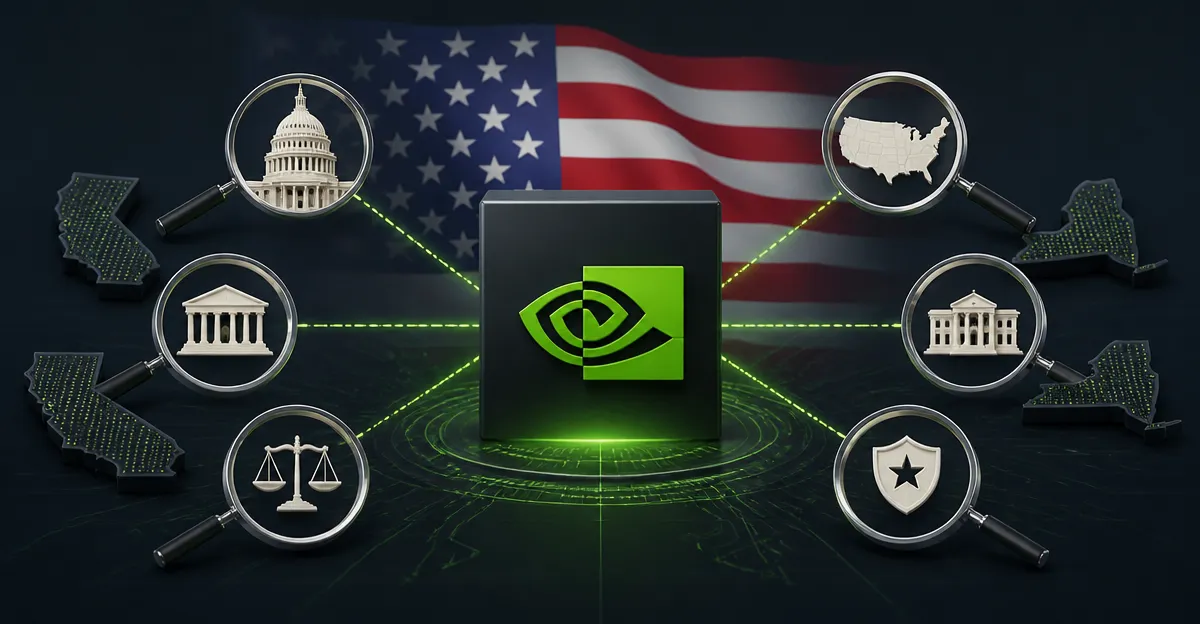
November 24, 2026, (Inside AI) — Nvidia and its reinstated chief executive Jensen Huang are now the subject of at least five separate government inquiries, spanning the FBI, the Justice Department, the Securities and Exchange Commission, California's attorney general, and multiple congressional committees. The scrutiny intensified after President Donald Trump backed Huang's return to the company's top job and publicly declared that the arrangement posed no national security risk.
The breadth of the probes is unusual for a single corporation. It reflects growing unease in Washington over Nvidia's central role in the artificial intelligence economy, its aggressive dealmaking, and the personal conduct of its most visible executive. The company has declined to comment on the investigations.
FBI and Intelligence Reviews
The FBI is examining Huang's extramarital relationship with Alice Huang, a Chinese businesswoman whom US intelligence agencies have investigated over possible ties to China's Ministry of State Security. Trump said on November 9 that the bureau was looking into the matter. Huang has acknowledged being unfaithful to his wife and apologized but has not publicly addressed the espionage allegations. China has denied the claims.
Trump told CNBC that Attorney General Todd Blanche confirmed the federal government has no evidence Huang engaged in unlawful conduct. "Let me just say, I have clearance. And if I didn't have clearance, I wouldn't have done the deal (with Nvidia's board for Jensen Huang's return)," Trump said.
Nvidia's board has formed a committee to investigate whether foreign intelligence efforts targeted Huang and is searching for a new chief compliance officer.
The intelligence dimension adds a layer of geopolitical risk that rarely attaches to corporate leadership disputes. If US agencies conclude that a foreign government attempted to exploit a CEO's personal relationships, the implications could extend beyond Nvidia to how American firms vet executive security. The board's decision to create a dedicated committee suggests it is treating the matter as a governance issue, not merely a personal one.
Antitrust and Accounting Inquiries
The Justice Department is reviewing Nvidia's $12.9 billion deal to acquire open-source platform Hugging Face as part of a broader antitrust investigation into the company's acquisitions and sales practices. Investigators have questioned whether Nvidia pressured customers by offering larger allocations of AI chips in exchange for purchasing its networking equipment and Groq processors. The department has also scrutinized Nvidia's 2025 deal to license technology from chip startup Groq and hire its engineers.
The SEC is probing Nvidia's accounting practices, according to two people briefed on the matter. Analysts have grown concerned about circular financing arrangements in which Nvidia backs AI companies and cloud providers, then provides guarantees for data-center projects that use its equipment. Critics say such deals can obscure the true quality of Nvidia's revenue.
On Nvidia's November 17 earnings call, then-interim CEO Colette Kress said the company was proud of its role in supporting the AI industry but would be far more selective about future financing deals.
California Attorney General Rob Bonta said on November 19 that his office had served Nvidia with an investigative subpoena related to the Huang affair. The probe will determine whether Nvidia's actions violated state law.
Congressional and Megaspeed Probes
Democrats, who will control both chambers of Congress starting in January, have signaled aggressive oversight. Senate Democratic leader Chuck Schumer said, "Democrats will wield their full power to investigate any wrongdoing by the Trump Administration, Jensen Huang, other Nvidia executives, and anyone selling out our national security for financial gain."
House Democratic leader Hakeem Jeffries said Congress will "not be deterred from conducting a swift, thorough and wide-ranging investigation into business malfeasance by Nvidia."
Huang has agreed to testify before the Senate Banking Committee on December 3. He and Nvidia General Counsel Tim Teter will also appear for transcribed interviews before House committees on December 1 and 2.
Separately, Democratic lawmakers have opened a probe into Nvidia's influence over a Commerce Department investigation of Megaspeed, a Singapore-based cloud provider and Nvidia partner. Alice Huang is a former Megaspeed executive. Washington added Megaspeed to its trade blacklist on November 23.
Nvidia said it consults with department officials to answer questions and request guidance, as any American company would.
The convergence of so many inquiries within a single month places Nvidia in a defensive posture just as it seeks to shape AI policy. The company's lobbying for looser chip export restrictions to China has made it a political target on both sides of the aisle. How Huang navigates the December hearings may determine whether the scrutiny remains a regulatory nuisance or escalates into a lasting constraint on Nvidia's expansion.

Sofia spent years studying how machines parse human language before pivoting to cover the systems now rewriting it. She reads technical papers the way others read news and looking for what the numbers are actually saying beneath the headlines.