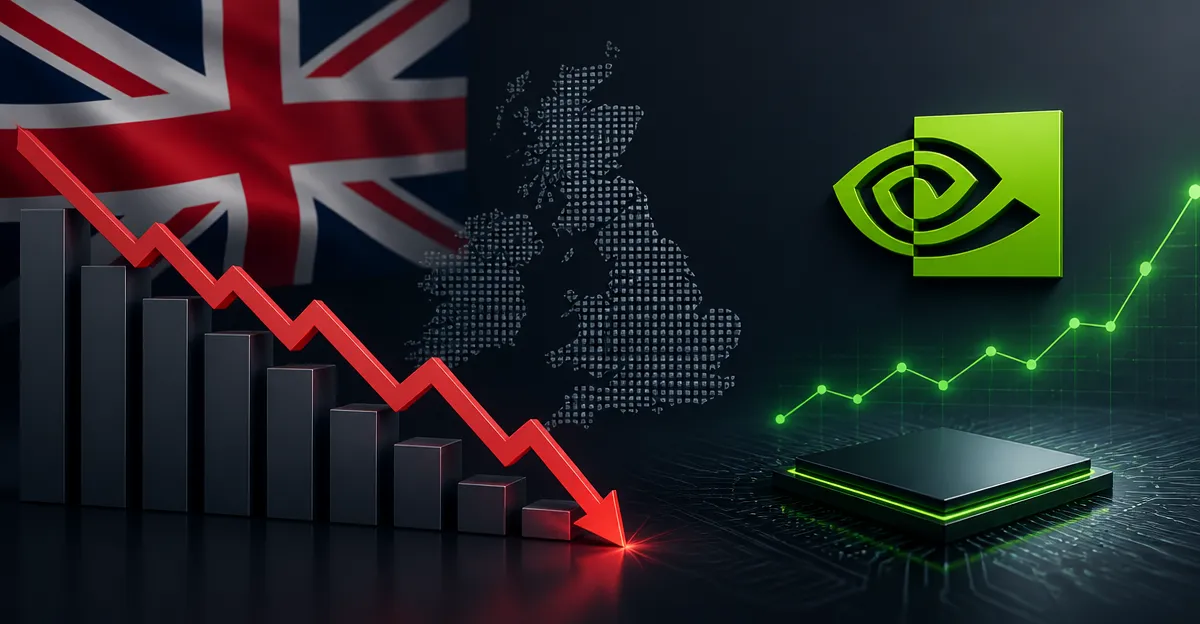
August 27, 2026, (Inside AI) — Britain’s benchmark FTSE 100 index fell 0.5% to 10,820.66 points by 10:00 a.m. GMT on Thursday, even as technology shares rallied on strong results from Nvidia, the world’s most valuable AI chipmaker. The midcap FTSE 250 slipped 0.04%, leaving investors to parse a market that shrugged off AI enthusiasm.
The decline exposed a fragile mood in London. Nvidia’s earnings, released after U.S. markets closed on Wednesday, beat analyst expectations and reinforced demand for AI infrastructure. Yet the FTSE 100’s tech gains were too narrow to lift a market weighed down by weakness in other sectors.
Nvidia reported record quarterly revenue driven by data center sales, a signal that AI investment remains robust. The company’s shares rose in after-hours trading. But in London, the reaction was muted. The FTSE 100 has a smaller technology weighting than U.S. indexes, so Nvidia’s success translates into limited index-level momentum.
The index has struggled to sustain gains this year. While U.S. markets have surged on AI optimism, the FTSE 100 has lagged, hampered by exposure to energy, mining, and financials. Those sectors face pressure from commodity price swings and global growth concerns. Thursday’s fall extends a pattern of underperformance that has frustrated investors seeking AI-linked upside.
Nvidia’s AI Boom Meets London’s Structural Limits
Nvidia’s latest results showed data center revenue up sharply year over year. The company’s chips power most large language model training runs, and demand has outstripped supply for several quarters. That has lifted Nvidia’s market value above $4 trillion, making it the most valuable company in the world at times.
But the FTSE 100 contains few direct AI hardware plays. Its largest tech constituents include Sage Group, Relx, and London Stock Exchange Group, none of which are pure AI chipmakers. The index’s tech sector rose modestly on Thursday, but the gains were offset by declines in consumer staples, utilities, and healthcare.
The FTSE 250, which tracks domestically focused midcap companies, barely moved. That suggests the Nvidia effect did not spread to the broader U.K. economy. Investors remain cautious about the pace of AI adoption in Europe, where regulation and energy costs create friction.
Nvidia’s results also raised questions about valuation. Some analysts warn that AI infrastructure spending may be peaking. If that happens, the ripple effects could hit even the modest tech gains seen in London. For now, the market is rewarding Nvidia but not extrapolating that optimism to other regions.
What the FTSE 100 Needs to Break Its Losing Streak
The FTSE 100 has underperformed the S&P 500 by a wide margin over the past two years. A stronger pound has also hurt exporters, making U.K. earnings less competitive when translated back into sterling. The Bank of England’s cautious rate path has kept borrowing costs elevated, pressuring consumer-facing stocks.
On Thursday, investors were also watching for signs of a U.S. interest rate cut. A cut could weaken the dollar and boost global equities, but the timing remains uncertain. The FTSE 100’s heavy weighting in dividend-paying defensive stocks means it often lags in risk-on rallies.
For U.K. investors, the Nvidia story is a reminder of what the London market lacks: a homegrown AI champion. Britain has produced promising AI startups, but many have listed in New York or been acquired by U.S. firms. That leaves the FTSE 100 dependent on global sentiment rather than domestic innovation.
Looking ahead, the index may find support if commodity prices stabilize and the Bank of England signals faster rate cuts. Until then, AI optimism from Silicon Valley will likely remain a sideshow for London traders.