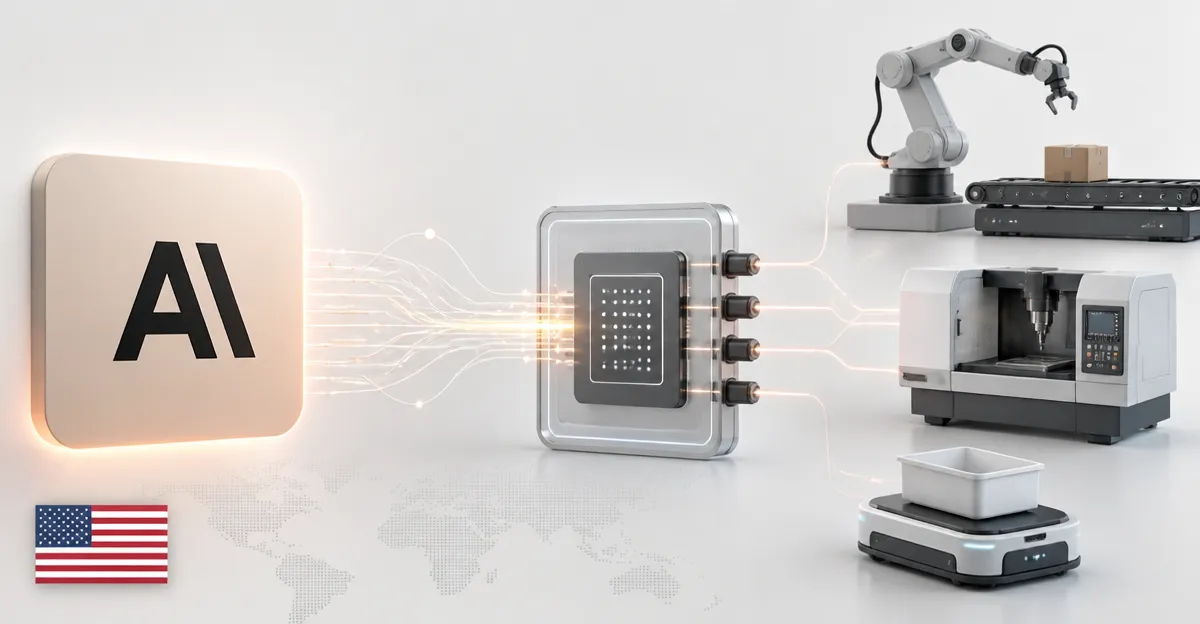
August 28, 2026, (Inside AI) — Anthropic has introduced a new standard that lets AI agents control physical machines directly. The company calls it the Model Hardware Standard (MHS), now in research preview.
The interface works with any device that has a programmable interface. That includes lab instruments, manufacturing equipment, and robotic arms. MHS creates a common language between AI agents and hardware.
Anthropic says MHS lets AI operate multiple instruments in parallel. Examples include microscopes, liquid handlers, and robotic arms. Tasks range from drug discovery experiments to laser calibration on quantum computers.
Today, labs often use equipment from different vendors. Each machine runs its own software. Making them work together can take weeks or months of custom integration.
MHS gives each device a standard software interface. A machine can tell the AI what it can do, what it can measure, and its safety limits. The AI can discover and operate the machine without engineers building a new integration from scratch.
The significance goes beyond single robot control. AI can potentially coordinate multiple machines at once. In a drug discovery experiment, an AI agent could work with a liquid handler, robotic arm, microscope, and data analysis tools. It could start an experiment, examine results, change parameters, and recover from some errors.
This shifts AI from suggesting actions to executing physical workflows. A scientist can describe a goal in natural language. The AI manages coordination, monitoring, and repetitive experimentation.
Early Deployments Reveal Speed Gains and Limits
Anthropic cited several early use cases. At Genentech, a US biotechnology company, Claude coordinated a liquid handler, robotic arm, and plate reader. It optimized how different liquids were handled.
At Carnegie Mellon, researchers used MHS to connect several pieces of lab equipment. An integration that usually took weeks took about eight hours. The eventual experiment ran roughly three times faster.
At HHMI Janelia, MHS connected a complex microscopy setup from multiple companies. A researcher said adding a new camera took minutes, not days of integration work.
But MHS is not a robot scientist that understands the physical world perfectly. Anthropic’s own experiments showed limitations. When bubbles appeared during liquid handling, Claude initially restarted the process. That made the problem worse.
A human had to explain the physical cause of the failure. The AI then incorporated that knowledge and handled similar situations better. The challenge is not just controlling machines. It is safely understanding what is happening in the physical world.
Anthropic plans to make the standard open source after the research preview phase. The system is designed to be model-agnostic, not limited to Claude.
MHS could make laboratories, factories, and other physical environments AI-native. It could change how humans interact with machines. Instead of operating software directly, humans may interact with AI agents that manage multiple machines.