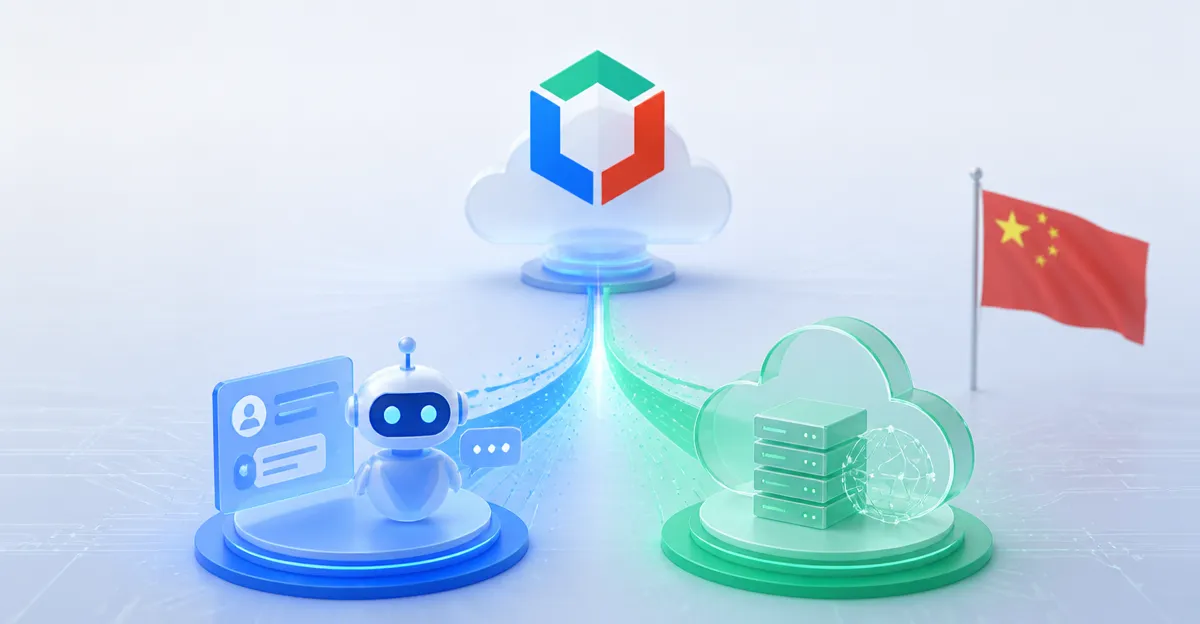
August 31, 2026, (Inside AI) — Baidu Cloud has split its AI agent and model-as-a-service businesses into separate operating units, according to sources familiar with the matter. The changes took effect in August.
The platform product division was renamed the intelligent-agent division. The model-as-a-service and Qianfan businesses moved to a new infrastructure division.
The data platform unit became the data-intelligence division and now sits under the intelligent-applications business. This separates model infrastructure, data services, and agent products into distinct units.
Baidu Cloud Recasts Enterprise AI Structure
Baidu Cloud is expanding its enterprise AI business. The reorganization aligns product ownership with distinct commercial motions: agent delivery versus platform consumption.
Read: Baidu Says Wenxin Will Return to AI’s Top Tier, Targets Hong Kong Listing by Year-End
Moving Qianfan and model-as-a-service into infrastructure signals that foundation model access is treated as a utility layer. Agent products sit closer to application teams, where integration and customization drive revenue.
Data services also gained a dedicated division under intelligent applications. This suggests Baidu Cloud sees data intelligence as a standalone offering rather than a backend function.
Industry analysts note that separating agent and model businesses mirrors moves by Alibaba Cloud and Tencent Cloud. Each is racing to capture enterprise AI budgets before infrastructure margins compress.
Baidu Cloud has not publicly commented on the internal changes. Sources requested anonymity because they were not authorized to discuss organizational matters.
The restructuring follows Baidu’s broader push into enterprise generative AI. Qianfan, its large model platform, has been positioned as a one-stop shop for model access, fine-tuning, and deployment.
By isolating Qianfan under infrastructure, Baidu Cloud may be preparing to compete more directly on price and scale. Agent products, meanwhile, require deeper customer engagement and vertical expertise.
Read: Zhipu AI First-Half Revenue Grows 400% to $141.96 Million
Agent Economics Shift Toward Applications
AI agents are moving from demos to production deployments. Enterprises want agents that connect to internal systems, execute workflows, and deliver measurable outcomes.
This requires a different operating model than selling raw model tokens. Baidu Cloud’s new intelligent-agent division can focus on solution engineering, partnerships, and industry templates.
The data-intelligence division under intelligent applications suggests a tighter loop between data preparation and agent performance. High-quality data remains the bottleneck for enterprise AI adoption.
Competitors are making similar bets. Microsoft integrated agents into Copilot Studio. Google Cloud pushed Vertex AI Agent Builder. Baidu Cloud’s move keeps it aligned with global trends.
The separation also creates clearer internal accountability. Infrastructure teams optimize for throughput and cost. Agent teams optimize for customer success and renewal rates.
Baidu Cloud’s enterprise revenue has grown steadily, though it remains smaller than Alibaba Cloud. The reorganization may help it move faster in a crowded market.
Looking ahead, the company is expected to announce new agent-focused products and industry solutions. How customers respond to the split structure will determine whether the bet pays off.








