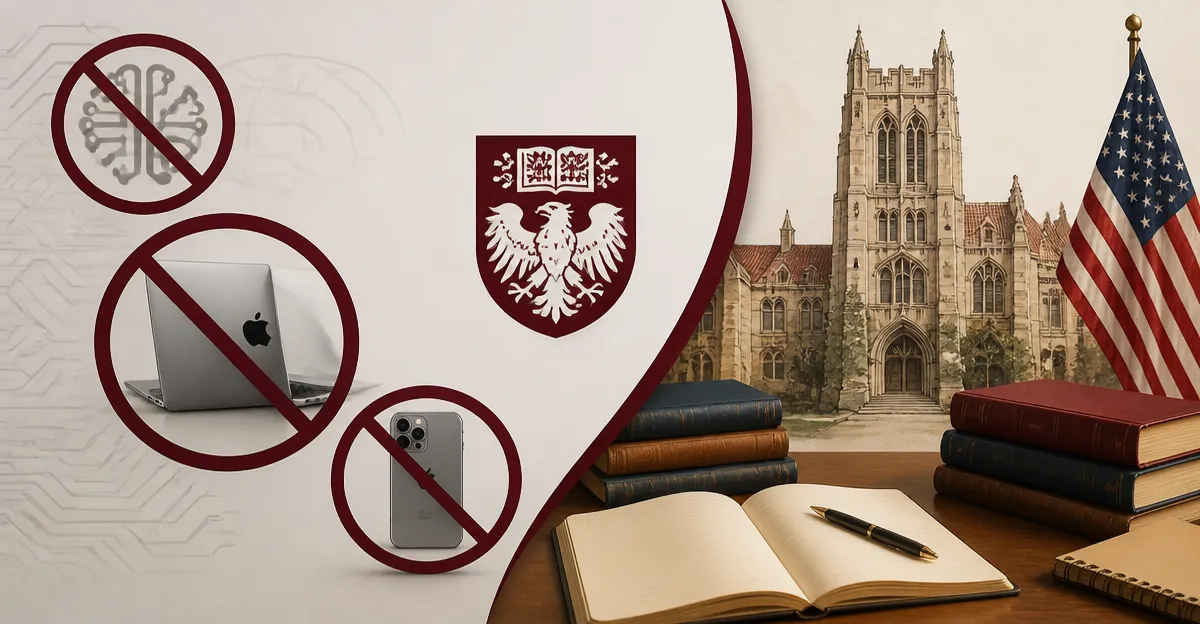
September 4, 2026, (Inside AI) — Starting in the 2026-27 academic year, the University of Chicago will ban AI tools and restrict personal technology in its Social Sciences Core courses. The shift to an “analog” model requires in-person attendance, paper texts, and discussion without laptops, phones, or wearable AI devices.
The policy, issued by the university’s Social Sciences Collegiate Division, applies to both students and instructors. Students must complete assignments without AI assistance. Instructors cannot use AI for grading. Course syllabi will be prepared by human scholars.
The decision reflects a “strong consensus” among faculty that the core is best taught without AI. A memo from the division states that although practices varied in recent years, the AY 2027 sequences are “collectively designed to be taught as ‘analog’ courses.”
The goal is to help students develop the ability to “read, write, and think” without becoming dependent on artificial intelligence. This marks a deliberate counterweight to the rapid integration of generative AI in higher education.
Why a Top University Is Going Analog
The University of Chicago has long championed rigorous, discussion-based learning. Its Social Sciences Core requires a three-course sequence focused on foundational texts and critical analysis. Faculty argue that screens and AI shortcuts undermine the slow, deep reading central to this tradition.
The policy does allow exceptions. Faculty may seek permission for specific academic uses of technology. Students with documented learning needs can receive reasonable accommodations. Professors may also experiment with AI where it serves a clear educational purpose.
Recording classroom discussions and lectures will be restricted. This protects the open exchange of ideas and reduces the risk of AI transcription or analysis of class dialogue.
The move follows a similar step at the university’s Law School, which recently prohibited electronic devices in most first-year core courses. That decision also included plans to teach students how AI can be used in legal practice, signaling a nuanced approach rather than outright rejection.
Campuses Split on AI Bans
Universities worldwide are divided on how to handle generative AI in teaching. Some institutions embrace AI as a writing and research aid. Others, like the University of Chicago, are drawing firm lines around foundational courses to protect independent skill development.
Critics of AI bans argue that students need guided practice with AI tools to prepare for a workforce where such skills are expected. Supporters counter that without analog guardrails, students may outsource thinking before learning to do it themselves.
The policy does not ban AI across the entire university. It applies specifically to the Social Sciences Core, leaving other departments free to integrate AI as they see fit. This targeted approach may become a model for institutions seeking balance.
The university has not released detailed enforcement guidelines. Faculty will likely rely on honor codes and in-class norms, similar to existing policies on plagiarism and academic integrity.
As the 2026-27 year approaches, attention will turn to how students and instructors adapt. The experiment will test whether removing screens and AI from core seminars can restore the focused, human-centered learning that the university values.