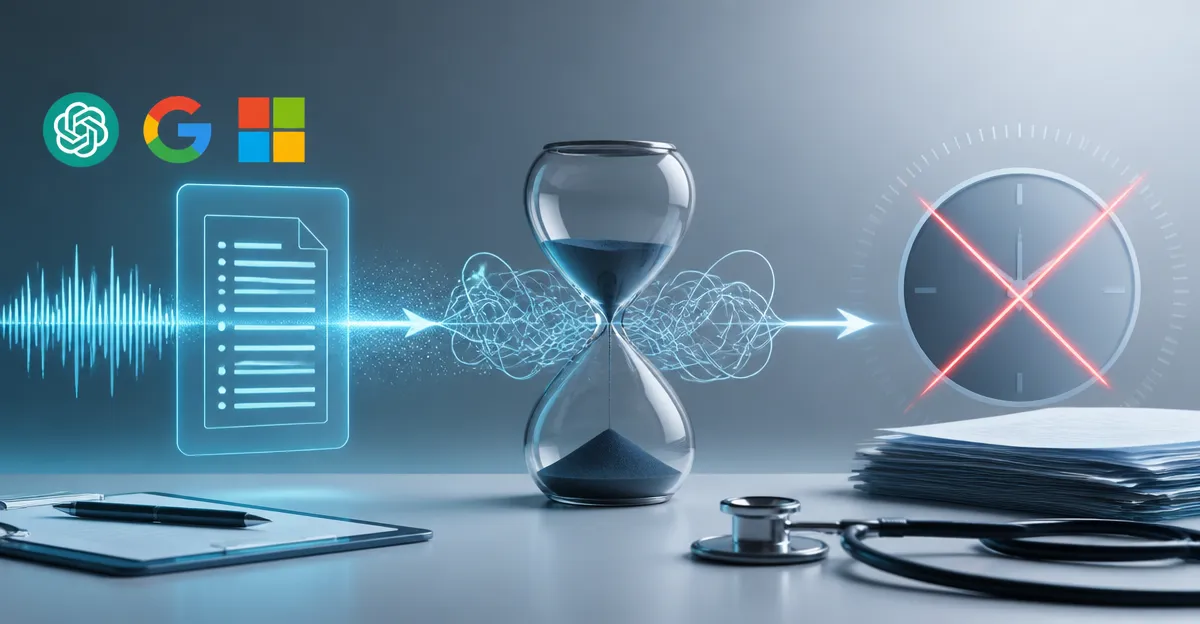
September 7, 2026, (Inside AI) — An out-of-hours general practitioner in Manchester has publicly challenged the claim that AI transcription tools save doctors time, warning that automated scribes frequently misunderstand patient histories and create dangerous duplication.
Dr Mary Gibbs, writing to a national newspaper, said her heart sinks when she sees that AI has been used to document a consultation. She described long, repetitive records with contradictions that force clinicians to recheck every detail.
The warning follows a news report that the NHS watchdog had found AI scribes getting drug names and diagnoses wrong. Gibbs said she finds meaningful errors far more often in AI consultations than in notes typed by human colleagues.
Gibbs explained that many patients she sees have already been assessed by phone. She must read a triage note before calling the patient in. When that note was generated by AI, she said the consultation is invariably long, with duplications and sometimes contradictions.
She added that any history she takes often turns out to be significantly different from what is listed in the AI note. This means she can never trust the automated record as correct.
Gibbs rejected the idea that the original clinician is solely to blame. She said anyone who has tried to proofread their own work under time pressure knows how difficult it is to spot errors. The result is that the first clinician must check a long, repetitive account, and the second clinician must check it again because the record cannot be trusted.
The core skill of turning a complex patient history into a clear account that a colleague can assimilate quickly is difficult to learn, Gibbs said. She warned that if doctors stop learning and maintaining this skill, both clinicians and patients will lose a lot.
Debbie Cameron, a former medical secretary from Formby, Merseyside, shared a firsthand example of transcription failure. She worked for a consultant who trialed voice recognition software for a week.
The consultant abandoned the tool after it transformed a drug recommendation into a travel suggestion. The phrase “I recommend two weeks on lansoprazole” became a suggestion for a two-week holiday on Lanzarote.
“A prescription I’m sure the patient would have been more than happy to try,” Cameron wrote.
The NHS has been exploring AI scribes to reduce administrative burden on doctors. But these accounts highlight a gap between promised efficiency and clinical reality. For Gibbs, the time-saving claim fails because verification doubles the workload.
Medical documentation requires precision. A mistranscribed drug name or dosage can lead to patient harm. The NHS watchdog warning cited by Gibbs aligns with broader concerns about AI reliability in high-stakes settings.
Gibbs’s critique goes beyond transcription errors. She argues that relying on AI erodes a core clinical skill: synthesizing a patient’s story into a concise, accurate narrative. If doctors outsource that task, they may lose the ability to do it well.
The debate reflects a wider tension in healthcare AI adoption. Tools that work in controlled pilots may fail in messy, real-world consultations. Accents, background noise, and medical jargon all challenge speech recognition systems.
Cameron’s Lanzarote example is humorous but revealing. It shows how a small acoustic mishearing can produce a completely wrong clinical instruction. In a prescription context, such an error could be catastrophic.
Gibbs did not call for a ban on AI scribes. But her message is clear: current tools are not ready to save time safely. Until accuracy improves, doctors will keep double-checking every automated note.