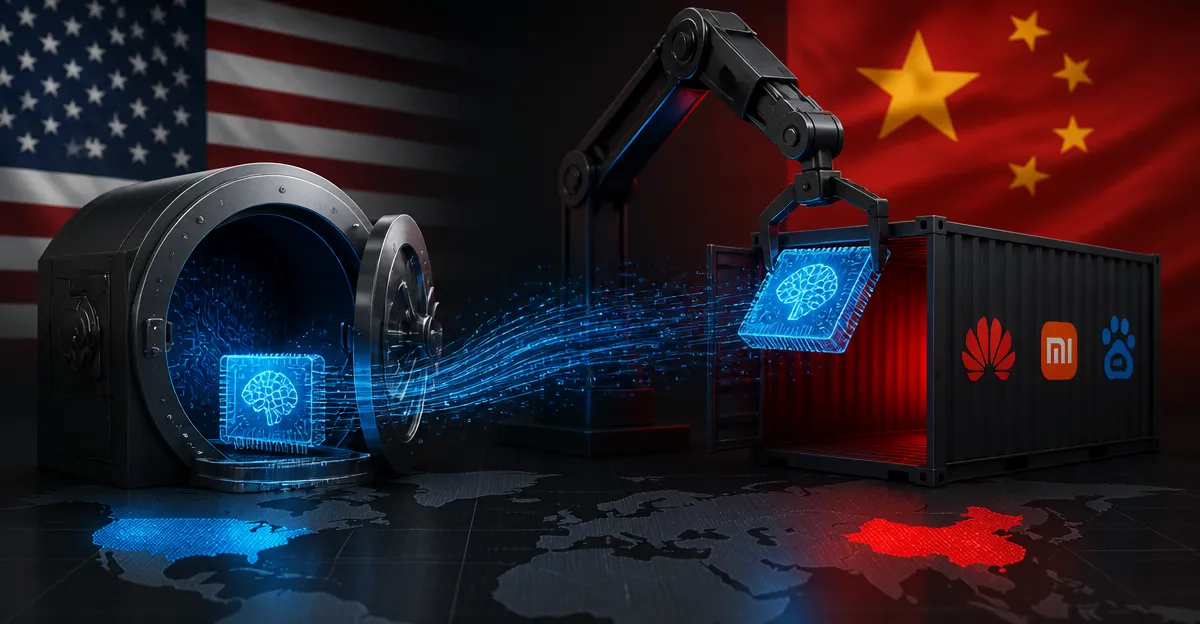
September 9, 2026, (Inside AI) — Three U.S. security agencies have accused Chinese AI companies of running industrial-scale distillation operations to steal American AI technology. The accusation came in a joint statement released Tuesday by cyber and law enforcement officials in Washington.
The agencies described the activity as aggressive and systematic, targeting the intellectual property embedded in large AI models. Distillation lets developers train smaller models using outputs from larger, costlier systems, slashing training costs and time.
Officials did not name specific companies or estimate the financial damage. But the language marked a sharp escalation in how the U.S. government frames Chinese AI competition. It moves from general warnings about intellectual property theft to a specific technical method.
The statement reflects growing concern that distillation can bypass export controls and licensing restrictions. A smaller model trained on a frontier system can inherit much of its capability without direct access to the original weights or infrastructure.
This technique is not inherently illegal. Many Western AI labs use distillation internally to compress models for mobile devices or enterprise deployment. The dispute centers on scale, intent, and whether the source models were accessed lawfully.
U.S. officials argue the activity is coordinated and state-aligned. They point to a pattern of API misuse, synthetic data harvesting, and systematic querying of public models. The goal, they claim, is to replicate frontier capabilities at a fraction of the cost.
Chinese AI companies have consistently denied stealing American technology. Industry groups in Beijing call the accusations politically motivated and say distillation is a standard machine learning practice used worldwide.
The timing is significant. Washington has spent two years tightening export controls on advanced chips and AI systems. This statement suggests regulators now see model outputs as a new front in the same technology war.
Security researchers have long warned that public AI endpoints can be mined. A determined actor can send millions of queries, collect responses, and use them to train a competing model. Detecting this abuse is difficult because legitimate users generate similar traffic.
Some U.S. AI providers have already added rate limits, watermarking, and behavioral analytics to flag suspicious query patterns. But the agencies' statement implies these defenses are insufficient against a well-resourced adversary.
The accusation also raises questions about the future of open-weight models. If distillation is framed as theft, companies may face pressure to restrict API access or require stricter licensing for commercial use.
Legal experts note that proving distillation in court is hard. Model outputs are not protected by traditional copyright in most jurisdictions. Trade secret claims require evidence of unauthorized access, not just similar performance.
The joint statement did not announce new sanctions or indictments. But it signals that U.S. prosecutors may be building cases around API abuse and unauthorized model access.
Industry analysts see the move as a warning shot. It tells Chinese firms that Washington is watching their training pipelines, not just their chip purchases. It also pressures U.S. cloud providers to tighten monitoring of foreign customers.
The broader context is a global race to reduce AI training costs. Distillation is one of several techniques, alongside quantization and pruning, that make large models cheaper to deploy. The U.S. accusation targets the most controversial use of that toolset.
For now, the statement leaves more questions than answers. Which companies are involved? What evidence exists? Will there be enforcement actions? The agencies offered no timeline for further disclosures.
The episode underscores how AI competition is shifting from hardware to data and model outputs. As frontier models become more capable, their outputs become valuable training data for competitors. That dynamic will likely define the next phase of U.S.-China AI tensions.