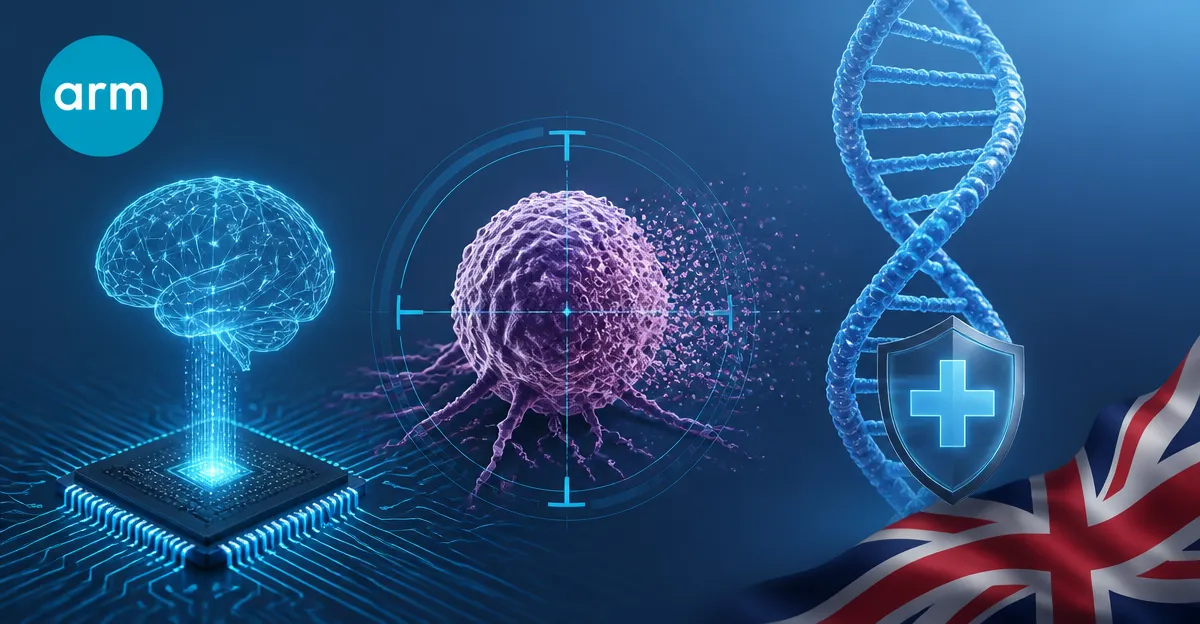
September 8, 2026, (Inside AI) — A top chip executive says artificial intelligence will crack cancer's genetic code within a human lifetime. Rene Haas, chief executive of Arm Holdings, made the prediction in a recent interview, framing the disease as a computational problem too vast for today's machines but solvable as models grow more sophisticated.
"AI is going to ... find a cure for cancer that today you and I, other humans [could] not in our lifetimes. I believe in our lifetime, AI will help cure cancer." Rene Haas, Chief Executive, Arm Holdings
Haas, who stepped down from the board of British pharmaceutical giant AstraZeneca in April, pointed to the complexity of modeling how DNA markers are affected by cancer. He said the task is currently beyond both human researchers and existing computing systems.
"Modelling how a DNA marker is impacted by cancer - it's too complex a problem, not only for humans today, but the computers that run AI. However, going forward, as we feed more and more of the models into these computers, and the computers get more sophisticated to run the models, they're going to solve it." Rene Haas, Chief Executive, Arm Holdings
The claim lands at a moment when AI is already moving into clinical settings. Earlier this year, the NHS said more than 4 million patients received faster lung diagnosis thanks to funding in AI-powered X-ray tools. Academic labs use machine learning to screen drug candidates and parse genomic data, though no AI-discovered cancer cure has reached market.
Robots in Five Years, Chips in Short Supply
Haas also predicted widespread humanoid robots within five years, but said chip shortages are stunting growth in that sector. He described a future where a service robot programmed to make a bed could learn to arrange towels or clean dustbins through AI-driven reprogramming.
"With artificial intelligence, these robots can see, learn, and essentially be reprogrammed for new tasks. So, in the service industry, the robot that was programmed to make a bed can also learn how to arrange the towels in a room, or clean the dustbins, or whatever you want to go off and do." Rene Haas, Chief Executive, Arm Holdings
Arm, listed in New York with global headquarters in Cambridge, licenses chip designs to about 500 companies worldwide, including Apple, Samsung, Qualcomm, and Nvidia. The company employs more than 7,000 staff, about 3,000 of them in the UK, and is valued at $269 billion.
SoftBank Ties and a Billion-Dollar Pay Scheme
Haas joined Arm in 2013 and became chief executive in 2022. He was recently named chief executive of SoftBank's international business. The Japanese investor holds a stake in ChatGPT maker OpenAI and remains one of the world's largest technology backers.
Earlier this year Arm proposed a pay scheme for Haas that could make him a billionaire if he hits targets to turn the chip designer into a trillion-dollar company. The incentive structure ties his personal fortune to Arm's market value, which currently sits far below that threshold.
Cancer researchers caution that biological complexity extends beyond raw computation. Drug development requires clinical trials, regulatory approval, and patient-specific variables that no model can yet capture. Still, Haas's timeline aligns with a broader industry bet that exponential gains in compute will eventually unlock biological mysteries.