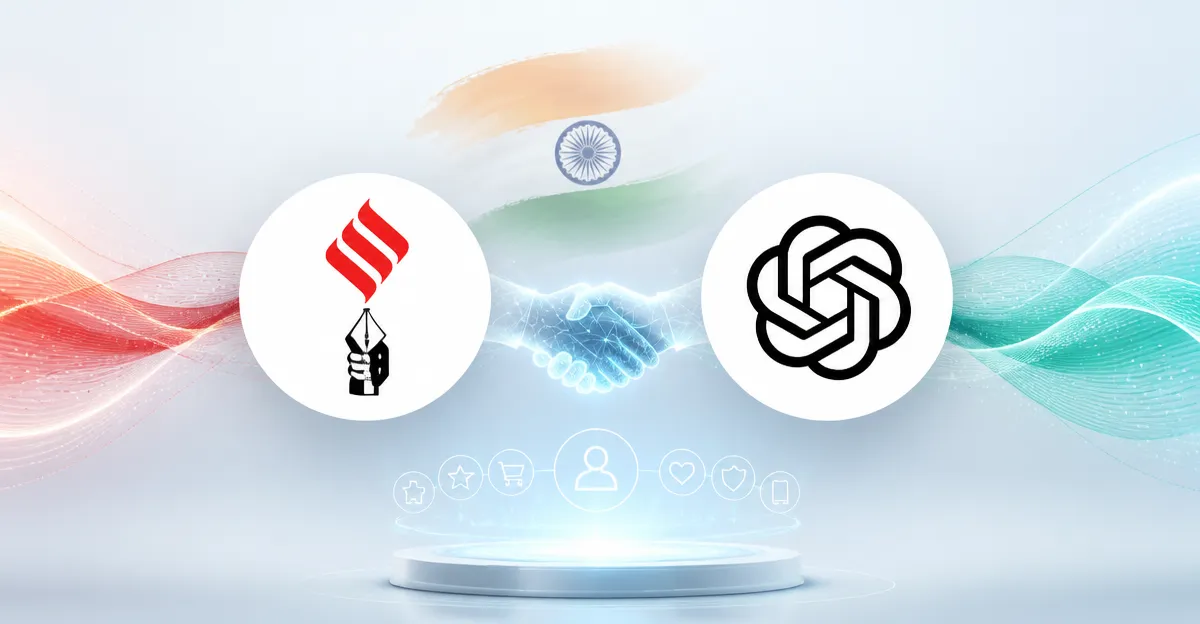
September 8, 2026, (Inside AI) — OpenAI has struck a content partnership with The Indian Express Group, one of India's largest news publishers, to surface its journalism inside ChatGPT with clear attribution and direct links back to original articles.
The deal covers live reporting and archived content from The Indian Express, The Financial Express, and the group's business properties across seven languages: English, Hindi, Marathi, Malayalam, Tamil, Bengali, and Gujarati.
When ChatGPT displays summaries or excerpts from these publications in response to user queries, results will identify the source and include a direct link to the full article on the publisher's platform.
Nandagopal Rajan, CEO of Indian Express Digital, framed the agreement as a discovery engine for the group's journalism. "Our legacy of agenda-setting investigations, news breaks and a breadth of voices that cut across the political spectrum makes the Express Group unique in Indian media. We have always been open to new technologies, and this partnership creates a new way for readers to discover the work of our large national network of journalists and their rigorous reporting with clear attribution and a direct path to the original source. As technology changes how people find and consume information, our priority remains credible journalism, with full editorial responsibility for everything we publish."
Varun Shetty, Vice President of Media Partnerships at OpenAI, said the collaboration reflects a broader push to work constructively with news organizations. "The Indian Express has an extraordinary tradition of in-depth investigations and unbiased reporting that helps people understand India in all its depth and complexity. We want AI to help more people discover that work, with clear attribution and direct links, reflecting our commitment to working constructively with publishers and developing technology that supports journalists, readers, and a strong news ecosystem."
The Indian Express Group retains complete editorial control. OpenAI will not influence which stories are reported, how they are produced, or what conclusions they reach.
Licensing Deals Reshape Publisher AI Economics
This agreement is not an isolated event. OpenAI has signed similar licensing deals with major publishers globally, including News Corp, Axel Springer, Financial Times, and Associated Press. These arrangements typically involve payment for content access and technical integration.
The Indian Express deal stands out for its multilingual scope. Seven languages cover a massive reader base across India, where regional language internet use is growing faster than English. This gives OpenAI a stronger foothold in non-English markets where training data and content partnerships remain thinner.
For publishers, the calculus is shifting. Early resistance to AI scraping has given way to pragmatic licensing. Many newsrooms now see AI platforms as distribution channels rather than pure threats. The direct links in ChatGPT responses could drive referral traffic, though whether users click through at meaningful rates remains an open question.
What The Deal Leaves Unanswered
Neither party disclosed financial terms. That opacity is common in publisher AI deals, but it makes independent assessment difficult. Without knowing payment structure or traffic guarantees, the value proposition for journalism remains unverified.
The partnership also includes exploring OpenAI technology for archive discovery, research, data analysis, translation, and business operations. Any editorial use will stay subject to the group's standards and human oversight. That caveat matters because AI-assisted newsroom workflows can introduce factual errors or bias if not carefully managed.
Competing viewpoints exist. Some media analysts argue these deals concentrate power in a few AI platforms, making publishers dependent on systems they do not control. Others see them as necessary revenue streams in a brutal advertising market. The Indian Express Group has chosen the latter path, betting that credible journalism can thrive inside AI interfaces.
The deal arrives as Indian regulators examine AI's impact on media. The Ministry of Electronics and Information Technology has signaled interest in content provenance and platform accountability. Publisher partnerships like this one could shape how those rules evolve.
For readers, the practical effect is simple: ChatGPT will now cite and link to Indian Express journalism more often. Whether that strengthens public access to reliable news or simply entrenches a new intermediary depends on execution, traffic data, and the durability of editorial independence.