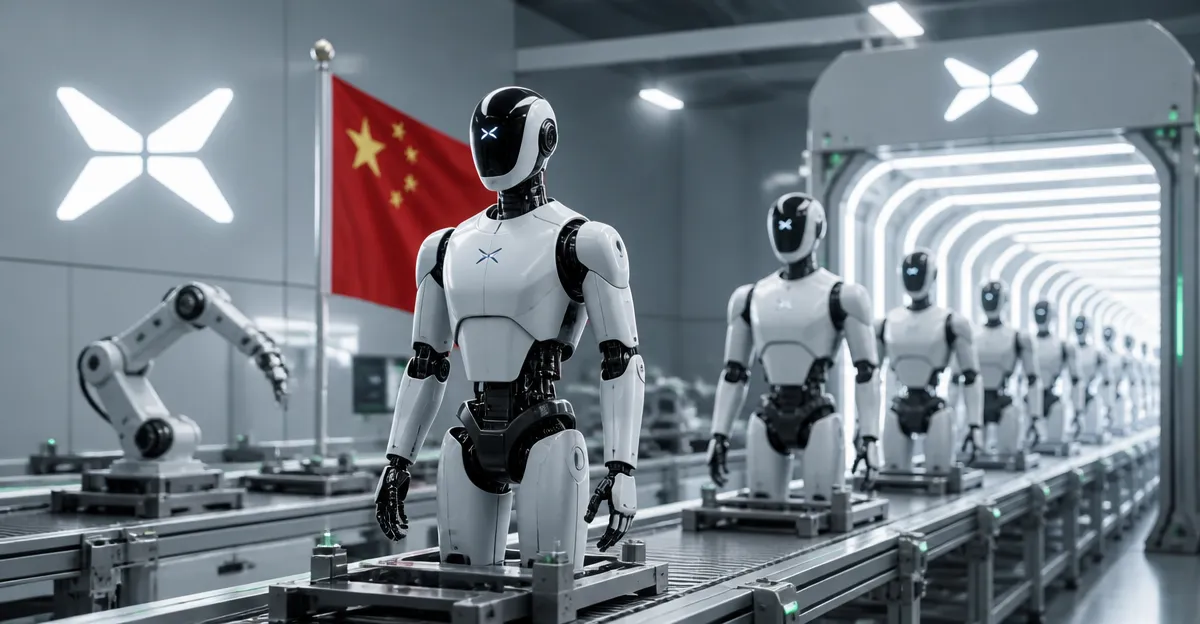
September 8, 2026, (Inside AI) — Xpeng has switched on an automated production line for its humanoid robot, marking a concrete step toward commercial deployment. The company said the first high-level general-purpose humanoid robot completed assembly and walked off the line autonomously.
The new line, designed for mass production, runs with an automation rate above 80% in core processes. Xpeng aims to begin volume production by the end of 2026 and start deliveries in China and overseas markets in 2027.
This move places Xpeng among a growing group of automakers betting that humanoid robots can leverage their manufacturing and supply chain expertise. The company has not disclosed pricing, target production volume, or specific use cases for the robot.
The activation signals a shift from prototype demonstrations to industrial readiness. Xpeng’s robot is described as a general-purpose platform, suggesting ambitions beyond narrow factory tasks. But the company has not released technical specifications, battery life, or software capabilities.
Automotive manufacturers have increasingly entered humanoid robotics. Tesla has showcased its Optimus robot in factory settings, while BYD and Nio have invested in robotics startups. Xpeng’s own effort, internally developed, now moves toward production at a time when the global humanoid robot market is projected to grow rapidly.
Industry analysts note that achieving reliable general-purpose autonomy remains difficult. Most humanoid robots today perform limited, scripted tasks. Xpeng’s claim of autonomous walking off the line is a notable milestone, but real-world performance in unstructured environments remains unproven.
China has prioritized robotics in its national technology strategy. Government policies encourage domestic production of humanoid robots, aiming for mass production by 2025 and world leadership by 2027. Xpeng’s timeline aligns with these goals, potentially benefiting from subsidies and industrial support.
The company has not named overseas markets for the 2027 deliveries. Regulatory approvals for humanoid robots in public or workplace settings vary by country. Safety standards, liability frameworks, and labor displacement concerns could shape adoption speed.
Xpeng’s production line automation rate of over 80% suggests a hybrid approach, with some manual assembly still required. Full automation for complex humanoid robots remains rare. The company may refine processes as it scales toward volume production.
Humanoid robots are expected to serve in logistics, elder care, and manufacturing. Xpeng has not confirmed initial target industries. Its automotive background could favor warehouse and factory deployments first, where controlled environments reduce technical risk.
The company’s move also intensifies competition with dedicated robotics firms like Unitree and Agibot, which have already begun selling humanoid robots in China. Xpeng enters a market where early movers hold distribution and integration advantages.
Whether Xpeng can deliver a truly general-purpose robot at scale remains an open question. The production line activation is a tangible signal, but the gap between walking off a line and performing useful work is wide. The coming months will reveal more about the robot’s capabilities and commercial strategy.