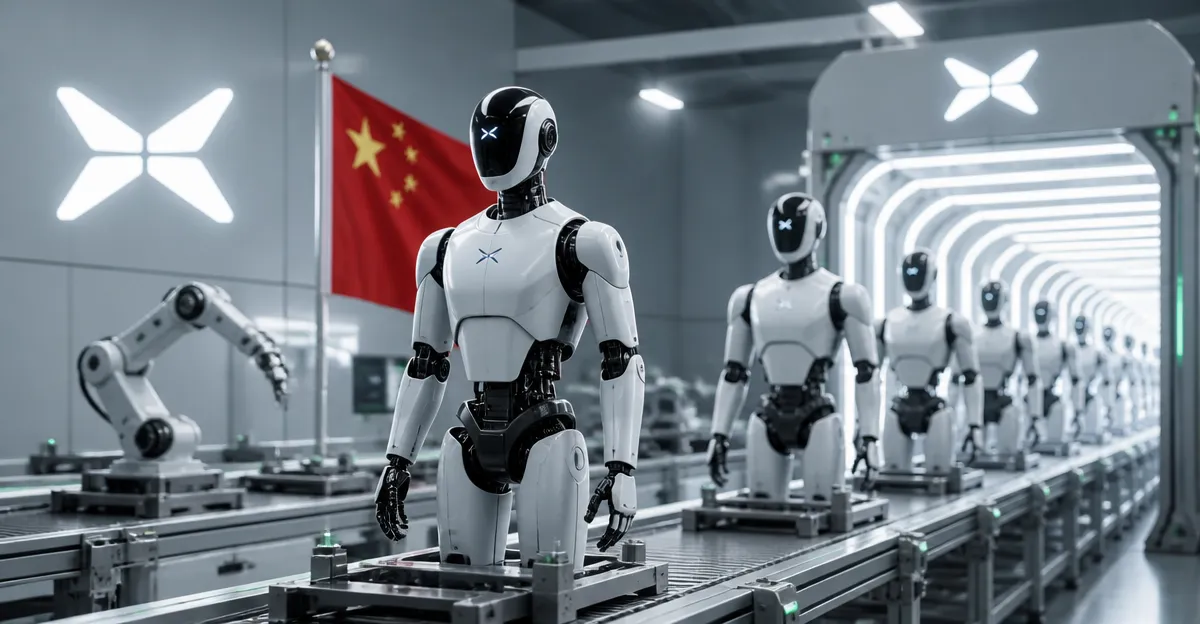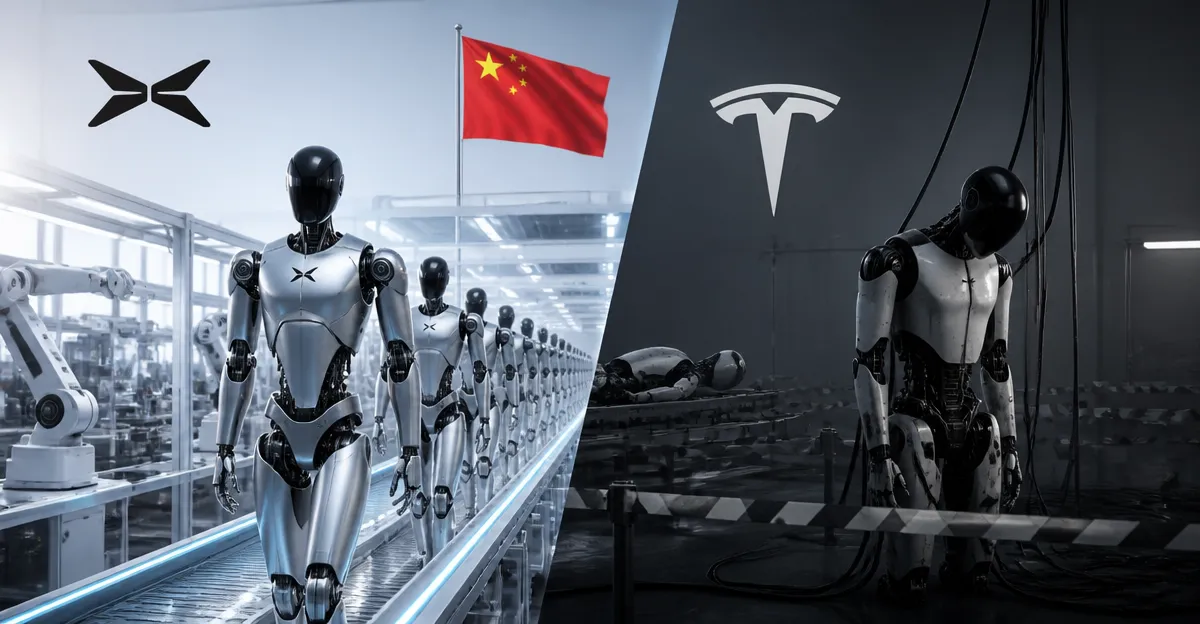
September 8, 2026, (Inside AI) — XPeng has activated what it calls the world's first automated production line for advanced humanoid robots. Its IRON robot then walked off that line under its own power in Guangzhou. The line runs with more than 80% of core processes automated.
The move signals a shift from viral prototype to real manufacturing. IRON first went viral in November 2025 when its smooth walk sparked accusations of a person in a costume. Engineers cut open its leg on stage to prove otherwise. Now the robot is being built on an automotive-grade line.
XPeng borrowed quality systems from electric car production. The facility spans roughly 110,000 square meters in Tianhe District's Guangtang Sci-Tech Innovation City. XPeng has developed robotics for seven years, starting with quadruped machines.
He Xiaopeng, XPeng's chairman and CEO, addressed the milestone.
"The robot production lines were created from scratch with no precedent to follow," He Xiaopeng, XPeng's chairman and CEO, said. "Today's step is small, but XPENG is building the production lines for an entirely new product category."
He clipped a staff badge onto IRON, signaling the robot now sits on the payroll. The company says the setup ensures consistent critical-process quality and supports rapid capacity expansion.
IRON's Specs Outpace Tesla's Stalled Optimus Timeline
IRON stands 178 centimeters tall and weighs 70 kilograms. It has 76 degrees of freedom across its body, plus 21 in each hand. Three in-house Turing AI chips deliver 2,250 TOPS. All-solid-state batteries keep construction lightweight. It runs XPeng's second-generation Vision-Language-Action model onboard.
The robotics unit raised over $900 million on August 24 at a $6.3 billion valuation. IDG Capital led the round, with Tencent and Alibaba participating. XPeng called it China's largest single embodied AI private raise yet.
The Tesla comparison is unflattering for Elon Musk. He predicted Tesla would build 10,000 Optimus robots in 2026. Tesla is still converting a car line. XPeng just turned one on entirely. Initial IRON deployments stay limited to XPeng's own stores before a 2027 commercial launch.
Guangzhou Base Marks a New Phase for Embodied AI
XPeng's full-chain manufacturing base was announced in February. It consolidates R&D, production, and testing under one roof. The company's seven-year robotics history gives it unusual depth for an automaker. Early quadruped machines evolved into today's bipedal IRON.
Industry analysts note that XPeng's automotive supply chain gives it an edge in scaling humanoids. Quality control systems from EV production transfer directly to robot assembly. The 80% automation rate reduces labor costs and improves consistency. This matters because humanoid robots require precise joint alignment and sensor calibration.
XPeng has not disclosed production volume targets. The company plans to use IRON in its own retail stores first. Commercial sales to outside customers are expected in 2027. The robot will likely handle customer service and product demonstration tasks initially.
Competitors are watching closely. Unitree and Figure AI are also racing to scale humanoid production. XPeng's automotive-grade line could set a new benchmark. The $900 million raise gives it capital to expand capacity quickly.
XPeng's approach contrasts with Tesla's iterative strategy. Tesla has focused on refining Optimus in lab settings. XPeng is pushing directly into volume manufacturing. The coming year will reveal which approach wins.